







Question: management 44. What are the two major environments that affect an organization? a. Specific and External environment b. Work and Sales c. General and Task
management
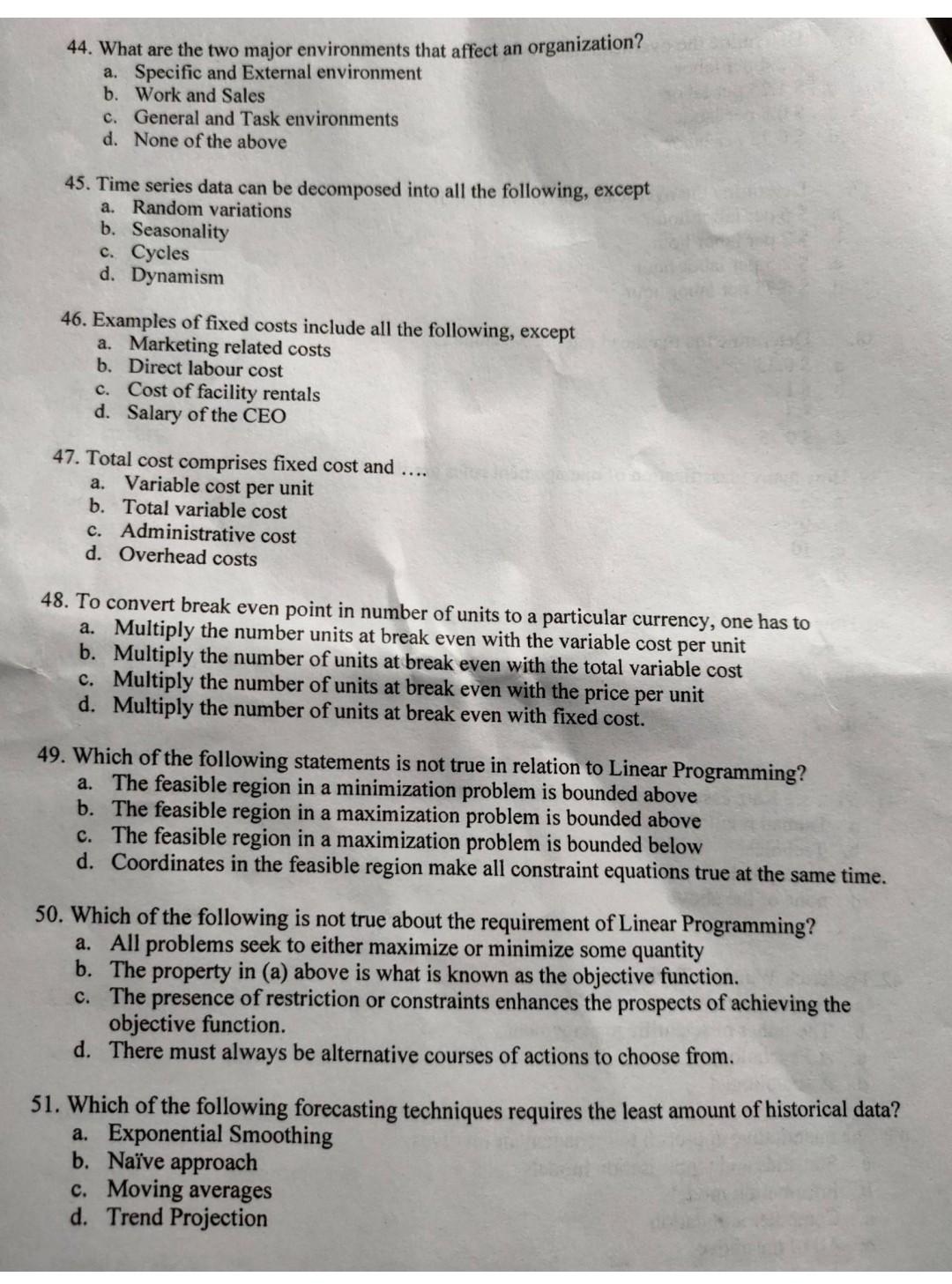
44. What are the two major environments that affect an organization? a. Specific and External environment b. Work and Sales c. General and Task environments d. None of the above 45. Time series data can be decomposed into all the following, except a. Random variations b. Seasonality c. Cycles d. Dynamism 46. Examples of fixed costs include all the following, except a. Marketing related costs b. Direct labour cost c. Cost of facility rentals d. Salary of the CEO 47. Total cost comprises fixed cost and .... a. Variable cost per unit b. Total variable cost c. Administrative cost d. Overhead costs 48. To convert break even point in number of units to a particular currency, one has to a. Multiply the number units at break even with the variable cost per unit b. Multiply the number of units at break even with the total variable cost c. Multiply the number of units at break even with the price per unit d. Multiply the number of units at break even with fixed cost. 49. Which of the following statements is not true in relation to Linear Programming? a. The feasible region in a minimization problem is bounded above b. The feasible region in a maximization problem is bounded above c. The feasible region in a maximization problem is bounded below d. Coordinates in the feasible region make all constraint equations true at the same time. 50. Which of the following is not true about the requirement of Linear Programming? a. All problems seek to either maximize or minimize some quantity b. The property in (a) above is what is known as the objective function. c. The presence of restriction or constraints enhances the prospects of achieving the objective function. d. There must always be alternative courses of actions to choose from. 51. Which of the following forecasting techniques requires the least amount of historical data? a. Exponential Smoothing b. Nave approach c. Moving averages d. Trend Projection
Step by Step Solution
There are 3 Steps involved in it

Get step-by-step solutions from verified subject matter experts
 Study Help