







Question: MANAGEMENT ACCOUNTING Problem 1. Cost Terms, Concepts and Classifications The term cost is defined in so many different ways in managerial accounting, depending on the
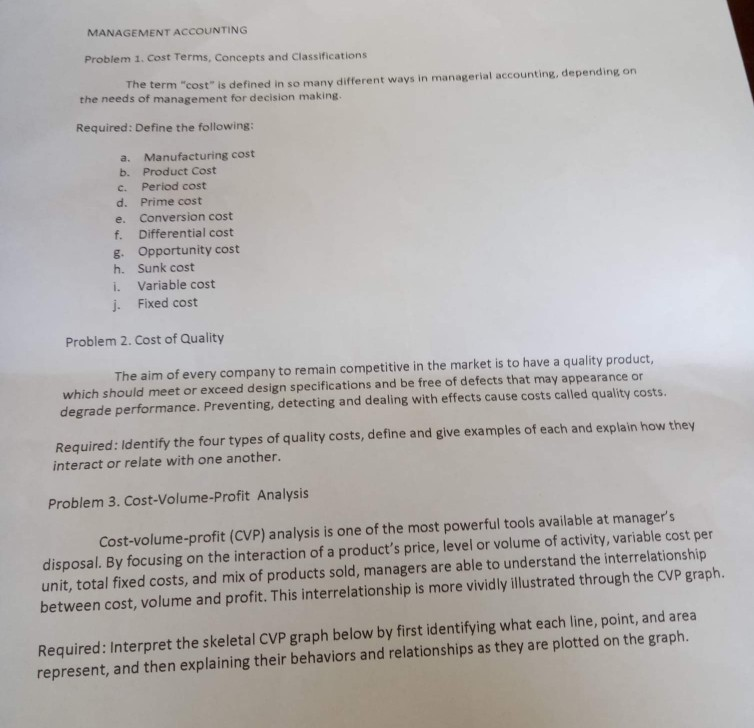
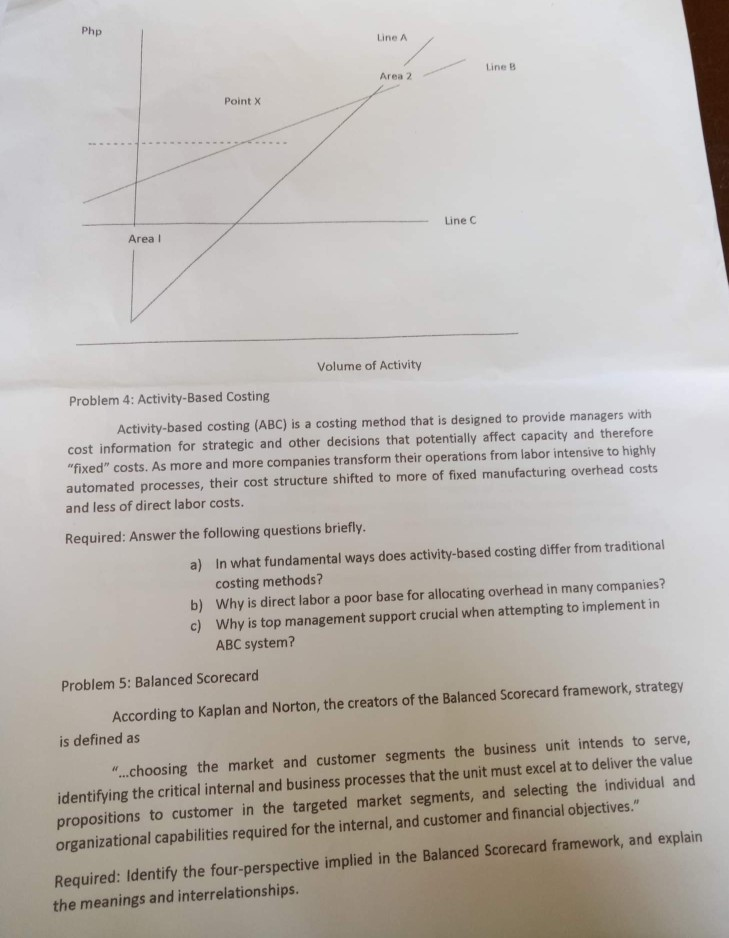
MANAGEMENT ACCOUNTING Problem 1. Cost Terms, Concepts and Classifications The term "cost" is defined in so many different ways in managerial accounting, depending on the needs of management for decision making. Required: Define the following: a. Manufacturing cost b. Product Cost Period cost d. Prime cost e. Conversion cost f. Differential cost g. Opportunity cost h. Sunk cost i. Variable cost j. Fixed cost Problem 2. Cost of Quality The aim of every company to remain competitive in the market is to have a quality product, which should meet or exceed design specifications and be free of defects that may appearance or degrade performance. Preventing, detecting and dealing with effects cause costs called quality costs. Required: Identify the four types of quality costs, define and give examples of each and explain how they interact or relate with one another. Problem 3. Cost-Volume-Profit Analysis Cost-volume-profit (CVP) analysis is one of the most powerful tools available at manager's disposal. By focusing on the interaction of a product's price, level or volume of activity, variable cost per unit, total fixed costs, and mix of products sold, managers are able to understand the interrelationship between cost, volume and profit. This interrelationship is more vividly illustrated through the CVP graph. Required: Interpret the skeletal CVP graph below by first identifying what each line, point, and area represent, and then explaining their behaviors and relationships as they are plotted on the graph. Php Line A Line B Area 2 Point X Line C Area! Volume of Activity Problem 4: Activity-Based Costing Activity-based costing (ABC) is a costing method that is designed to provide managers with cost information for strategic and other decisions that potentially affect capacity and therefore "fixed" costs. As more and more companies transform their operations from labor intensive to highly automated processes, their cost structure shifted to more of fixed manufacturing overhead costs and less of direct labor costs. Required: Answer the following questions briefly. a) In what fundamental ways does activity-based costing differ from traditional costing methods? b) Why is direct labor a poor base for allocating overhead in many companies? c) Why is top management support crucial when attempting to implement in ABC system? Problem 5: Balanced Scorecard According to Kaplan and Norton, the creators of the Balanced Scorecard framework, strategy is defined as "...choosing the market and customer segments the business unit intends to serve, identifying the critical internal and business processes that the unit must excel at to deliver the value propositions to customer in the targeted market segments, and selecting the individual and organizational capabilities required for the internal, and customer and financial objectives." Required: Identify the four-perspective implied in the Balanced Scorecard framework, and explain the meanings and interrelationships
Step by Step Solution
There are 3 Steps involved in it

Get step-by-step solutions from verified subject matter experts
 Study Help