







Question: management and organization behavior Case study 1: Wal-Mart Faces Discrimination Lawsuit Among the ranks of retailers, Wal-Mart has no peer, no one even close, Wal-Mart
management and organization behavior 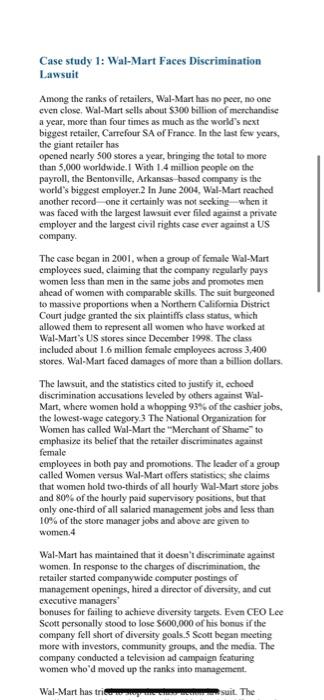
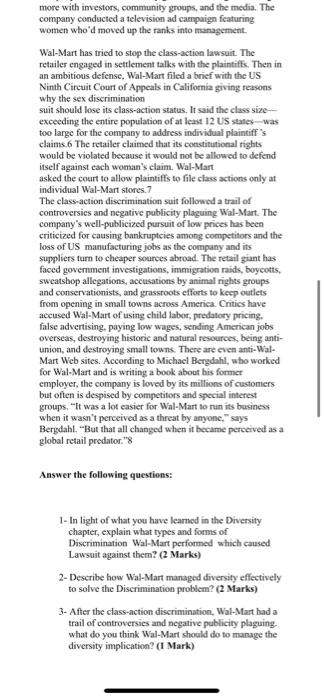
Case study 1: Wal-Mart Faces Discrimination Lawsuit Among the ranks of retailers, Wal-Mart has no peer, no one even close, Wal-Mart sells about $300 billion of merchandise a year, more than four times as much as the world's next biggest retailer, Carrefour SA of France. In the last few years, the giant retailer has opened nearly 500 stores a year, bringing the total to more than 5,000 worldwide. With 1.4 million people on the payroll, the Bentonville, Arkansas based company is the world's biggest employer.2 In June 2004, Wal-Mart reached another record one it certainly was not seeking when it was faced with the largest lawsuit ever filed against a private employer and the largest civil rights case ever against a US company The case began in 2001, when a group of female Wal-Mart employees sued, claiming that the company regularly pays women less than men in the same jobs and promotes men ahead of women with comparable skills. The suit burgeoned to massive proportions when a Northern California District Court judge granted the six plaintiffs class status, which allowed them to represent all women who have worked at Wal-Mart's US stores since December 1998. The class included about 1.6 million female employees across 3,400 stores, Wal-Mart faced damages of more than a billion dollars. The lawsuit, and the statistics cited to justify it, echoed discrimination accusations leveled by others against Wal- Mart, where women hold a whopping 93% of the cashier jobs. the lowest-wage category 3 The National Organization for Women has called Wal-Mart the "Merchant of Shame to emphasize its belief that the retailer discriminates against female employees in both pay and promotions. The leader of a group called Women versus Wal-Mart offers statistics, she claims that women hold two-thirds of all hourly Wal-Mart store jobs and 80% of the hourly paid supervisory positions, but that only one-third of all salaried management jobs and less than 10% of the store manager jobs and above are given to women.4 Wal-Mart has maintained that it doesn't discriminate against women. In response to the charges of discrimination, the retailer started companywide computer postings of management openings, hired a director of diversity, and cut executive managers bonuses for failing to achieve diversity targets. Even CEO Lee Scott personally stood to lose 5600,000 of his bones if the company fell short of diversity goals. 5 Scott began meeting more with investors, community groups, and the media. The company conducted a television ad campaign featuring women who'd moved up the ranks into management. Wal-Mart has tree suit. The more with investors, community groups, and the media. The company conducted a television ad campaign featuring women who'd moved up the ranks into management Wal-Mart has tried to stop the class-action lawsuit. The retailer engaged in settlement talks with the plaintiffs. Then in an ambitious defense, Wal-Mart filed a brief with the US Ninth Circuit Court of Appeals in California giving reasons why the sex discrimination suit should lose its class-action status. It said the class size- exceeding the entire population of at least 12 US stafies was too large for the company to address individual plaintiff's claims6 The retailer claimed that its constitutional rights would be violated because it would not be allowed to defend itself against each woman's claim. Wal-Mart asked the court to allow plaintiffs to file class actions only at individual Wal-Mart stores. 7 The class-action discrimination suit followed a trail of controversies and negative publicity plaguing Wal-Mart. The company's well-publicized pursuit of low prices has been criticized for causing bankruptcies among competitors and the loss of US manufacturing jobs as the company and its suppliers turn to cheaper sources abroad. The retail giant has faced government investigations, immigration raids, boycotts, sweatshop allegations, accusations by animal rights groups and conservationists, and grassroots efforts to keep outlets from opening in small towns across America. Critics have accused Wal-Mart of using child labor, predatory pricing. false advertising, paying low wages, sending American jobs overseas, destroying historic and natural resources, being anti- union, and destroying small towns. There are even anti-Wal- Mart Web sites. According to Michael Bergdahl, who worked for Wal-Mart and is writing a book about his former employer, the company is loved by its millions of customers but often is despised by competitors and special interest groups. "It was a lot easier for Wal-Mart to rin its business when it wasn't perceived as a threat by anyone," says Bergdahl. "But that all changed when it became perceived as a global retail predator." Answer the following questions: 1- In light of what you have learned in the Diversity chapter, explain what types and forms of Discrimination Wal-Mart performed which caused Lawsuit against them? (2 Marks) 2- Describe how Wal-Mart manaped diversity effectively to solve the Discrimination problem? (2 Marks) 3- After the class-action discrimination, Wal-Mart had a trail of controversies and negative publicity plaguing what do you think Wal-Mart should do to manage the diversity implication? (I Mark) Step by Step Solution
There are 3 Steps involved in it
1 Expert Approved Answer
Step: 1 Unlock

Question Has Been Solved by an Expert!
Get step-by-step solutions from verified subject matter experts
Step: 2 Unlock
Step: 3 Unlock
 Study Help