







Question: Management Science Linear Program / Inventory Model Barilla Pasta Case Background ( This case was taken from an article that appears in The Economist Nov.
Management Science
Linear ProgramInventory Model
Barilla Pasta Case
Background This case was taken from an article that appears in The Economist Nov.
Barilla Pasta is the largest pasta maker in the world. The organization has a modern hightech facility located at its world headquarters in Parma, Italy. Barilla exports of its products; mainly to Europe and the US Because of the COVID pandemic, people around the world are staying home and cooking for themselves. As a result, pasta sales world wide have increased. Likewise, pasta sales for Barilla have increased around from to One of Barilla's most important markets is Germany. Since March of Barilla has supplied of the pasta and of the pasta sauces and pestos eaten in Germany The Economist, Nov. Global sales for Barilla were $ billion for
The Problems
Because of the international growth in pasta sales, Barilla may be experiencing problems with its hourly production capacity and its rail train shipments. You are an executive with Barilla and you are a member of a team responsible for inventory and supply chains. You need to evaluate whether to focus your attention on hourly production capacity or rail car shipments as a way to increase revenue streams.
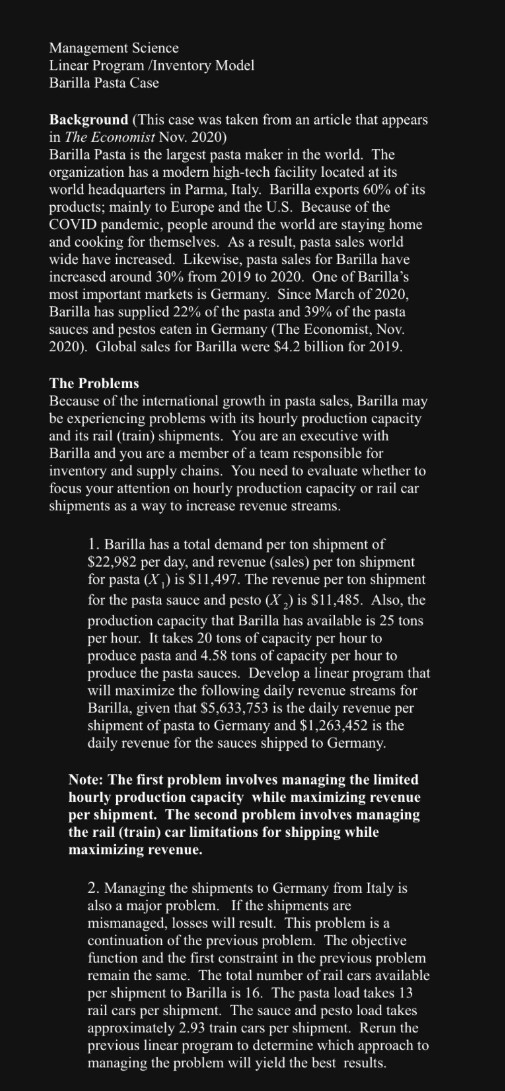
Barilla has a total demand per ton shipment of $ per day, and revenue sales per ton shipment for pasta is $ The revenue per ton shipment for the pasta sauce and pesto is $ Also, the production capacity that Barilla has available is tons per hour. It takes tons of capacity per hour to produce pasta and tons of capacity per hour to produce the pasta sauces. Develop a linear program that will maximize the following daily revenue streams for Barilla, given that $ is the daily revenue per shipment of pasta to Germany and $ is the daily revenue for the sauces shipped to Germany.
Note: The first problem involves managing the limited hourly production capacity while maximizing revenue per shipment. The second problem involves managing the rail train car limitations for shipping while maximizing revenue.
Managing the shipments to Germany from Italy is also a major problem. If the shipments are mismanaged, losses will result. This problem is a continuation of the previous problem. The objective function and the first constraint in the previous problem remain the same. The total number of rail cars available per shipment to Barilla is The pasta load takes rail cars per shipment. The sauce and pesto load takes approximately train cars per shipment. Rerun the previous linear program to determine which approach to managing the problem will yield the best results.
Step by Step Solution
There are 3 Steps involved in it
1 Expert Approved Answer
Step: 1 Unlock

Question Has Been Solved by an Expert!
Get step-by-step solutions from verified subject matter experts
Step: 2 Unlock
Step: 3 Unlock
 Study Help