







Question: Management Skill Builder - Gaining Power and Influence - Read the Skill Basics on pages 188 - 189 and the questions at the end of
Management Skill Builder - "Gaining Power and Influence" - Read the Skill Basics on pages 188 - 189 and the questions at the end of the Practicing the Skill exercise that follows. Submit a one page single spaced report of your analysis of Margret's skill in building a power base.
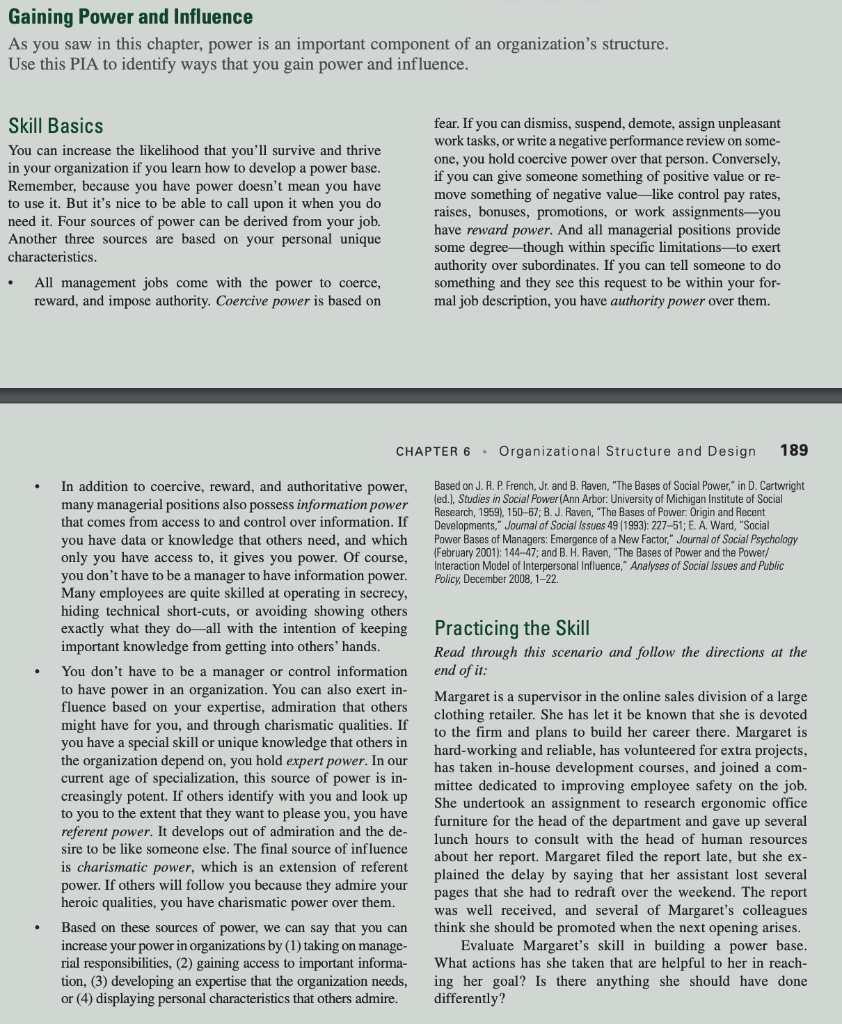
Gaining Power and Influence As you saw in this chapter, power is an important component of an organization's structure. Use this PIA to identify ways that you gain power and influence. Skill Basics You can increase the likelihood that you'll survive and thrive in your organization if you learn how to develop a power base. Remember, because you have power doesn't mean you have to use it. But it's nice to be able to call upon it when you do need it. Four sources of power can be derived from your job. Another three sources are based on your personal unique characteristics. All management jobs come with the power to coerce, reward, and impose authority. Coercive power is based on fear. If you can dismiss, suspend, demote, assign unpleasant work tasks, or write a negative performance review on some- one, you hold coercive power over that person. Conversely, if you can give someone something of positive value or re- move something of negative value-like control pay rates, raises, bonuses, promotions, or work assignmentsyou have reward power. And all managerial positions provide some degreethough within specific limitationsto exert authority over subordinates. If you can tell someone to do something and they see this request to be within your for- mal job description, you have authority power over them. CHAPTER 6 Organizational Structure and Design 189 Based on J. R. P. French, Jr. and B. Raven, "The Bases of Social Power," in D. Cartwright (ed.), Studies in Social Power (Ann Arbor: University of Michigan Institute of Social Research, 1959), 150-67; B. J. Raven, "The Bases of Power. Origin and Recent Developments" Joumal of Social Issues 49 (1993): 227-51; E. A Ward, "Social Power Bases of Managers: Emergence of a New Factor," Journal of Social Psychology (February 2001): 144-47; and B. H. Raven, "The Bases of Power and the Power/ Interaction Model of Interpersonal Influence." Analyses of Social Issues and Public Policy, December 2008, 1-22. In addition to coercive, reward, and authoritative power, many managerial positions also possess information power that comes from access to and control over information. If you have data or knowledge that others need, and which only you have access to, it gives you power. Of course, you don't have to be a manager to have information power. Many employees are quite skilled at operating in secrecy, hiding technical short-cuts, or avoiding showing others exactly what they doall with the intention of keeping important knowledge from getting into others' hands. You don't have to be a manager or control information to have power in an organization. You can also exert in- fluence based on your expertise, admiration that others might have for you, and through charismatic qualities. If you have a special skill or unique knowledge that others in the organization depend on, you hold expert power. In our current age of specialization, this source of power is in- creasingly potent. If others identify with you and look up to you to the extent that they want to please you, you have referent power. It develops out of admiration and the de- sire to be like someone else. The final source of influence is charismatic power, which is an extension of referent power. If others will follow you because they admire your heroic qualities, you have charismatic power over them. Based on these sources of power, we can say that you can increase your power in organizations by (1) taking on manage- rial responsibilities, (2) gaining access to important informa- tion, (3) developing an expertise that the organization needs, or (4) displaying personal characteristics that others admire. Practicing the Skill Read through this scenario and follow the directions at the end of it: Margaret is a supervisor in the online sales division of a large clothing retailer. She has let it be known that she is devoted to the firm and plans to build her career there. Margaret is hard-working and reliable, has volunteered for extra projects, has taken in-house development courses, and joined a com- mittee dedicated to improving employee safety on the job. She undertook an assignment to research ergonomic office furniture for the head of the department and gave up several lunch hours to consult with the head of human resources about her report. Margaret filed the report late, but she ex- plained the delay by saying that her assistant lost several pages that she had to redraft over the weekend. The report was well received, and several of Margaret's colleagues think she should be promoted when the next opening arises. Evaluate Margaret's skill in building a power base. What actions has she taken that are helpful to her in reach- ing her goal? Is there anything she should have done differentlyStep by Step Solution
There are 3 Steps involved in it
1 Expert Approved Answer
Step: 1 Unlock

Question Has Been Solved by an Expert!
Get step-by-step solutions from verified subject matter experts
Step: 2 Unlock
Step: 3 Unlock
 Study Help