



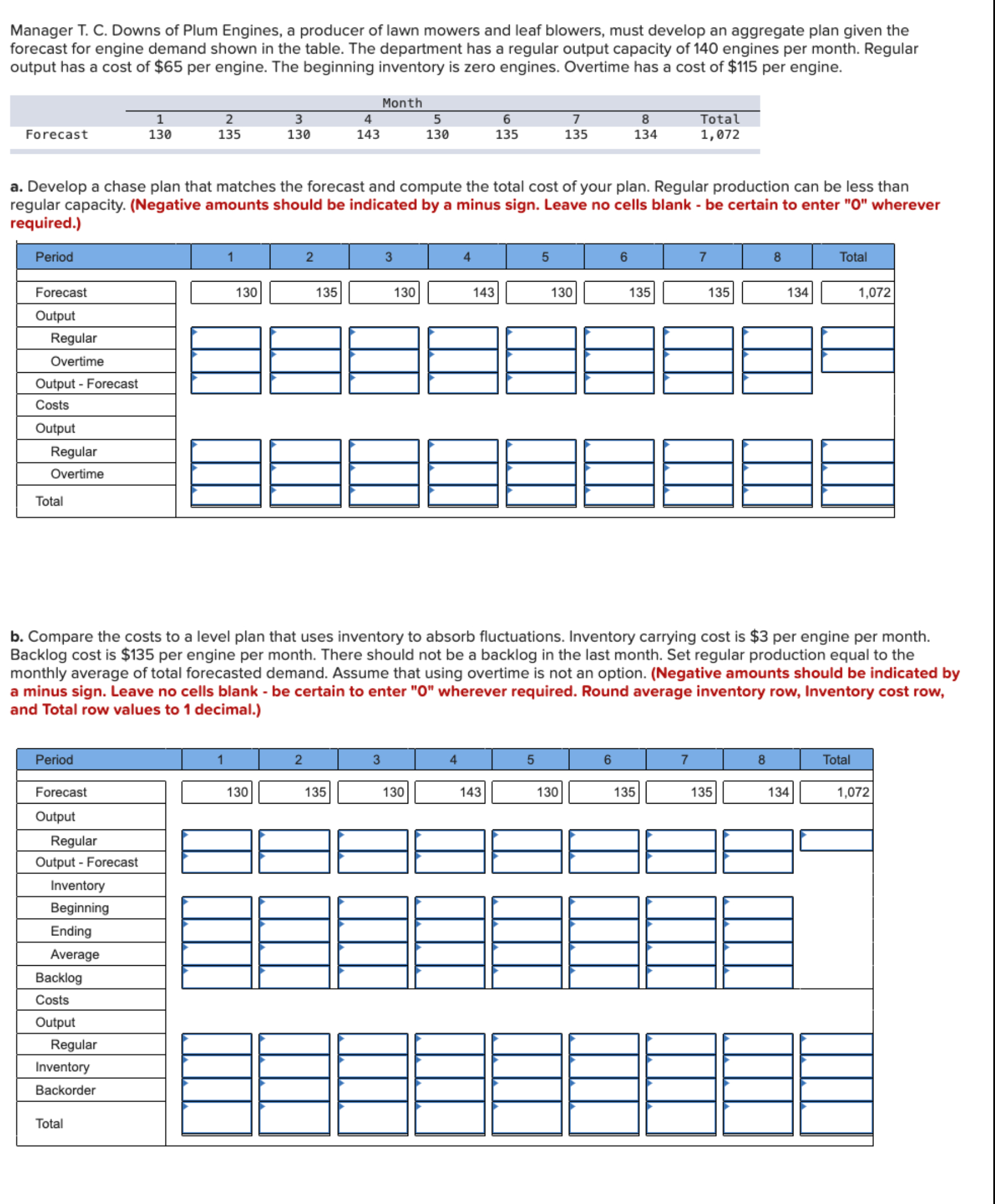
Question: Manager T . C . Downs of Plum Engines, a producer of lawn mowers and leaf blowers, must develop an aggregate plan given the forecast
Manager T C Downs of Plum Engines, a producer of lawn mowers and leaf blowers, must develop an aggregate plan given the
forecast for engine demand shown in the table. The department has a regular output capacity of engines per month. Regular
output has a cost of $ per engine. The beginning inventory is zero engines. Overtime has a cost of $ per engine.
a Develop a chase plan that matches the forecast and compute the total cost of your plan. Regular production can be less than
regular capacity. Negative amounts should be indicated by a minus sign. Leave no cells blank be certain to enter wherever
required.
b Compare the costs to a level plan that uses inventory to absorb fluctuations. Inventory carrying cost is $ per engine per month.
Backlog cost is $ per engine per month. There should not be a backlog in the last month. Set regular production equal to the
monthly average of total forecasted demand. Assume that using overtime is not an option. Negative amounts should be indicated by
a minus sign. Leave no cells blank be certain to enter wherever required. Round average inventory row, Inventory cost row,
and Total row values to decimal.Manager T C Downs of Plum Engines, a producer of lawn mowers and leaf blowers, must develop an aggregate plan given the
forecast for engine demand shown in the table. The department has a regular output capacity of engines per month. Regular
output has a cost of $ per engine. The beginning inventory is zero engines. Overtime has a cost of $ per engine.
a Develop a chase plan that matches the forecast and compute the total cost of your plan. Regular production can be less than
regular capacity. Negative amounts should be indicated by a minus sign. Leave no cells blank be certain to enter wherever
required.
b Compare the costs to a level plan that uses inventory to absorb fluctuations. Inventory carrying cost is $ per engine per month.
Backlog cost is $ per engine per month. There should not be a backlog in the last month. Set regular production equal to the
monthly average of total forecasted demand. Assume that using overtime is not an option. Negative amounts should be indicated by
a minus sign. Leave no cells blank be certain to enter wherever required. Round average inventory row, Inventory cost row,
and Total row values to decimal.
hundreds of bolts. The department has a regular output capacity of bolts per month, except for the seventh month, when
capacity will be bolts. Regular output has a cost of $ per hundred bolts. Workers can be assigned to other jobs if production
is less than regular. The beginning inventory is zero bolts.
a Develop a chase plan that matches the forecast and compute the total cost of your plan. Overtime is $ per hundred bolts. Regular
production can be less than regular capacity. Negative amounts should be indicated by a minus sign. Leave no cells blank be
certain to enter wherever required.
b Would the total cost be less with full regular production each period with no overtime, but using a subcontractor to handle the
excess above regular capacity at a cost of $ per hundred bolts? Backlogs are not allowed. The inventory carrying cost is $ per
hundred bolts. Round your Average inventory values to decimal place. Negative amounts should be indicated by a minus sign.
Leave no cells blank be certain to enter wherever required.
Step by Step Solution
There are 3 Steps involved in it
1 Expert Approved Answer
Step: 1 Unlock

Question Has Been Solved by an Expert!
Get step-by-step solutions from verified subject matter experts
Step: 2 Unlock
Step: 3 Unlock