







Question: Managerial Problem: Amazon's Delivery Services (P&B, pp. 191 & 221) Amazon has a problem: It's too successful. It controls 44% of the U.S. e-commerce market,
Managerial Problem: Amazon's Delivery Services (P&B, pp. 191 & 221)
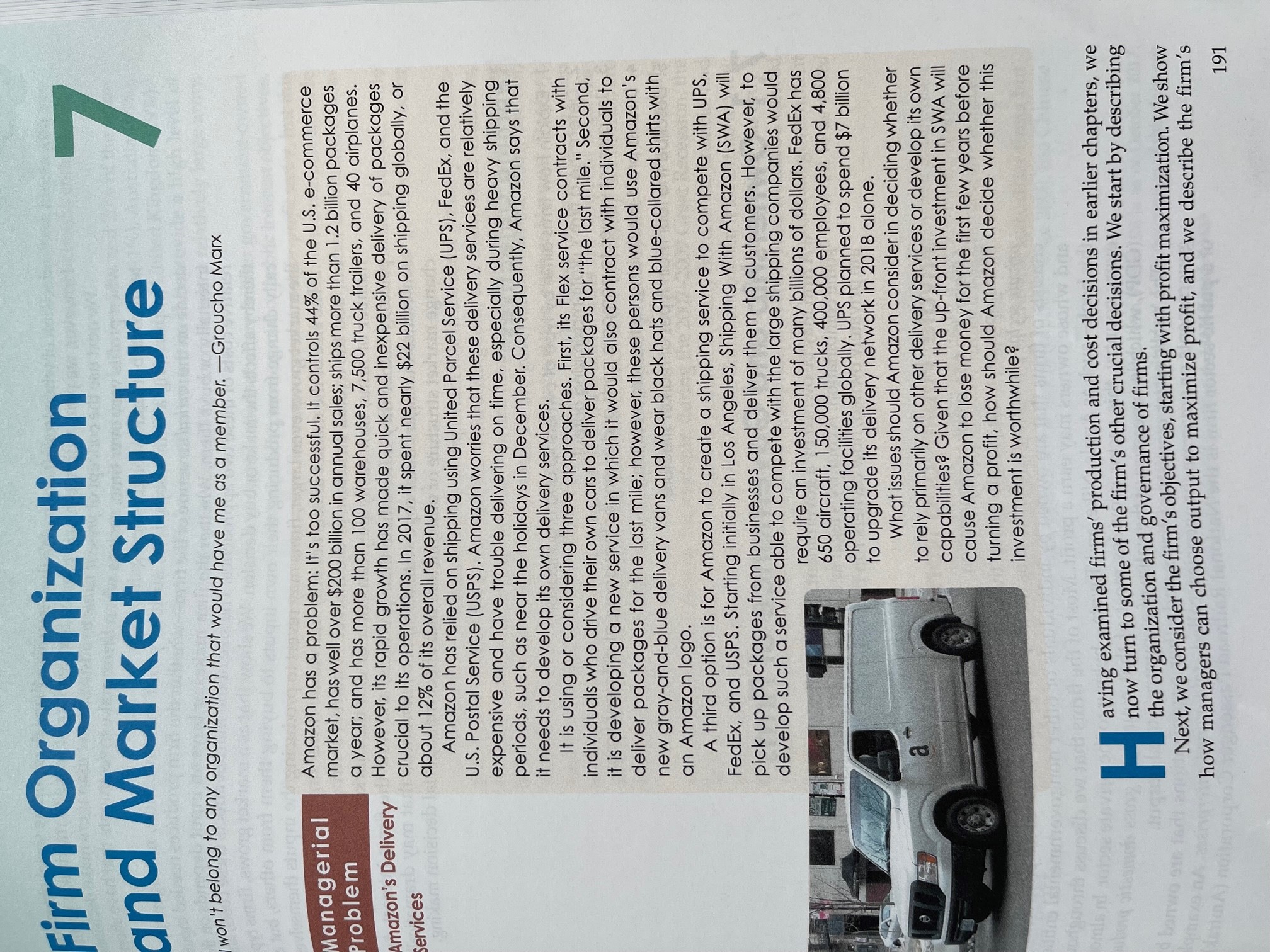
Amazon has a problem: It's too successful. It controls 44% of the U.S. e-commerce market, has well over $200 billion in annual sales, ships more than 1.2 billion packages a year, and has more than 100 warehouses, 7,500 truck trailers, and 40 airplanes. However, its rapid growth has made quick and inexpensive delivery of packages crucial to its operations. In 2017, it spent nearly $22 billion on shipping globally, or about 12% of its overall revenue.
Amazon has relied on shipping using United Parcel Service (UPS), FedEx, and the U.S. Postal Service (USPS). Amazon worries that these delivery services are relatively expensive and have trouble delivering on time, especially during heavy shipping periods, near the holidays in December. Consequently, Amazon says that it needs to develop its delivery services.
Amazon uses or considers three approaches.
- First, its Flex service contracts with individuals who drive their cars to deliver packages for "the last mile."
- Second, it is developing a new service. It would contract with individuals to deliver packages for the last mile; however, these persons would use Amazon's new gray-and-blue delivery vans and wear black hats and blue-collared shirts with an Amazon logo.
- A third option is to create a shipping service to compete with UPS, FedEx, and USPS. Starting initially in Los Angeles, Shipping With Amazon (SWA) will pick up packages from businesses and deliver them to customers. However, to develop such a service able to compete with the large shipping companies would require an investment of many billions of dollars.
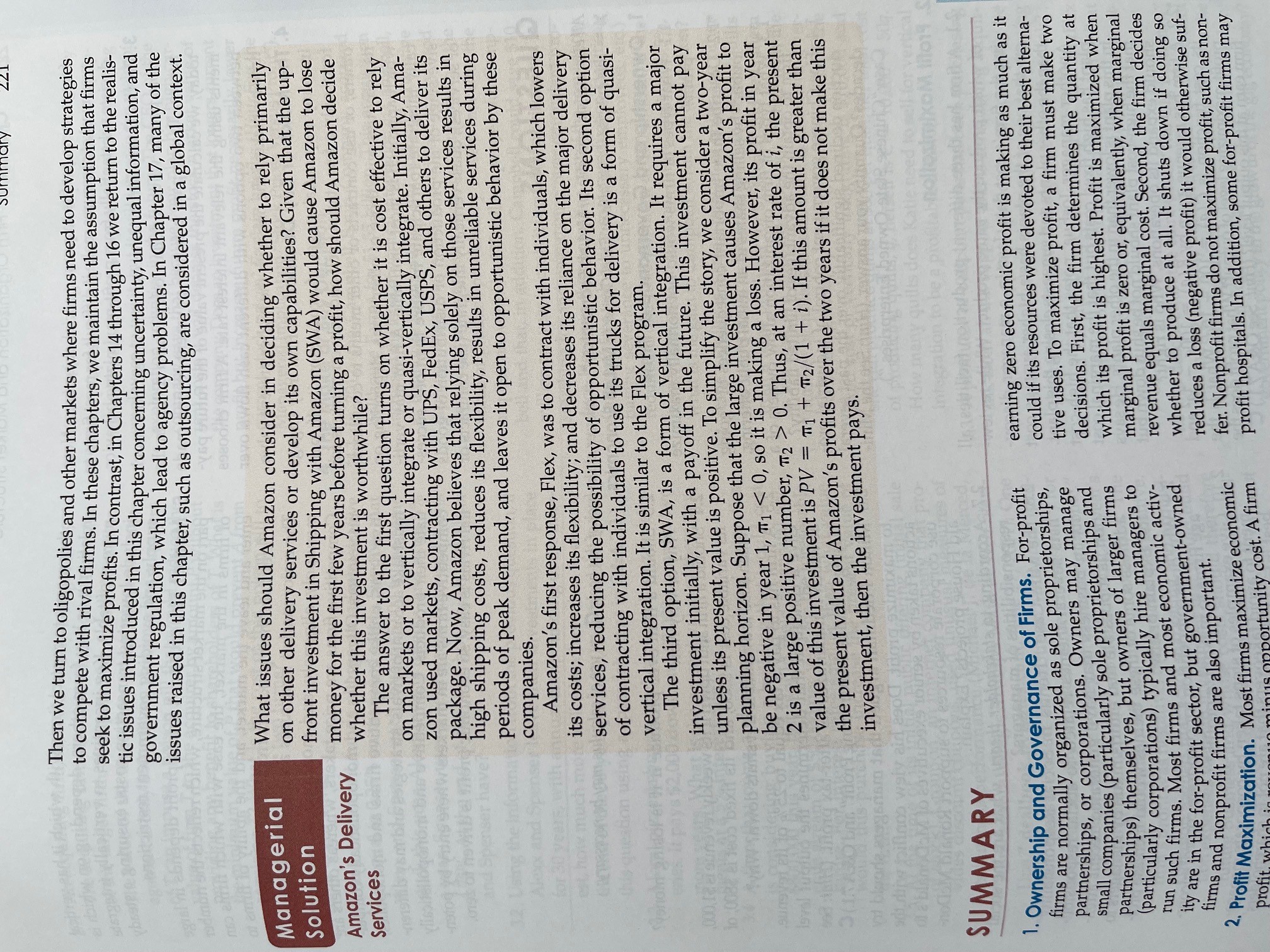
What issues should Amazon consider in deciding whether to rely primarily on other delivery services or develop its capabilities? Given that the up-front investment in SWA will cause Amazon to lose money for the first few years before turning a profit, how should Amazon decide whether this investment is worthwhile?
The answer to the first question turns on whether it is cost-effective to rely on markets or to vertically integrate or quasi-vertically integrate. Initially, Amazon used markets, contracting with UPS, FedEx, USPS, and others to deliver its package. Now, Amazon believes that relying solely on those services results in high shipping costs, reduces its flexibility, results in unreliable services during periods of peak demand, and leaves it open to opportunistic behavior by these companies.
Amazon's first response, Flex, was to contract with individuals, which lowers its costs; increases its flexibility; and decreases its reliance on the major delivery services, reducing the possibility of opportunistic behavior. Its second option of contracting with individuals to use its trucks for delivery is a form of quasi-vertical integration. It is similar to the Flex program.
The third option, SWA, is a form of vertical integration. It requires a significant investment initially, with a payoff in the future. This investment cannot pay unless its present value is positive.
1. To which market structure belong Amazon? Explain.
2. Would an increase in interest rates make the Shipping With Amazon (SWA) option more attractive or less attractive to Amazon? Use the suggested questions below to answer this question.
3. Show formally using an equation involving interest rates to explain your answer.
4. Use an Excel sheet to confirm your answer to question. In the excel sheet, use 3%, 5%, and 7% interest rates.
Firm Organization and Market Structure 7 I won't belong to any organization that would have me as a member. Groucho Marx Managerial Problem Amazon's Delivery Services Amazon has a problem: It's too successful. It controls 44% of the U.S. e-commerce market, has well over $200 billion in annual sales; ships more than 1.2 billion packages a year, and has more than 100 warehouses, 7,500 truck trailers, and 40 airplanes. However, its rapid growth has made quick and inexpensive delivery of packages crucial to its operations. In 2017, it spent nearly $22 billion on shipping globally, or about 12% of its overall revenue. Amazon has relied on shipping using United Parcel Service (UPS), FedEx, and the U.S. Postal Service (USPS). Amazon worries that these delivery services are relatively expensive and have trouble delivering on time, especially during heavy shipping periods, such as near the holidays in December. Consequently, Amazon says that it needs to develop its own delivery services. It is using or considering three approaches. First, its Flex service contracts with individuals who drive their own cars to deliver packages for "the last mile." Second, it is developing a new service in which it would also contract with individuals to deliver packages for the last mile; however, these persons would use Amazon's new gray-and-blue delivery vans and wear black hats and blue-collared shirts with an Amazon logo. A third option is for Amazon to create a shipping service to compete with UPS, FedEx, and USPS. Starting initially in Los Angeles, Shipping With Amazon (SWA) will pick up packages from businesses and deliver them to customers. However, to develop such a service able to compete with the large shipping companies would require an investment of many billions of dollars. FedEx has 650 aircraft, 150,000 trucks, 400,000 employees, and 4,800 operating facilities globally. UPS planned to spend $7 billion to upgrade its delivery network in 2018 alone. What issues should Amazon consider in deciding whether a to rely primarily on other delivery services or develop its own capabilities? Given that the up-front investment in SWA will cause Amazon to lose money for the first few years before turning a profit, how should Amazon decide whether this investment is worthwhile? 1 ro H DIE aving examined firms' production and cost decisions in earlier chapters, we now turn to some of the firm's other crucial decisions. We start by describing the organization and governance of firms. Next, we consider the firm's objectives, starting with profit maximization. We show how managers can choose output to maximize profit, and we describe the firm's bono 191 Summary Then we turn to oligopolies and other markets where firms need to develop strategies to compete with rival firms. In these chapters, we maintain the assumption that firms seek to maximize profits. In contrast, in Chapters 14 through 16 we return to the realis- tic issues introduced in this chapter concerning uncertainty, unequal information, and government regulation, which lead to agency problems. In Chapter 17, many of the issues raised in this chapter, such as outsourcing, are considered in a global context. dir Managerial Solution Services What issues should Amazon consider in deciding whether to rely primarily on other delivery services or develop its own capabilities? Given that the up- front investment in Shipping with Amazon (SWA) would cause Amazon to lose Amazon's Delivery money for the first few years before turning a profit , how should Amazon decide whether this investment is worthwhile? The answer to the first question turns on whether it is cost effective to rely on markets or to vertically integrate or quasi-vertically integrate. Initially, Ama- zon used markets, contracting with UPS, FedEx, USPS, and others to deliver its package. Now, Amazon believes that relying solely on those services results in high shipping costs, reduces its flexibility, results in unreliable services during periods of peak demand, and leaves it open to opportunistic behavior by these companies. Amazon's first response, Flex, was to contract with individuals, which lowers ber its costs; increases its flexibility; and decreases its reliance on the major delivery services, reducing the possibility of opportunistic behavior. Its second option of contracting with individuals to use its trucks for delivery is a form of quasi- vertical integration. It is similar to the Flex program. The third option, SWA, is a form of vertical integration. It requires a major investment initially, with a payoff in the future. This investment cannot pay 0001 unless its present value is positive. To simplify the story, we consider a two-year planning horizon. Suppose that the large investment causes Amazon's profit to be negative in year 1, T1 0. Thus, at an interest rate of i, the present oral value of this investment is PV TT1 + 12/(1 + i). If this amount is greater than the present value of Amazon's profits over the two years if it does not make this DOOR investment, then the investment pays. In welvaao vstoupe de a 779 SUMMARY partnerships, firms are normally organized as sole proprietorships, 1. Ownership and Governance of Firms. For-profit or corporations. Owners may manage small companies (particularly sole proprietorships and partnerships) themselves, but owners of larger firms (particularly corporations) typically hire managers to run such firms. Most firms and most economic activ- ity are in the for-profit sector, but government-owned firms and nonprofit firms are also important. 2. Profit Maximization. Most firms maximize economic earning zero economic profit is making as much as it could if its resources were devoted to their best alterna- tive uses. To maximize profit, a firm must make two decisions. First, the firm determines the quantity at which its profit is highest. Profit is maximized when marginal profit is zero or, equivalently, when marginal revenue equals marginal cost. Second, the firm decides whether to produce at all. It shuts down if doing so reduces a loss (negative profit) it would otherwise suf- fer. Nonprofit firms do not maximize profit, such as non- profit hospitals. In addition, some for-profit firms may minus opportunity cost. A firm profit, which Firm Organization and Market Structure 7 I won't belong to any organization that would have me as a member. Groucho Marx Managerial Problem Amazon's Delivery Services Amazon has a problem: It's too successful. It controls 44% of the U.S. e-commerce market, has well over $200 billion in annual sales; ships more than 1.2 billion packages a year, and has more than 100 warehouses, 7,500 truck trailers, and 40 airplanes. However, its rapid growth has made quick and inexpensive delivery of packages crucial to its operations. In 2017, it spent nearly $22 billion on shipping globally, or about 12% of its overall revenue. Amazon has relied on shipping using United Parcel Service (UPS), FedEx, and the U.S. Postal Service (USPS). Amazon worries that these delivery services are relatively expensive and have trouble delivering on time, especially during heavy shipping periods, such as near the holidays in December. Consequently, Amazon says that it needs to develop its own delivery services. It is using or considering three approaches. First, its Flex service contracts with individuals who drive their own cars to deliver packages for "the last mile." Second, it is developing a new service in which it would also contract with individuals to deliver packages for the last mile; however, these persons would use Amazon's new gray-and-blue delivery vans and wear black hats and blue-collared shirts with an Amazon logo. A third option is for Amazon to create a shipping service to compete with UPS, FedEx, and USPS. Starting initially in Los Angeles, Shipping With Amazon (SWA) will pick up packages from businesses and deliver them to customers. However, to develop such a service able to compete with the large shipping companies would require an investment of many billions of dollars. FedEx has 650 aircraft, 150,000 trucks, 400,000 employees, and 4,800 operating facilities globally. UPS planned to spend $7 billion to upgrade its delivery network in 2018 alone. What issues should Amazon consider in deciding whether a to rely primarily on other delivery services or develop its own capabilities? Given that the up-front investment in SWA will cause Amazon to lose money for the first few years before turning a profit, how should Amazon decide whether this investment is worthwhile? 1 ro H DIE aving examined firms' production and cost decisions in earlier chapters, we now turn to some of the firm's other crucial decisions. We start by describing the organization and governance of firms. Next, we consider the firm's objectives, starting with profit maximization. We show how managers can choose output to maximize profit, and we describe the firm's bono 191 Summary Then we turn to oligopolies and other markets where firms need to develop strategies to compete with rival firms. In these chapters, we maintain the assumption that firms seek to maximize profits. In contrast, in Chapters 14 through 16 we return to the realis- tic issues introduced in this chapter concerning uncertainty, unequal information, and government regulation, which lead to agency problems. In Chapter 17, many of the issues raised in this chapter, such as outsourcing, are considered in a global context. dir Managerial Solution Services What issues should Amazon consider in deciding whether to rely primarily on other delivery services or develop its own capabilities? Given that the up- front investment in Shipping with Amazon (SWA) would cause Amazon to lose Amazon's Delivery money for the first few years before turning a profit , how should Amazon decide whether this investment is worthwhile? The answer to the first question turns on whether it is cost effective to rely on markets or to vertically integrate or quasi-vertically integrate. Initially, Ama- zon used markets, contracting with UPS, FedEx, USPS, and others to deliver its package. Now, Amazon believes that relying solely on those services results in high shipping costs, reduces its flexibility, results in unreliable services during periods of peak demand, and leaves it open to opportunistic behavior by these companies. Amazon's first response, Flex, was to contract with individuals, which lowers ber its costs; increases its flexibility; and decreases its reliance on the major delivery services, reducing the possibility of opportunistic behavior. Its second option of contracting with individuals to use its trucks for delivery is a form of quasi- vertical integration. It is similar to the Flex program. The third option, SWA, is a form of vertical integration. It requires a major investment initially, with a payoff in the future. This investment cannot pay 0001 unless its present value is positive. To simplify the story, we consider a two-year planning horizon. Suppose that the large investment causes Amazon's profit to be negative in year 1, T1 0. Thus, at an interest rate of i, the present oral value of this investment is PV TT1 + 12/(1 + i). If this amount is greater than the present value of Amazon's profits over the two years if it does not make this DOOR investment, then the investment pays. In welvaao vstoupe de a 779 SUMMARY partnerships, firms are normally organized as sole proprietorships, 1. Ownership and Governance of Firms. For-profit or corporations. Owners may manage small companies (particularly sole proprietorships and partnerships) themselves, but owners of larger firms (particularly corporations) typically hire managers to run such firms. Most firms and most economic activ- ity are in the for-profit sector, but government-owned firms and nonprofit firms are also important. 2. Profit Maximization. Most firms maximize economic earning zero economic profit is making as much as it could if its resources were devoted to their best alterna- tive uses. To maximize profit, a firm must make two decisions. First, the firm determines the quantity at which its profit is highest. Profit is maximized when marginal profit is zero or, equivalently, when marginal revenue equals marginal cost. Second, the firm decides whether to produce at all. It shuts down if doing so reduces a loss (negative profit) it would otherwise suf- fer. Nonprofit firms do not maximize profit, such as non- profit hospitals. In addition, some for-profit firms may minus opportunity cost. A firm profit, which
Step by Step Solution
There are 3 Steps involved in it

Get step-by-step solutions from verified subject matter experts
 Study Help