







Question: Managing Individual Differences and Behavior I CHAPTER 11 419 How can you reduce the cognitive dissonance you experi- ence as a result of high performance
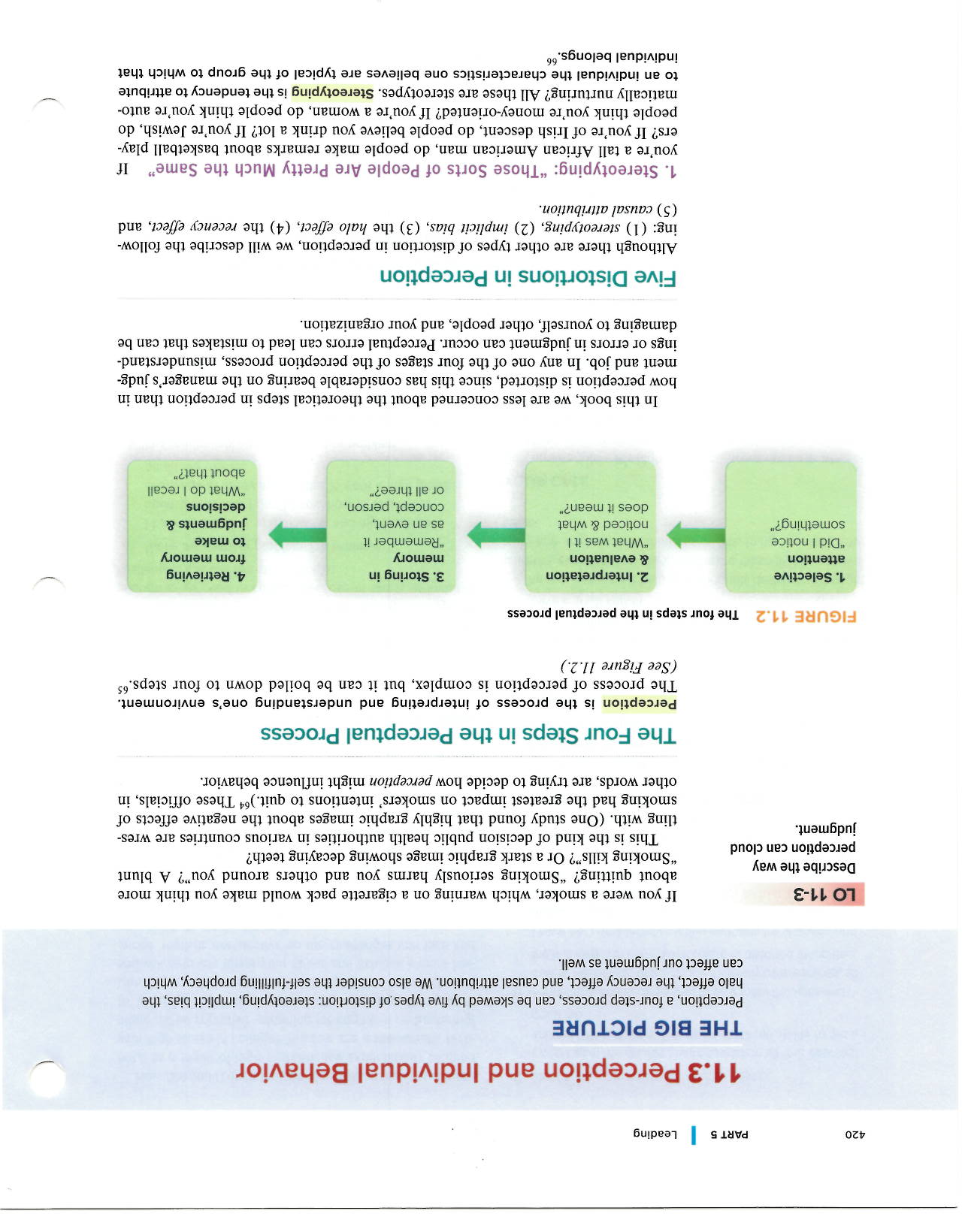
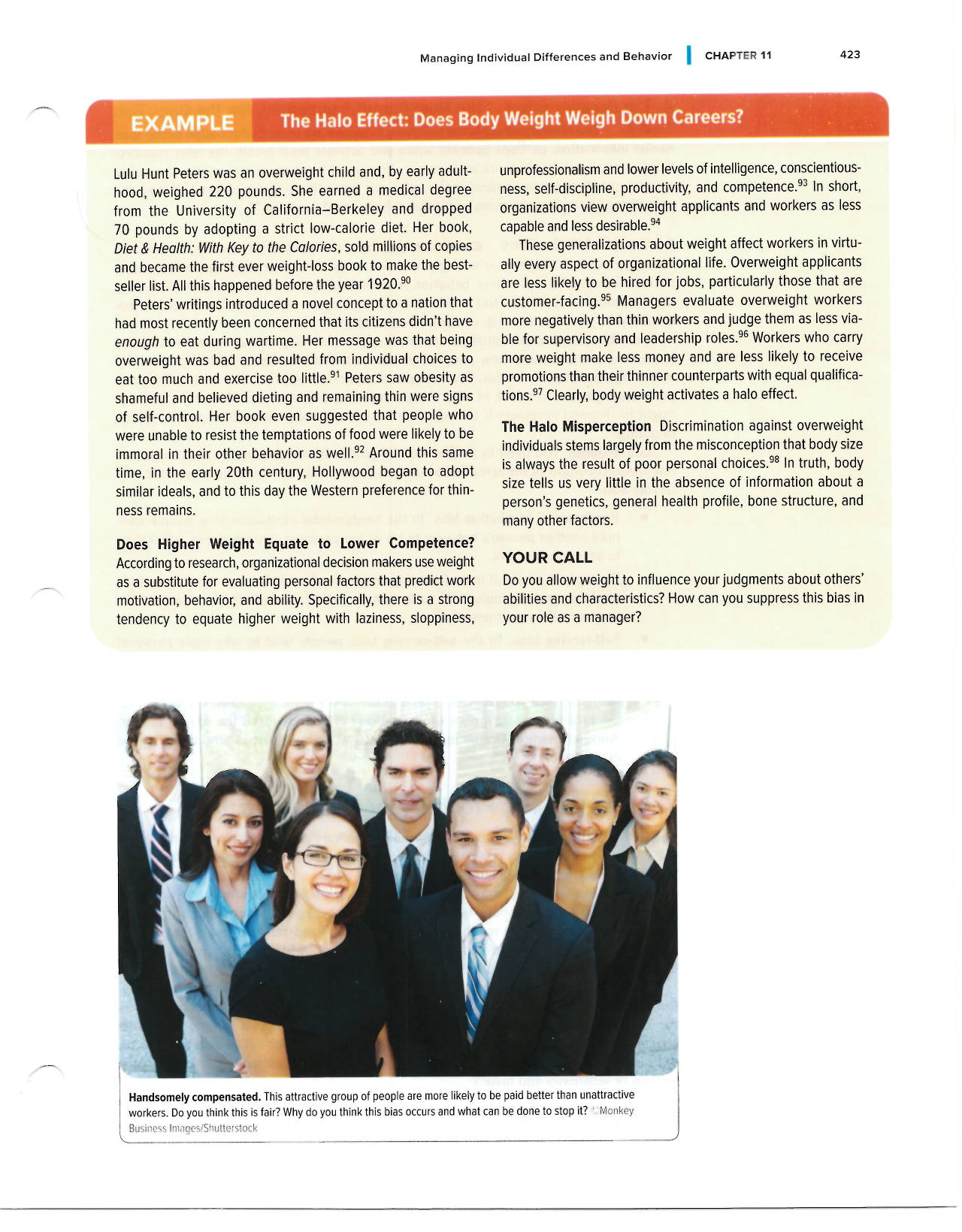
Managing Individual Differences and Behavior I CHAPTER 11 419 How can you reduce the cognitive dissonance you experi- ence as a result of high performance expectations coupled with high stress in college? You can use a therapeutic tech- nique called cognitive reframing (or cognitive restructuring) to identify, challenge, and modify negative thoughts. Learning to reframe destructive thoughts is a critical life skill and will help you lower your stress and achieve a more bal- anced, realistic perspective on the challenges you face and your ability to master them Give Yourself Some Advice Self-made billionaire Richard Branson struggled so much with dyslexia in high school that he dropped out. Now Branson is part of the global charity Made By Dyslexia, which aims to help people reframe dyslexia \"as a positive influence in their lives.\"" Branson suggests people struggling with cognitive dif- ferences write a letter to their younger selves explaining that the challenges they face are assets and unigue capabilities rather than flaws. In Branson's letter to his teenage self, he says to \"use your alternative ways of thinking to be creative and think bigger."s? Ask Yourself a Few Questions Another useful technique for reframing your thoughts is called the ABCDEs of Cognitive Restructuring. When you begin to feel like you aren't good enough, smart enough, or capable enough to succeed in college because of stress or invisible challenges, use this five-step process: A Name the event or problem. For example: | have four exams in one week and my grades are important to me. | don't know how to tackle the challenge of studying in order to earn a high grade on all the exams. B List your beliefs about the event or problem. | don't have enough time to study for all these exams. | will either need to focus on studying for one or two and accept poor performance on the others, or study just enough for each exam to get passing grades on all four. C Identify the consequences of your beliefs. | won't earn the grades | want to earn in all four courses and my GPA will drop. This can reduce my ability to get a good job. D Formulate a counterargument to your initial thoughts and beliefs. Pessimistic thoughts are generally overreactions, so the first step is to correct inaccurate or distorted thoughts. | have not considered creative methods for studying and performing well on all my exams. | may not be able to assemble thorough study guides for all four, but | know others in my classes are in the same boat, and we may be able to combine our materials and work as a group to study for these exams. | could also ask my professors for advice on narrowing down the content for studying. The worst-case scenario is that | don't earn As on all four exams and | use this experience to learn to prepare ear- lier for future exams. One bad exam grade may not mean | am unable to earn a high final course grade or find a good job after graduation. E Describe how energized and empowered you feel at the moment. I'm motivated to do as well as | can on these exams. | got into college and have made it this far. There s no reason | can't continue to be a successful student and go on to have a great career. These questions will help you to identify destructive thought patterns, evaluate their merit, neutralize those that are unreal- istic, and work to find solutions to the things causing your stress. YOUR CALL Do you struggle with high levels of stress because of your workload, responsibilities, a cognitive difference, or some other invisible challenge such as anxiety or depression that sometimes gets the better of your self-esteem? Which of the preceding suggestions would help you to reframe your experi- ences in a more positive light? Behavior: How Values and Attitudes Affect People's Actions and Judgments Values (global) and attitudes (specific) are generally in harmony, but not always. For example, a manager may put a positive value on helpful behavior (global) yet may have a negative attitude toward helping an unethical co-worker (specific). Together, however, values and attitudes infiuence people's workplace behaviortheir actions and judgments, & 420 PART 5 Leading 11.3 Perception and Individual Behavior THE BIG PICTURE Perception, a four-step process, can be skewed by five types of distortion: stereotyping, implicit bias, the halo effect, the recency effect, and causal attribution. We also consider the self-fulfilling prophecy, which can affect our judgment as well. LO 11-3 If you were a smoker, which warning on a cigarette pack would make you think more Describe the way about quitting? "Smoking seriously harms you and others around you"? A blunt perception can cloud 'Smoking kills"? Or a stark graphic image showing decaying teeth? judgment. This is the kind of decision public health authorities in various countries are wres- tling with. (One study found that highly graphic images about the negative effects of smoking had the greatest impact on smokers' intentions to quit.) These officials, in other words, are trying to decide how perception might influence behavior. The Four Steps in the Perceptual Process Perception is the process of interpreting and understanding one's environment. The process of perception is complex, but it can be boiled down to four steps. 65 (See Figure 11.2.) FIGURE 11.2 The four steps in the perceptual process 1. Selective 2. Interpretation 3. Storing in 4. Retrieving attention & evaluation memory from memory "Did I notice "What was it I "Remember it to make something?" noticed & what as an event, judgments & does it mean?" concept, person, decisions or all three?" "What do I recall about that?" In this book, we are less concerned about the theoretical steps in perception than in how perception is distorted, since this has considerable bearing on the manager's judge ment and job. In any one of the four stages of the perception process, misunderstand- ings or errors in judgment can occur. Perceptual errors can lead to mistakes that can be damaging to yourself, other people, and your organization. Five Distortions in Perception Although there are other types of distortion in perception, we will describe the follow- ing: (1) stereotyping, (2) implicit bias, (3) the halo effect, (4) the recency effect, and (5) causal attribution. 1. Stereotyping: "Those Sorts of People Are Pretty Much the Same" If you're a tall African American man, do people make remarks about basketball play- ers? If you're of Irish descent, do people believe you drink a lot? If you're Jewish, do people think you're money-oriented? If you're a woman, do people think you're auto- matically nurturing? All these are stereotypes. Stereotyping is the tendency to attribute to an individual the characteristics one believes are typical of the group to which that individual belongs. 6Managing Individual Differences and Behavior CHAPTER. 11 421 Principal areas of stereotyping that should be of concern to you as a manager are '1) sex-role stereotypes. (2) age stereotypes, and (3) race/ethnicity stereotypes, (People with disabilities, discussed in Section 11.5, are also apt to be stereotyped.) Sex-Role Stereotypes A sex-role stereotype is the belief that differing traits and abil- ities make males and females particularly well suited to different roles. Thus, for exam- ple, people tend to prefer male bosses (33 percent) to female bosses (20 percent) in a new job, according to a recent Gallup poll, even though the public generally views women as being every bit as capable as men at being leaders, according to Pew Research."(Reverse bias can occur when managers fighting bias against women overdo it and discriminate against men.)" Another recent study demonstrated that entrepre- neurs displaying stereotypically female traits (warmth, sensitivity, and emotionality) were less likely to have a proposal accepted by venture capitalists than those exhibiting masculine traits (forcefulness, aggressiveness, and assertiveness), 69 A summary of research revealed that Women perceive more sex-based mistreatment then men, and racial minorities similarly perceive more race-based mistreatment than Whites. On the positive side, however, perceptions of sex and race differences have been decreasing over time. 70 Women have a harder time than men in being perceived as effective leaders. The exception: Women were seen as more effective when the organization faced a crisis and needed a turnaround.) Women of color are more negatively affected by sex-role stereotypes than are white women or men in general." Another Pew study of more than 4,500 U.S. adults found that most believe in various gender differences: "87%% believe men and women express their feelings differently, 76% believe they have different physical abilities, 68% think they have different personal inter- ests or hobbies and 64% believe they take different approaches to parenting." In contrast, only 37 percent appear to believe men's and women's workplace skills differ." Age Stereotypes Another example of an inaccurate stereotype is the belief that older workers are less motivated, more resistant to change, less trusting, less healthy, and more likely to have problems with work-life balance. A recent study refuted all these negative beliefs about age.' While such beliefs can still create problems, a report. by the Transamerica Center for Retirement Studies found that more than half the nation's baby boomers plan to work beyond the age of 65, and perhaps even indefi- nitely, thanks in large part to financial worries associated with the high cost of medical care and the fragility of Social Security and other benefits. In fact, the labor force of workers aged 65 to 75 and up is expected to grow faster through 2024 than any other, between 4.5 and 6.4 per year, according to the U.S. Bureau of Labor Statistics.74 The New York Times recently reported on several companies that prize their older work ers. One of these is Lee Spring, a Brooklyn-based firm that gave a valued factory technician an office job at age 57 to relieve him of the need to stand and lift all day. The employee's. insights were valuable to the company's younger engineers, who had never worked on the. factory floor, and they in turn taught him about design and software. Lee Spring received an Age Smart Employer Award by entering a competition run by Columbia University's Aging Center. The Center's program, which had 100 applicants in 2017 (twice as many as in 2016), identifies employers that are setting new standards by adjusting training, schedul- ing, and job demands for older workers, They include a military shipbuilder, an accounting firm; a film production company, and Steelcase, the office furniture maker." Race/Ethnicity Stereotypes Consider the stereotypes Dr. Sutton-Ramsey encountered while tending to an emergency room patient at Bellevue Hospital in Manhattan. When the doctor, who is African American, entered the patient's room, the patient's mother422 PART 5 Leading "demanded that a physician come in," according to The Wall Street Journal. "Well, you've got one, I'm here," said Dr. Sutton-Ramsey. The mother did not believe him and asked to see the physician in charge. The supervisor, who also is black, entered and asked how to be of assistance. "The patient ended up refusing medical care and left the emergency room." Studies of race-based stereotypes have demonstrated that people of color experienced more perceived discrimination and less psychological support than whites." Perceived racial discrimination was also associated with more negative work attitudes, physical health, psychological health, and organizational citizenship behavior. " Among the expe riences whites tend to take for granted at work that people of color may not experience are being consistently in the racial majority, having plenty of roles models of their own race, being heard in meetings without having to assert themselves, making mistakes with- out other people offering race-related excuses for them, succeeding without being hailed as an example of "progress," not being asked to present the "white perspective" on a problem, and not having to worry about whether race will impede their career." 2. Implicit Bias: "I Really Don't Think I'm Biased, but I Just Have a Feeling about Some People" More than 85% of Americans consider themselves to be unprej- udiced, but researchers conclude that most hold some degree of implicit racial bias. 80 Explicit bias reflects attitudes or beliefs endorsed at a conscious level-for example, "I don't let any teenage black men wearing hoodies come into my store; they might hold me up." Implicit bias is the attitudes or beliefs that affect our understanding, actions, and decisions in an unconscious manner-for example, from several New York City police officers, "We had to shoot him, he seemed to be reaching for a gun." (This was the 1999 shooting of Guinean immigrant Amadou Diallo, who was killed when police fired 41 rounds as he pulled out his wallet. )& Implicit bias has come into the forefront of public discussion with the rise in the number of deaths of African Americans at the hands of the police in Ferguson, Missouri; Cleveland; New York; Baton Rouge; Chicago; Charlotte, North Carolina; Baltimore; Cincinnati; Falcon Heights, Minnesota; Tulsa; and Sacramento, among others. In some cases the shootings were filmed; in several, the police were not convicted or not charged. $2 But implicit bias also appears to affect employment-related decisions. A recent study showed that racism led to discriminatory decisions in hiring and performance evaluations. Ageism also was found to impact discriminatory hiring decisions. If changing explicit bias is difficult, taking steps to root out implicit bias is even harder. Nevertheless, police departments, in particular, are taking great steps forward, requiring intergroup contact, positive feedback, clear norms of behavior, and similar matters.$4 3. The Halo Effect: "One Trait Tells Me All I Need to Know" We often use faces as markers for gender, race, and age, but face and body characteristics can lead us to fall back on cultural stereotypes. For example, height has been associated with per- ceptions of prosperity-high income-and occupational success. Excess weight can be stereotypically associated with negative traits such as laziness, incompetence, and lack of discipline. These examples illustrate the halo effect, in which we form an impression of an individual based on a single trait. (The phenomenon is also called the horn-and-halo effect because not only can a single positive trait be generalized into an array of positive traits, but the reverse is also true.) As if we needed additional proof that life is unfair, it has been shown that attractive people generally are treated better than unattractive people. Attractive members of Congress get more TV coverage, and attractive political candidates win more often. 86 Attractive students have higher expectations by teachers in terms of academic achieve- ment. Attractive employees are generally paid higher salaries than unattractive ones are, and attractive CEOs are paid more than less appealing CEOs. (Male CEOs also tend to be taller-6 feet compared to an average man's 5-feet-10.5 inches, in one Swedish study.)' Clearly, however, if a manager fails to look at all of an individual's traits, he or she has no right to complain if that employee doesn't work out.Managing Individual Differences and Behavior l CHAPTER 11 423 Lulu Hunt Peters was an overweight child and, by early adult- hood, weighed 220 pounds. She earned a medical degree from the University of California-Berkeley and dropped 70 pounds by adopting a strict low-calorie diet. Her book, Diet & Health: With Key to the Calories, sold millions of copies and became the first ever weight-loss book to make the best- seller list. All this happened before the year 1920.% Peters' writings introduced a novel concept to a nation that had most recently been concerned that its citizens didn't have enough to eat during wartime. Her message was that being overweight was bad and resulted from individual choices to eat too much and exercise too little.\"' Peters saw obesity as shameful and believed dieting and remaining thin were signs of self-control. Her book even suggested that people who were unable to resist the temptations of food were likely to be immoral in their other behavior as well.?2 Around this same time, in the early 20th century, Hollywood began to adopt similar ideals, and to this day the Western preference for thin- ness remains. Does Higher Weight Equate to Lower Competence? According to research, organizational decision makers use weight as a substitute for evaluating personal factors that predict work motivation, behavior, and ability. Specifically, there is a strong tendency to equate higher weight with laziness, sloppiness, The Halo Effect: Does Body Weight Weigh Down Careers? unprofessionalism and lower levels of intelligence, conscientious- ness, self-discipline, productivity, and competence. In short, organizations view overweight applicants and workers as less capable and less desirable.?* These generalizations about weight affect workers in virtu- ally every aspect of organizational life. Overweight applicants are less likely to be hired for jobs, particularly those that are customer-facing.> Managers evaluate overweight workers more negatively than thin workers and judge them as less via- ble for supervisory and leadership roles.% Workers who carry more weight make less money and are less likely to receive promotions than their thinner counterparts with equal qualifica- tions.*\" Clearly, body weight activates a halo effect. The Halo Misperception Discrimination against overweight individuals stems largely from the misconception that body size is always the result of poor personal choices. In truth, body size tells us very little in the absence of information about a person's genetics, general health profile, bone structure, and many other factors. YOUR CALL Do you allow weight to influence your judgments about others' abilities and characteristics? How can you suppress this bias in your role as a manager? | Handsomely compensated. This attractive group of people are more likely to be paid better than unattractive | | workers. Do you think this is fair? Why do you think this bias occurs and what can be done to stop it? * Monkey l | s/Shutierstock 424 PART 5 Leading 4. The Recency Effect: "The Most Recent Impressions Are the Ones That Count" The recency effect is the tendency to remember recent information better than earlier information, perhaps because when you activate your recall, the later recollect tions are still present in working memory. You see this misperception often operating among investors (even professionals), who are more likely to buy a stock if they see something about it in the news or if it has a high one-day return." 5. Causal Attributions Causal attribution is the activity of inferring causes for observed behavior. Rightly or wrongly, we constantly formulate cause-and-effect expla nations for our own and others' behavior. Attributional statements such as the following are common: "Joe drinks too much because he has no willpower, but I need a few drinks after work because I'm under a lot of pressure.' Even though our causal attributions tend to be self-serving and are often invalid, it's important to understand how people formulate attributions because they profoundly affect organizational behavior. For example, a supervisor who attributes an employee's poor performance to a lack of effort might reprimand that person. However, training might be deemed necessary if the supervisor attributes the poor performance to a lack of ability. As a manager, you need to be alert to two attributional tendencies that can distort one's interpretation of observed behavior-the fundamental attribution bias and the self- serving bias. Fundamental attribution bias. In the fundamental attribution bias, people attri- bute another person's behavior to his or her personal characteristics rather than to situational factors. Example: A study of manufacturing employees found that top managers attrib uted the cause of industrial back pain to individuals, whereas workers attrib- uted it to the environment. 10 Self-serving bias. In the self-serving bias, people tend to take more personal responsibility for success than for failure. Examples: You get an A on an exam and conclude that it's due to your level of studying. Had you received a poor grade, you would more likely conclude that the professor wrote a poor exam or didn't effectively teach the subject matter. Another example occurs in car accidents, when both parties tend to blame the other driver. 101 The Self-Fulfilling Prophecy, or Pygmalion Effect The self-fulfilling prophecy, also known as the Pygmalion ("pig-mail-yun") effect, describes the phenomenon in which people's expectations of themselves or others lead them to behave in ways that make those expectations come true. Expectations are important. An example is a waiter who expects some poorly dressed customers to be stingy tippers, who therefore gives them poor service and so gets the result he or she expected-a much lower tip than usual. Research has shown that by rais- ing managers' expectations for individuals performing a wide variety of tasks, higher levels of achievement and productivity can be achieved. 102 The lesson for you as a manager is that when you expect employees to perform badly, they probably will, and when you expect them to perform well, they probably will. (In the G. B. Shaw play Pygmalion, a speech coach bets he can get a lower-class girl to change her accent and her demeanor so that she can pass herself off as a duchess. In six months, she successfully "passes" in high society, having assumed the attributes of a woman of sensitivity and taste.) Research in a variety of industries and occupations shows that the effect of the self- fulfilling prophecy can be quite strong. " That is, managerial expectations powerfully influence employee behavior and performance. Among the things managers can do toInstructions In our discussions about Human Resources Management, we learned about many ways that bias can affect the selection process, and, in particular, job interviews. Module 8 in our course pack discusses multiple ways that our perceptions of people can become distorted (i.e., biased). For this assignment, please think about how these sources of distorted perception could cause bias in the interview process. These pages from the textbook | used in this class in the past can also serve as a useful resource. Specifically, choose at least two of the distortions in perception and submit a written response (1-2 pages, 12-pt. double-spaced) that includes the following: -An "in your own words" description of each of the distortions you chose -One way that each of those distortions could cause the interview process to be biased against a particular job candidate -Something a manager or human resources officer could do to reduce the likelihood that the interview process could be biased by each of those distortions
Step by Step Solution
There are 3 Steps involved in it

Get step-by-step solutions from verified subject matter experts
 Study Help