







Question: Many have written that the external environment changes very rapidly, often in unpredictable ways. Do you agree? Why or Why not? Assuming that the environment
Many have written that the external environment changes very rapidly, often in unpredictable ways. Do you agree? Why or Why not? Assuming that the environment does change in unpredictable ways, what revelance does this have for 1 attempting to take a proactive approach and 2 strategy formulation? 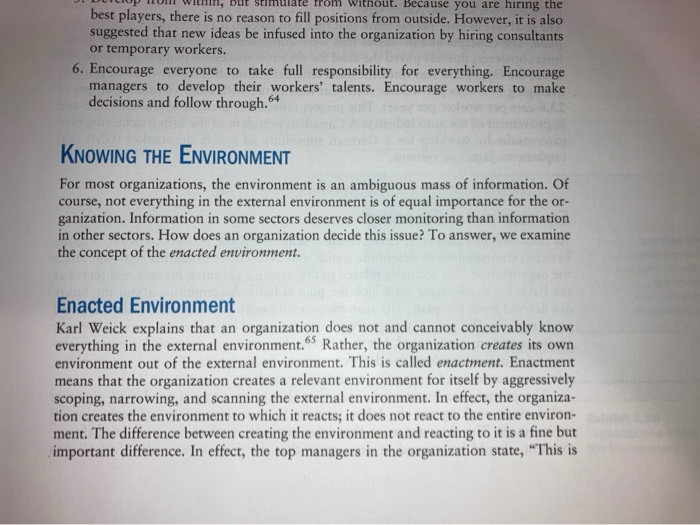
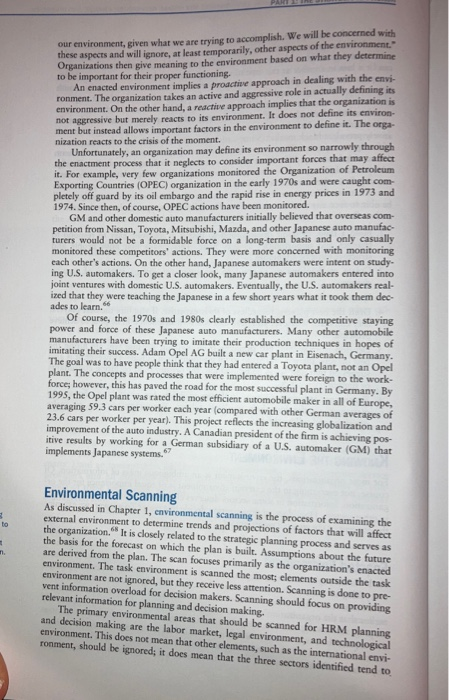
Because you are hiring the best players, there is no reason to fill positions from outside. However, it is also suggested that new ideas be infused into the organization by hiring consultants or temporary workers. 6. Encourage everyone to take full responsibility for everything. Encourage managers to develop their workers' talents. Encourage workers to make decisions and follow through. 64 KNOWING THE ENVIRONMENT For most organizations, the environment is an ambiguous mass of information. Of course, not everything in the external environment is of equal importance for the or- ganization. Information in some sectors deserves closer monitoring than information in other sectors. How does an organization decide this issue? To answer, we examine the concept of the enacted environment. Enacted Environment Karl Weick explains that an organization does not and cannot conceivably know everything in the external environment. Rather, the organization creates its own environment out of the external environment. This is called enactment. Enactment means that the organization creates a relevant environment for itself by aggressively scoping, narrowing, and scanning the external environment. In effect, the organiza- tion creates the environment to which it reacts; it does not react to the entire environ- ment. The difference between creating the environment and reacting to it is a fine but important difference. In effect, the top managers in the organization state, This is our environment, given what we are trying to accomplish. We will be concerned with these aspects and will ignore, at least temporarily, other aspects of the environment." Organizations then give meaning to the environment based on what they determine to be important for their proper functioning. An enacted environment implies a proactive approach in dealing with the envi- ronment. The organization takes an active and aggressive role in actually defining its environment. On the other hand, a reactive approach implies that the organization is not aggressive but merely reacts to its environment. It does not define its environ- ment but instead allows important factors in the environment to define it. The orga nization reacts to the crisis of the moment Unfortunately, an organization may define its environment so narrowly through the enactment process that it neglects to consider important forces that may affect it. For example, very few organizations monitored the Organization of Petroleum Exporting Countries (OPEC) organization in the early 1970s and were caught com- pletely off guard by its oil embargo and the rapid rise in energy prices in 1973 and 1974. Since then, of course, OPEC actions have been monitored. GM and other domestic auto manufacturers initially believed that overseas com- petition from Nissan, Toyota, Mitsubishi, Mazda, and other Japanese auto manufac- turers would not be a formidable force on a long-term basis and only casually monitored these competitors' actions. They were more concerned with monitoring each other's actions. On the other hand, Japanese automakers were intent on study ing U.S. automakers. To get a closer look, many Japanese automakers entered into joint ventures with domestic U.S. automakers. Eventually, the U.S. automakers real- ized that they were teaching the Japanese in a few short years what it took them dec- ades to learn. Of course, the 1970s and 1980s clearly established the competitive staying power and force of these Japanese auto manufacturers. Many other automobile manufacturers have been trying to imitate their production techniques in hopes of imitating their success. Adam Opel AG built a new car plant in Eisenach, Germany. The goal was to have people think that they had entered a Toyota plant, not an Opel plant. The concepts and processes that were implemented were foreign to the work- force; however, this has paved the road for the most successful plant in Germany. By 1995, the Opel plant was rated the most efficient automobile maker in all of Europe, averaging 59.3 cars per worker each year (compared with other German averages of 23.6 cars per worker per year). This project reflects the increasing globalization and improvement of the auto industry. A Canadian president of the firm is achieving pos- itive results by working for a German subsidiary of a U.S. automaker (GM) that implements Japanese systems. 3 to n. Environmental Scanning As discussed in Chapter 1, environmental scanning is the process of examining the external environment to determine trends and projections of factors that will affect the organization. It is closely related to the strategic planning process and serves as the basis for the forecast on which the plan is built. Assumptions about the future are derived from the plan. The scan focuses primarily as the organization's enacted environment. The task environment is scanned the most; clements outside the task environment are not ignored, but they receive less attention. Scanning is done to pre- vent information overload for decision makers. Scanning should focus on providing relevant information for planning and decision making. The primary environmental areas that should be scanned for HRM planning and decision making are the labor market, legal environment, and technological environment. This does not mean that other elements, such as the international envi- ronment, should be ignored, it does mean that the three sectors identified tend to
Step by Step Solution
There are 3 Steps involved in it
1 Expert Approved Answer
Step: 1 Unlock

Question Has Been Solved by an Expert!
Get step-by-step solutions from verified subject matter experts
Step: 2 Unlock
Step: 3 Unlock
 Study Help