







Question: Many mathematical models in engineering use exponential function. The general form of the exponential decay function is: (t)=Ae^(-T/t) where A is the initial value at
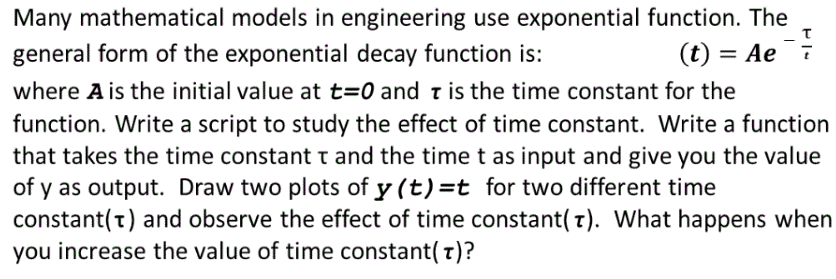 Many mathematical models in engineering use exponential function. The general form of the exponential decay function is: (t)=Ae^(-T/t) where A is the initial value at t=0 and T is the time constant for the function. Write a script to study the effect of time constant. Write a function that takes the time constant T and the time t as input and give you the value of y as output. draw two plots of y(t)=t for two different time constant (T) and observe the effect of time constant (T). What happens when you increase the value of time constant(T)?
Many mathematical models in engineering use exponential function. The (t) general form of the exponential decay function is: Ae where A is the initial value at t 0 and t is the time constant for the function. Write a script to study the effect of time constant. Write a function that takes the time constant t and the time t as input and give you the value of y as output. Draw two plots of y (t) t for two different time constant (t) and observe the effect of time constant(T). What happens when you increase the value of time constant(T)? Many mathematical models in engineering use exponential function. The (t) general form of the exponential decay function is: Ae where A is the initial value at t 0 and t is the time constant for the function. Write a script to study the effect of time constant. Write a function that takes the time constant t and the time t as input and give you the value of y as output. Draw two plots of y (t) t for two different time constant (t) and observe the effect of time constant(T). What happens when you increase the value of time constant(T)
Step by Step Solution
There are 3 Steps involved in it

Get step-by-step solutions from verified subject matter experts
 Study Help