



Question: Many of the first computers built ( including 1 9 4 6 ' s ENIAC ) worked in base 1 0 . Since video screens
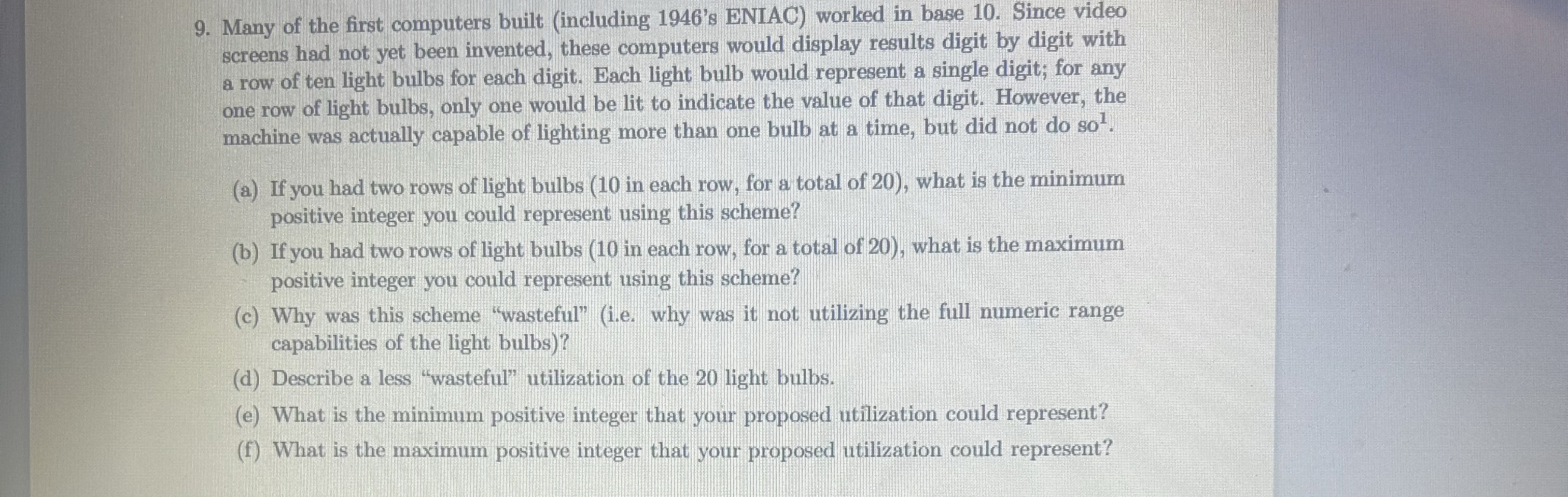
Many of the first computers built including s ENIAC worked in base Since video screens had not yet been invented, these computers would display results digit by digit with a row of ten light bulbs for each digit. Each light bulb would represent a single digit; for any one row of light bulbs, only one would be lit to indicate the value of that digit. However, the machine was actually capable of lighting more than one bulb at a time, but did not do so
a If you had two rows of light bulbs in each row, for a total of what is the minimum positive integer you could represent using this scheme?
b If you had two rows of light bulbs in each row, for a total of what is the maximum positive integer you could represent using this scheme?
c Why was this scheme "wasteful" ie why was it not utilizing the full numeric range capabilities of the light bulbs
d Describe a less "wasteful" utilization of the light bulbs.
e What is the minimum positive integer that your proposed utilization could represent?
f What is the maximum positive integer that your proposed utilization could represent?
Step by Step Solution
There are 3 Steps involved in it
1 Expert Approved Answer
Step: 1 Unlock

Question Has Been Solved by an Expert!
Get step-by-step solutions from verified subject matter experts
Step: 2 Unlock
Step: 3 Unlock