







Question: Maple Leaf Shoes Ltd . is a medium - sized manufaeftusereghleather and vinyl shoes located near Wilmington, Ontario. It began operations in 1 9 6
Maple Leaf Shoes Ltd is a mediumsized manufaeftusereghleather and vinyl shoes located near Wilmington, Ontario. It began operations in and currently employs about persons in its Ontario plant and some more in offices and warehouses throughout Canada and internationally. More information on the firm and its operations is provided at the end of Chapter
The cost of production at Maple Leaf Shoes has been rising slowly but steadily. Labour costs currently account for over percent of manufacturing costs and have been increasing rapidly. The productivity levels of the employees have not shown any significant increase in recent years. Concerned with the situation, Maple Leaf Shoes' management has been attempting to introduce more sophisticated technology in its various plants. More capitalintensive, automated production processes are being considered by the management as part of the solution to the productivity challenge facing the firm.
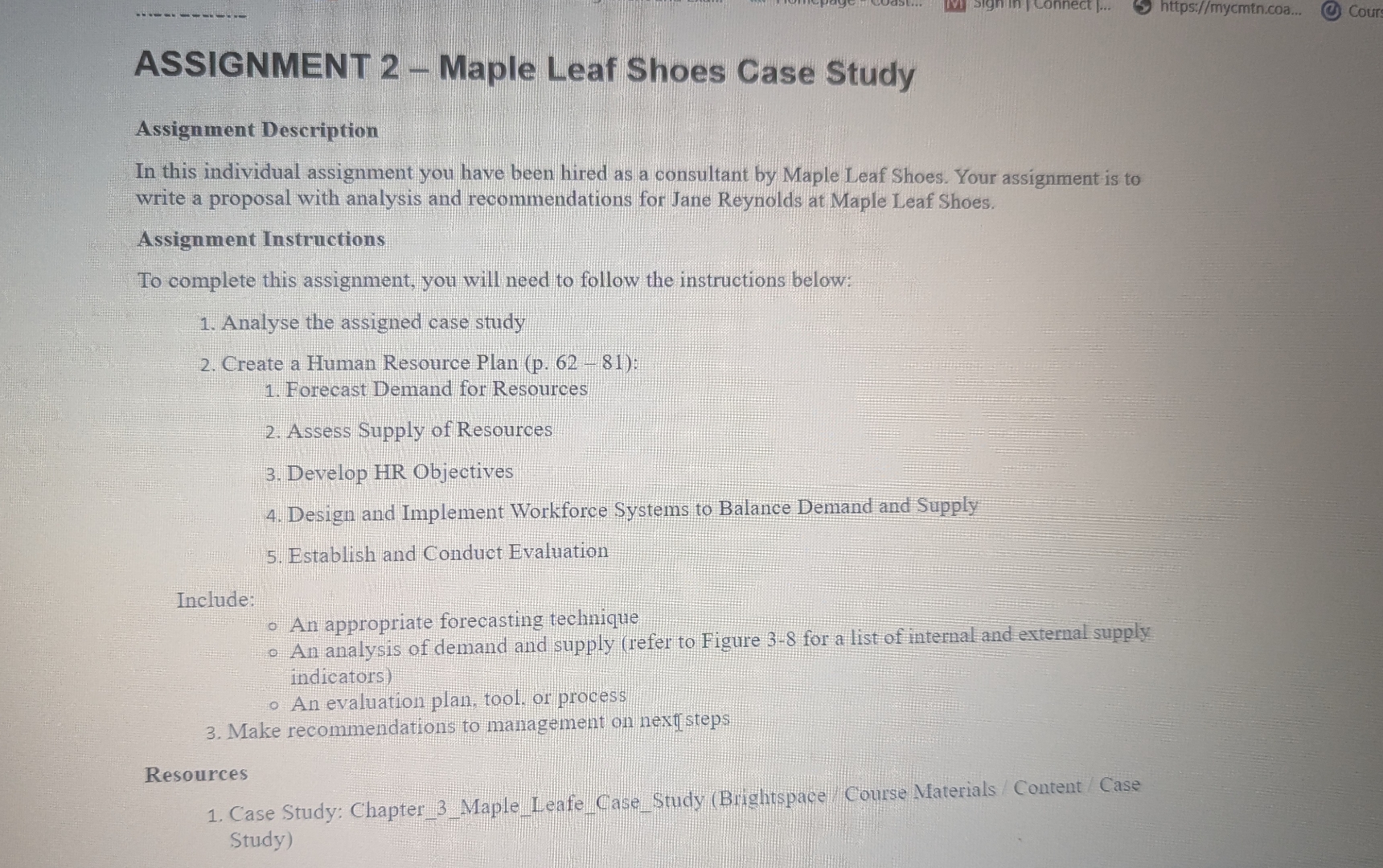
The company is now in the midst of a strategic reorientation. As part of the exercise, Robert Clark, the president, has asked Jane Reynolds, Special Assistant in the Human Resources Division in the firm, to prepare a human resource forecast for the company.
Reynolds examined the company records that were likely to help her in her task. To her dismay, she found that very few plans or systematic procedures existed that would assist her in human resource planning. She decided to begin her analysis with the division in charge of shoes for children and youths commonlyand half humorouslyreferred to as the "juvenile division" in the company It currently employed fewer than persons in total and seemed to have the most complete records related to employee hiring, transfers, exits, and training. But even here, production and labour statistics for several years were incomplete or inaccurate.
Her survey of company records resulted in the information given below. Reynolds also met with key managers in the firm including Clark several times to find out more about their goals and action plans for the immediate future. Her findings are also summarized below.
All of the juvenile division's manufacturing operations were located in Ontario. Reynolds considered that there were four distinct manufacturing stages: cutting, shaping, assembling, and finishing. Of course, each of these stages contained several tasks; for example, "shaping" involved several subtasks such as bending the leather, vinyl, or plastic; making lace holes; attaching reinforcers, padding, and so on Reynolds also found that the operations progressively became more complex, from "cutting" to "finishing." Workers were normally hired as cutters and then progressively moved up to do shaping, assembling, and then finishing as they gained experience.
Cutting and shaping were more repetitive and boring, while assembling and finishing required greater attention and expertise and therefore were more challenging. Despite this, a few workers who were doing assembling chose to do shaping since the latter almost always fetched them more overtime work and significantly higher earnings No one doing final finishing had so far asked for reassignment to shaping or cutting. Employee movements during among the four operations are shown in Table
TABLE
Movement of Workers across the Four Operations
tableFrom:To:CuttingShaping,Assembling Finishing Exits,Total,,,CuttingShapingAssemblingFinishingTotal at the end after,,,,,,accounting for exits
The firm's labour productivity has not shown any significant improvement in the recent past. This has also been true of the juvenile division. Table shows the production and staffing records of the entire division.
TABLE
Production and Workforce Statistics in the Juvenile Division
tableYearProduction s of pairsNumber of Employees
tableExit Fullscreen
Through the introduction of computerintegrated technology and automated work systems, the firm expects to increase the division's productivity level by percent in over its record. Much of this will be achieved by automating much of the cutting. operations. It is expected that automation will reduce the need for percent of cutters. The productivity of other operations namely shaping, assembling, and finishing is also expected to increase, but at lower levels than in the case of cutting. The productivity improvement in these operations is expected to be equal. Workers who lose their jobs as a result of automation and computerization will receive severance pay.
Compared to other divisions, the juvenile division has an aging workforce. On average, to pe
Step by Step Solution
There are 3 Steps involved in it
1 Expert Approved Answer
Step: 1 Unlock

Question Has Been Solved by an Expert!
Get step-by-step solutions from verified subject matter experts
Step: 2 Unlock
Step: 3 Unlock
 Study Help