







Question: Marias changes to the department only resulted in temporary changes in behavior. This is best explained by which of the following terms? Multiple Choice Equity
Marias changes to the department only resulted in temporary changes in behavior. This is best explained by which of the following terms?
Multiple Choice
Equity Theory
Expectancy Theory
Hertzbergs Two-Factor Theory
Maslows Hierarchy of Needs
The Hawthorne Effect
Which of the following factors from Hertzbergs Two-Factor theory should Maria address in order to improve employee motivation?
Multiple Choice
closer supervision
better working conditions
advancement opportunities
increased job security
clarify company policies
Maria recognized that beyond their basic job description, employees do not identify with any specific goals individualized given their specific needs and interests. Which of the following management techniques should Maria consider using?
Multiple Choice
Equity theory
Management by objectives
Hertzbergs two-factor model
Expectancy theory
Theory X of motivation
The work has been divided across employees, so that each employee completes a simple task, and only completes that simple task on every project. Maria recognizes that some employees are becoming bored, and that there is value in understanding the work of other employees. Maria should reorganize the employees based on
Multiple Choice
job simplification.
equity theory.
expectancy theory.
job rotation.
job sharing.
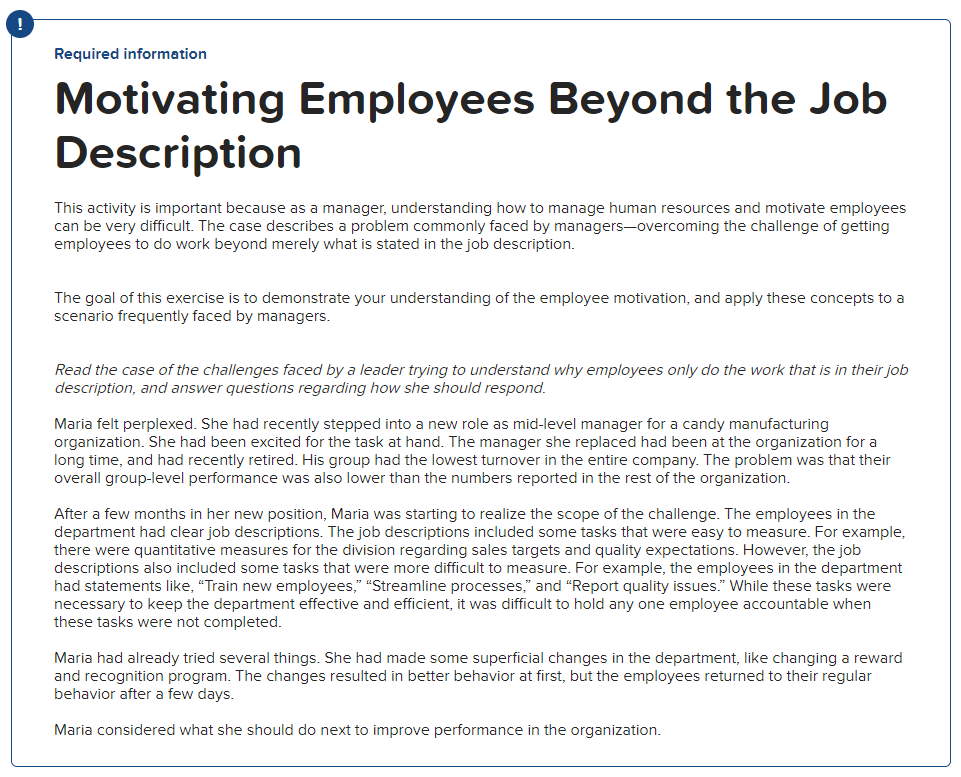
Motivating Employees Beyond the Job Description This activity is important because as a manager, understanding how to manage human resources and motivate employees can be very difficult. The case describes a problem commonly faced by managers-overcoming the challenge of getting employees to do work beyond merely what is stated in the job description. The goal of this exercise is to demonstrate your understanding of the employee motivation, and apply these concepts to a scenario frequently faced by managers. Read the case of the challenges faced by a leader trying to understand why employees only do the work that is in their job description, and answer questions regarding how she should respond. Maria felt perplexed. She had recently stepped into a new role as mid-level manager for a candy manufacturing organization. She had been excited for the task at hand. The manager she replaced had been at the organization for a long time, and had recently retired. His group had the lowest turnover in the entire company. The problem was that their overall group-level performance was also lower than the numbers reported in the rest of the organization. After a few months in her new position, Maria was starting to realize the scope of the challenge. The employees in the department had clear job descriptions. The job descriptions included some tasks that were easy to measure. For example, there were quantitative measures for the division regarding sales targets and quality expectations. However, the job descriptions also included some tasks that were more difficult to measure. For example, the employees in the department had statements like, "Train new employees," "Streamline processes," and "Report quality issues." While these tasks were necessary to keep the department effective and efficient, it was difficult to hold any one employee accountable when these tasks were not completed. Maria had already tried several things. She had made some superficial changes in the department, like changing a reward and recognition program. The changes resulted in better behavior at first, but the employees returned to their regular behavior after a few days. Maria considered what she should do next to improve performance in the organization
Step by Step Solution
There are 3 Steps involved in it

Get step-by-step solutions from verified subject matter experts
 Study Help