







Question: Mark all that apply. If A and B are regular languages, then A((BA)A) is regular also. All regular languages are finite. All finite languages are
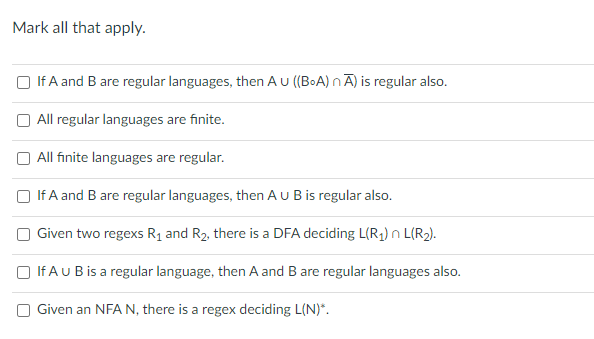
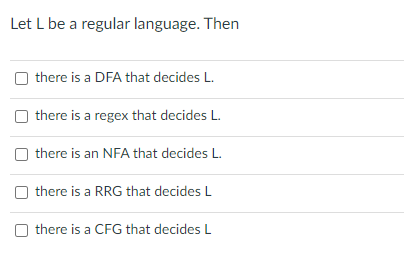
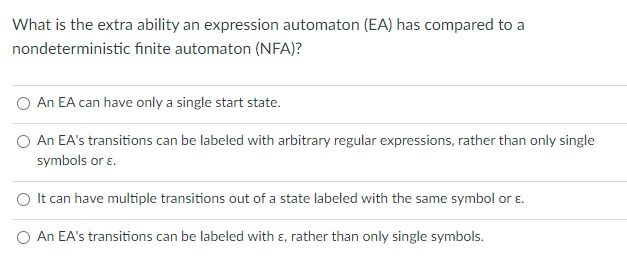
Mark all that apply. If A and B are regular languages, then A((BA)A) is regular also. All regular languages are finite. All finite languages are regular. If A and B are regular languages, then AB is regular also. Given two regexs R1 and R2, there is a DFA deciding L(R1)L(R2). If AB is a regular language, then A and B are regular languages also. Given an NFA N, there is a regex deciding L(N). Let L be a regular language. Then there is a DFA that decides L. there is a regex that decides L. there is an NFA that decides L. there is a RRG that decides L there is a CFG that decides L What is the extra ability an expression automaton (EA) has compared to a nondeterministic finite automaton (NFA)? An EA can have only a single start state. An EA's transitions can be labeled with arbitrary regular expressions, rather than only single symbols or . It can have multiple transitions out of a state labeled with the same symbol or . An EA's transitions can be labeled with , rather than only single symbols
Step by Step Solution
There are 3 Steps involved in it

Get step-by-step solutions from verified subject matter experts
 Study Help