







Question: Markups and Price Setting OQuestion 4 Time flapsed Atemet d Dectats 2 Minutes. 13 Second The distinction between markup based on selling price and
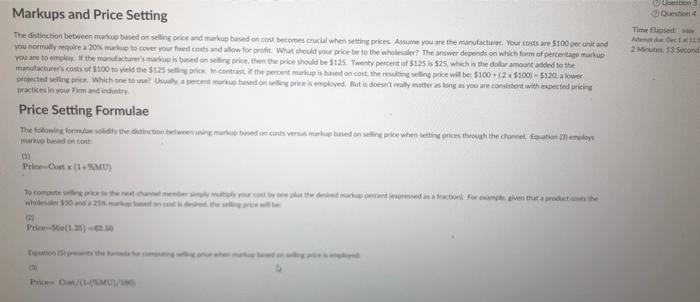

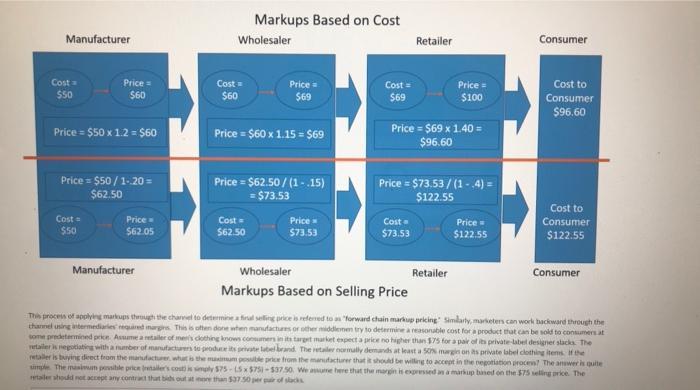
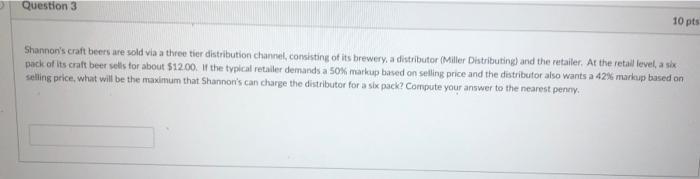
Markups and Price Setting OQuestion 4 Time flapsed Atemet d Dectats 2 Minutes. 13 Second The distinction between markup based on selling price and markup based on cost becomes crucial when setting prices. Assume you are the manufacturer. Your costs are $100 per unit and you normally requaire a 20% markup to cover your faed costs and allow for profit. What should your price be to the wholesaler? The answer depends on which form of percentage marku you are to employ. If the manufacturer's markup is based on selling price, then the price should be $125. Twenty percerit of $125 is $25, which in the dollr amount added to the manufacturers costs of $100 to yield the $125 selling price. In contrast, it the percent markup is based on cost, the resulting seling price will be: $100 + (2 x $1001 - $120, a lower projected wlling price. Which one to une Usually, a percent markup based on selling price is enmoloyed. But is doesn't eally matter as long an you are consistent with expected pricing practices in your Flem and induntry Price Setting Formulae The following formtasolidity the ditinction between uning marke based on cunts verun markup based on selling price when setting pres through the channet. Equation employs markue based on cont (1 Price-Cost x (1MU) To compute sg p the net cha meber m y cot e p the desied urkp peent lespressed ana fractioni For eample given that a product cot the wholesaler 0 d s25 ted ntde the slling e Prieoe(10)-2.0 taation i the at g Price C/(-MU/I) Pricing Through the Channel Manutacturers often are interested in determining a sugested retail price for their products that may even be preprinted on packages. Vou alrdy krnow how this in done. The manutacturer simply bepins with its own costs and required margins and works forward through the distritution channel computing price at each level gven the marpns required by each intermediary. Assune the manufacturer faces cants of S50 ant requires a 20 margin. The wholesaler needs a 15N margin and the retailer demands a 4% margin. What supested retail seling price lprice to the comsume will provide all channel members with their desired margins Figure 1 ilustrates the logic and provides the computations when the magin is operationalized as either markuo bined on selling price or markup based on cent The top halt of Figure 3ustrates markup based on cest. The end result is a sutested selling price to consumers of $96.00 The bottom part of Fipre 3 projectsa spested selling price of $122.55 when markup based on seling price in uned Markups Based on Cost Manufacturer Wholesaler Retailer Consumer Cost= $50 Price = $60 Cost $60 Cost $69 Price = Price = Cost to $69 $100 Consumer $96.60 Price = $50 x 1.2 = $60 Price = $60 x 1.15 = S69 Price = $69 x 1.40 = $96.60 Price = $62.50 / (1-.15) = $73.53 Price = $50 /1-20 = Price = $73.53/ (1 - 4) = $122.55 $62.50 Cost to Cost= Price Price $62.05 Cost= S62.50 Cost $73.53 Price $122.55 Consumer $50 S73.53 $122.55 Manufacturer Wholesaler Retailer Consumer Markups Based on Selling Price Ths process of applying markups through the charvel to determinea fal selling price is referred to an "forward chain markup pricing Simlarty, marketern can work backward through the thannel uning termediaries required imarg. This is oten done when manufachaes or other middlenen try to determine a reasonuble cost for a product that can be sold to consumers at some predetermined price. Asume a retailer of mers dothing knows consumers in its target market espect a price no higher than $75 for a pair of its private labet designer slacks The vetailer is negotiating with a number of manufacturers to produe its private label brand. The retailer nomally demands at least a SO margin on ts private label clothing items if the retaler is buying dieect from the manufacturer simple The masimum pesitle price retailer's cost is simply $75-LSx $75-$37.50. We aume here that the margin is exprerssed an a markup baned on the S75 selling price. The ertailer should net accept any contract that bids out at nere than 537.50 per p of slacs mainum posble price from the manufacturer that it should be willing to acceot in the negotiation proce The anwer is quite Question 3 10 pts Shannon's craft beers are sold via a three tier distribution channel, consisting of its brewery, a distributor (Miller Distributing) and the retailer. At the retail level, a six pack of its craft beer sells for about $12.00. If the typical retailer demands a 50% markup based on selling price and the distributor also wants a 42% markup based on selling price, what will be the maximum that Shannon's can charge the distributor for a six pack? Compute your answer to the nearest penny.
Step by Step Solution
3.41 Rating (167 Votes )
There are 3 Steps involved in it
Solution 3 Computation of maximum sale price for Shannons six pack beer The retailer sells a six pa... View full answer

Get step-by-step solutions from verified subject matter experts
 Study Help