







Question: Mastery Problem: Decision Making using Differential Analysis Decision making involves quantifying relevant revenues and costs with the goal of maximizing net cash flows. In many
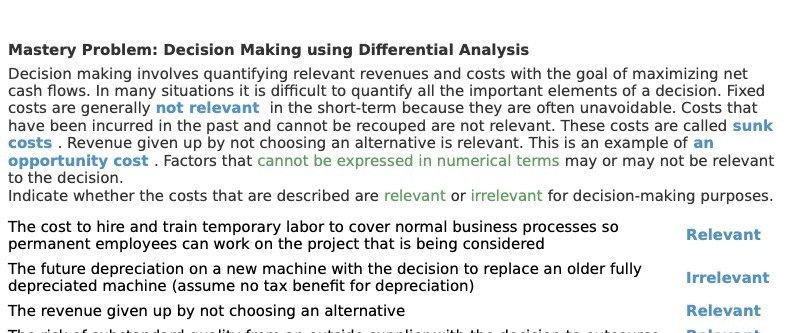
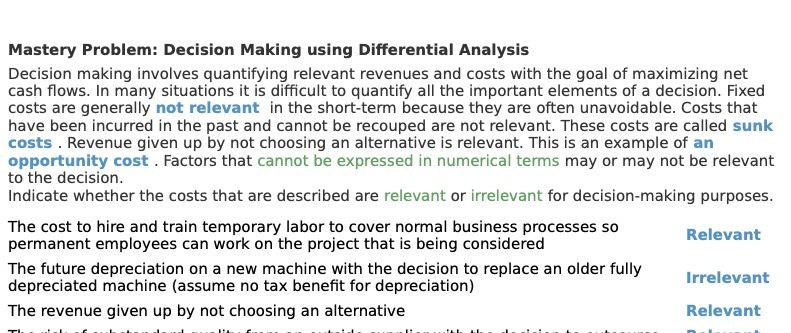
Mastery Problem: Decision Making using Differential Analysis Decision making involves quantifying relevant revenues and costs with the goal of maximizing net cash flows. In many situations it is difficult to quantify all the important elements of a decision. Fixed costs are generally not relevant in the short-term because they are often unavoidable. Costs that have been incurred in the past and cannot be recouped are not relevant. These costs are called sunk costs . Revenue given up by not choosing an alternative is relevant. This is an example of an opportunity cost . Factors that cannot be expressed in numerical terms may or may not be relevant to the decision. Indicate whether the costs that are described are relevant or irrelevant for decision-making purposes. The cost to hire and train temporary labor to cover normal business processes so permanent employees can work on the project that is being considered Relevant The future depreciation on a new machine with the decision to replace an older fully depreciated machine (assume no tax benefit for depreciation) Irrelevant The revenue given up by not choosing an alternative Relevant
Step by Step Solution
There are 3 Steps involved in it

Get step-by-step solutions from verified subject matter experts
 Study Help