



Question: Mastery Problem: Evaluating Decentralized Operations BOR CPAs, Inc. BOR CPAS, Inc. is a closely held corporation owned by three stockholders who used the initials of
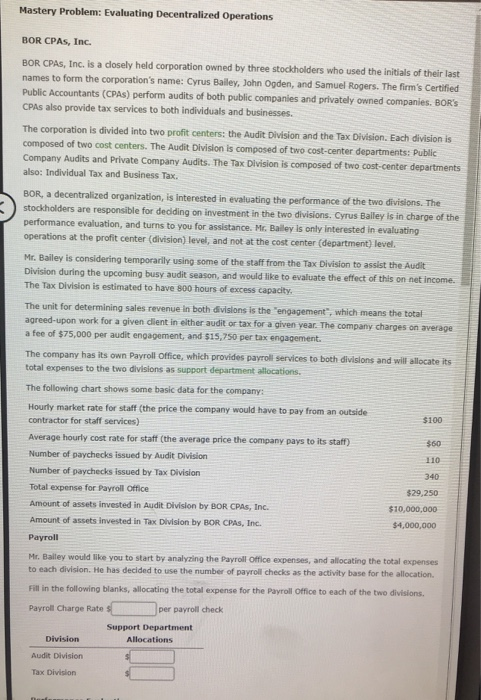
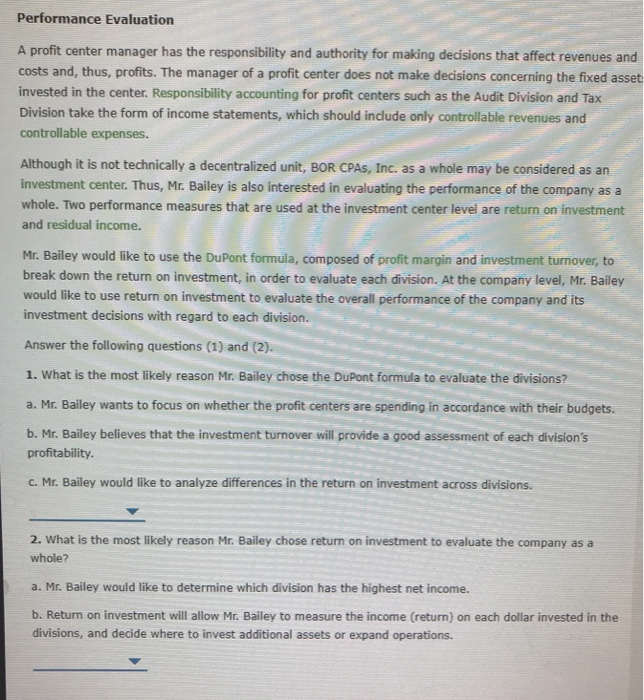
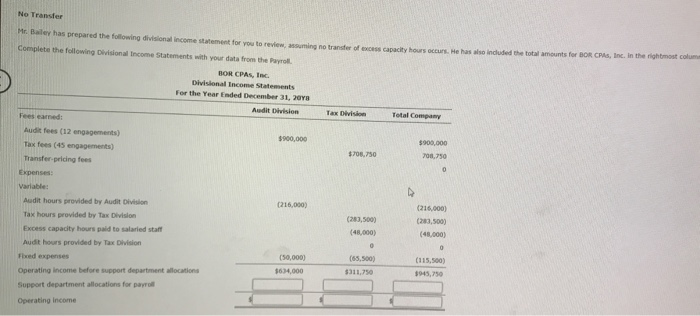
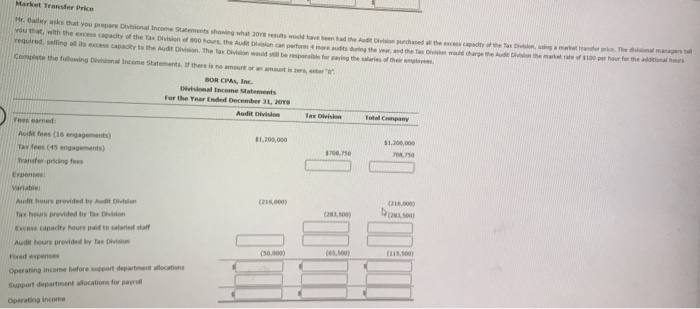
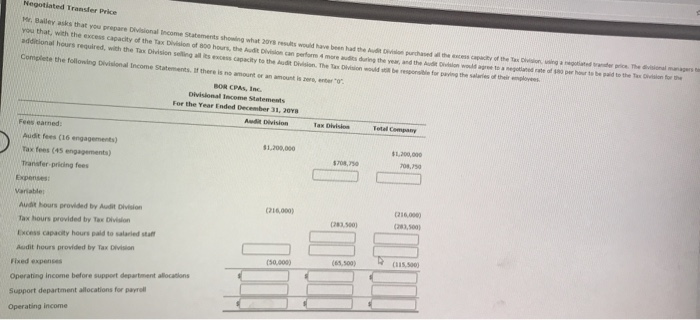
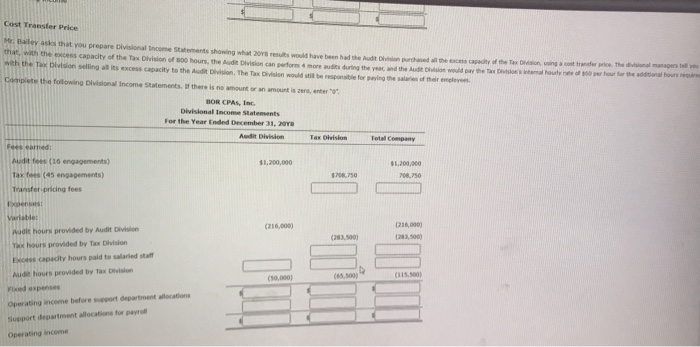
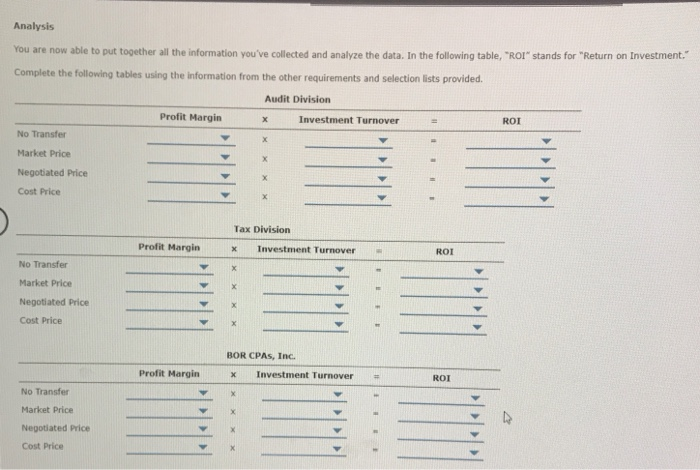
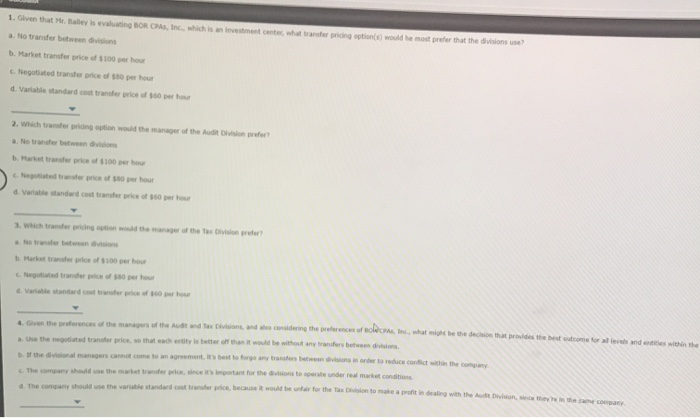
Mastery Problem: Evaluating Decentralized Operations BOR CPAs, Inc. BOR CPAS, Inc. is a closely held corporation owned by three stockholders who used the initials of their last names to form the corporation's name: Cyrus Bailey, John Ogden, and Samuel Rogers. The firm's Certified Public Accountants (CPA) perform audits of both public companies and privately owned companies. BOR'S CPAs also provide tax services to both individuals and businesses. The corporation is divided into two profit centers: the Audit Division and the Tax Division. Each division is composed of two cost centers. The Audit Division is composed of two cost-center departments: Public Company Audits and Private Company Audits. The Tax Division is composed of two cost-center departments also: Individual Tax and Business Tax. BOR, a decentralized organization, is interested in evaluating the performance of the two divisions. The stockholders are responsible for deciding on investment in the two divisions. Cyrus Bailey is in charge of the performance evaluation, and turns to you for assistance. Mr. Bailey is only interested in evaluating operations at the profit center (division) level, and not at the cost center (department) level. Mr. Bailey is considering temporarily using some of the staff from the Tax Division to assist the Audit Division during the upcoming busy audit season, and would like to evaluate the effect of this on net income. The Tax Division is estimated to have 800 hours of excess capacity The unit for determining sales revenue in both divisions is the 'engagement", which means the total agreed-upon work for a given client in either audit or tax for a given year. The company charges on average a fee of $75,000 per audit engagement, and $15,750 per tax engagement. The company has its own Payroll Office, which provides payroll services to both divisions and will allocate its total expenses to the two divisions as support department allocations The following chart shows some basic data for the company: Hourly market rate for staff (the price the company would have to pay from an outside $100 contractor for staff services) Average hourly cost rate for staff (the average price the company pays to its staff) $60 Number of paychecks issued by Audit Division 110 Number of paychecks issued by Tax Division 340 Total expense for Payroll Office $29,250 Amount of assets invested in Audit Division by BOR CPAS, Inc. $10,000,000 Amount of assets invested in Tax Division by BOR CPAS, Inc. $4,000,000 Payroll Mr. Balley would like you to start by analyzing the Payroll Office expenses, and allocating the total expenses to each division. He has decided to use the number of payroll checks as the activity base for the allocation. Fill in the following blanks, allocating the total expense for the Payroll Office to each of the two divisions. Payroll Charge Rates per payroll check Support Department Division Allocations Audit Division Tax Division Performance Evaluation A profit center manager has the responsibility and authority for making decisions that affect revenues and costs and, thus, profits. The manager of a profit center does not make decisions concerning the fixed asset invested in the center. Responsibility accounting for profit centers such as the Audit Division and Tax Division take the form of income statements, which should include only controllable revenues and controllable expenses. Although it is not technically a decentralized unit, BOR CPAS, Inc. as a whole may be considered as an investment center. Thus, Mr. Bailey is also interested in evaluating the performance of the company as a whole. Two performance measures that are used at the investment center level are return on investment and residual income. Mr. Bailey would like to use the DuPont formula, composed of profit margin and investment turnover, to break down the return on investment, in order to evaluate each division. At the company level, Mr. Bailey would like to use return on investment to evaluate the overall performance of the company and its investment decisions with regard to each division. Answer the following questions (1) and (2). 1. What is the most likely reason Mr. Bailey chose the DuPont formula to evaluate the divisions? a. Mr. Bailey wants to focus on whether the profit centers are spending in accordance with their budgets. b. Mr. Bailey believes that the investment turnover will provide a good assessment of each division's profitability. c. Mr. Bailey would like to analyze differences in the return on investment across divisions. 2. What is the most likely reason Mr. Bailey chose return on investment to evaluate the company as a whole? a. Mr. Bailey would like to determine which division has the highest net income. b. Return on investment will allow Mr. Bailey to measure the income (return) on each dollar invested in the divisions, and decide where to invest additional assets or expand operations. No Transfer Mr. Bailey has prepared the following divisional income statement for you to review, wing no transfer of excess capacity hours occurs. He has also included the total amounts for BOR CP, Inc. in the rightmost column Complete the following Divisional Income Statements with your data from the Payroll BOR CPAS, Inc Divisional Income Statements For the Year Ended December 31, 2018 Audit Division Tax Division Total Company Fees earned Audit fees (12 engagements) $900,000 $900,000 Tax fees (45 engagements) $700.750 700.750 Transfer pricing fees 0 Expenses Variable: Audit hours provided by Audit Division (216,000) (216,000) Tax hours provided by Tax Division (283,5001 (283,500) Excess capacity hours paid to salaried staff (48,000) (45.000) Audit hours provided by Tax Division 0 (50,000) (65,500) bred expenses (115.500) $634,000 $311,750 Operating Income before support department locations $945,750 Support department allocations for par Operating income 0 Market Transfer Price M. Bailey asks that you prepare Divisional Income Stements showing what 20 results would have been had the purchased the capacity of selections and price. The divisional managers telt vou that with the excess coacity of the Tax Dion of 300 hours, the form mere udts during the year, and the would charge the Audition the marre 100 per hour for the additional hours required, selling all its excess coacy to the Audition. The tax would be for saying the ware of the complete the following Divisional Income Statements. If there is no mount amount is, BORCA, Inc. Disional Income Statements For the Year Ended December 31, 2018 Audit Division Tax Division Tot Com 1.200,000 $1,200,000 703.750 $700.750 Pescared Audit fees (16 engagements) Tax fees (45 engagements) Wander-riding fees Expenses Variable Audit hours provided by Audit Division Taxons provided by Tax Division Excess capacity hours paldto salaried staff Audit hours drovided by Tax Division (216.0001 216.000) (283) D. (50.000 (115.500 Operating income before support department allocations Support department locations for parell Operating income Negotiated Transfer Price Mr. Ballevaks that you prepare Divisional Income Statements showing what 2018 redes would have been has the abilion purchased the excess capacity of the town, and were. The most you that with the excess capacity of the Tax Division of 800 hours, the doctor more during the year, and the lion would be tonelated rate of 80 per hour to be paid to the Telur additional hours required, with the Tax Division selling all its excess capacity to the Audition. The would be for saving the stories of their employees Complete the following Divisional Income Statements. If there is no amount or an amount is to BORCAS, Divisione Statements For the Year Ended December 31, 2018 Ad Division Tax Olisi $1,200,000 $700.750 1.200,000 700.750 Fees canned Audit fees (16 engagements) Tax fees (45 engagements) Transfer pricing fees Expenses Variable Audit hours provided by Audit Division Tax hours provided by Tax Division Es capacity hours paid to salaried stall Audit hours provided by Tax Division Fixed expenses Operating income before support department allocations Support department allocations for payroll (210.000) 16.0000 (203,5001 (201.500 (50,000 (63.500) CHIS, 5000 Operating income Cost Transfer Price Bailey asks that you prepare Divisional Income Statements showing what 2015 results would have been had the sudt purchased at the end of the Tax Dancot trder price. The managers tell you that with the excess capacity of the tax Division of 100 hours, the con performare audits during the year, and the Audies would say the term out of per how to the detonatore with the Tax Division selling all its excess capacity to the lion. The Taxonwould be retur paving the sales of Complete the following Divisional Income Statements. If there is no mount or amount inter BOR CPAS, Inc. Divisional Income Statements For the Year Ended December 31, 2018 Audit Division Tax Division Total Company $1,200,000 $1.200.000 $700.750 708.750 (216,000) (216,000 1203.500 2.500 Fees earned: Audits (16 engagements) Taxes (45 engagements) Transfer pricing fees Ex Variablet Audit hours provided by Audit Division hours provided by Tax Division Es capacity hours paid to started to Alde hours provided by Tax Division Fixed expenses Operating income before sport department locations support department allocations for payroll Operating income (50,000) 6.500 CH. Analysis You are now able to put together all the information you've collected and analyze the data. In the following table, "ROI stands for "Return on Investment." Complete the following tables using the information from the other requirements and selection lists provided. Audit Division Profit Margin X Investment Turnover ROI No Transfer Market Price X X Negotiated Price Cost Price Tax Division Profit Margin x Investment Turnover ROI X No Transfer Market Price Negotiated Price Cost Price x X BOR CPAS, Inc. Profit Margin X Investment Turnover ROI No Transfer X X Market Price Negotiated Price Cost Price 1. Given that Mr. Balley is evaluating BORC, Inc. which is that transfer pricing Option) would be most prefer that the divisions ? Notransfer between divisions b. Mara transfer price of $100 thout Negotiated transfer price of 0 per hour d. Va standard cost traders 2. which trading to the manager of the ..No transfer between ceteros of hour Variable standard corner rice per hour Negotiated trader price of 80 per hour Var standard corner of the perences of the managers of the authors and concerns the percent, Inc., what might be the decision that provides the best outcome for at levels and entities within the Use the negotiated transfer price, so that each entity is better off than it would be without any transfers between division of the divisional managers cannot come to an agreement, its best to forge any trade between dions in order to reduce conflict within the company The company should use the market transfer price ince it's important for the divisions to entender real market conditions a. The company should use the variable standard corner price, because it would be used for the Tax Dion to make a profit in dealing with the Audit Division, ce there in the same can
Step by Step Solution
There are 3 Steps involved in it

Get step-by-step solutions from verified subject matter experts