



Question: Mastery Problem: Evaluating Variances from Standard Costs Sole Purpose Shoe Company Sole Purpose Shoe Company is owned and operated by Sarah Charles. The company manufactures
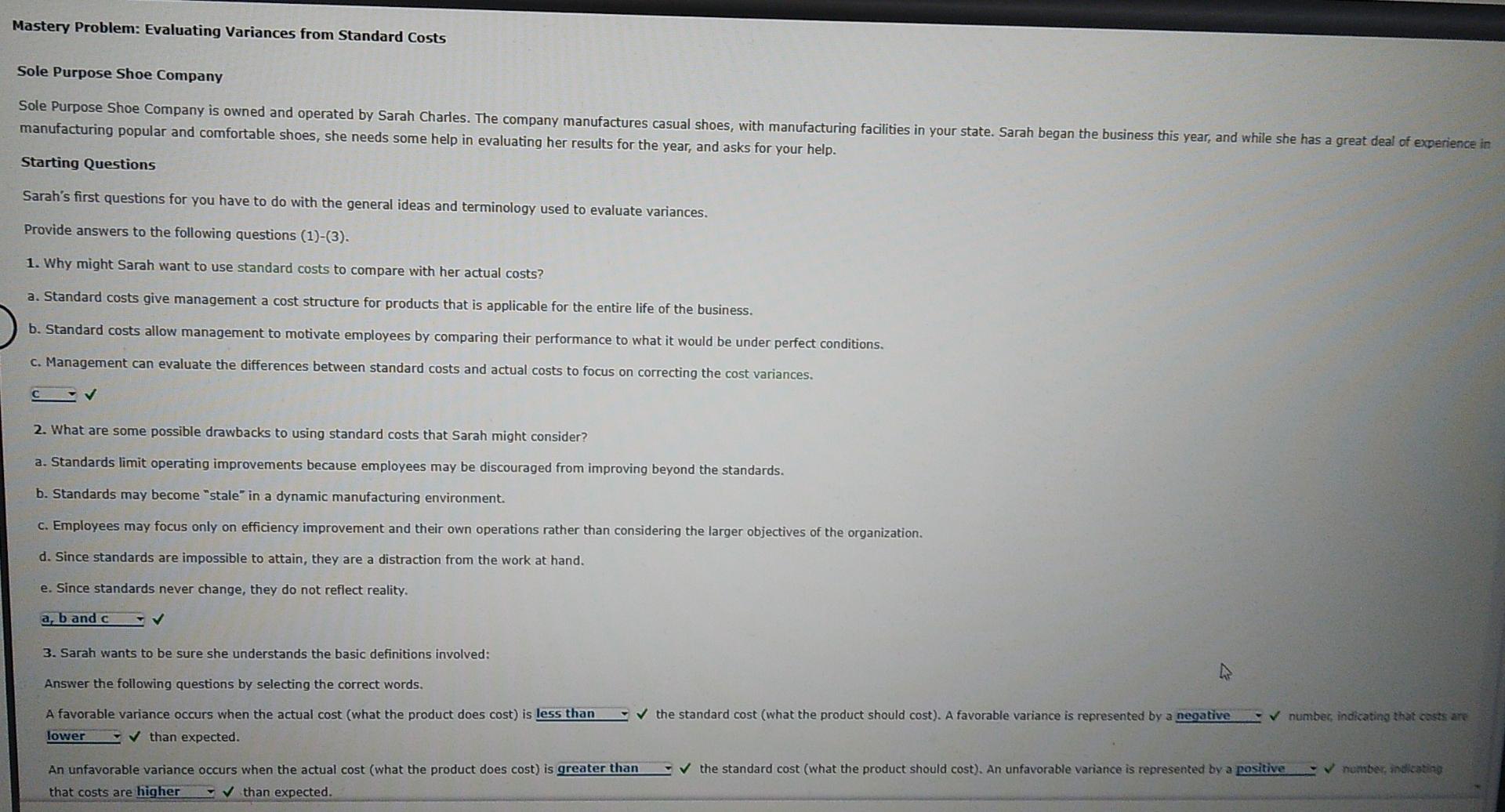
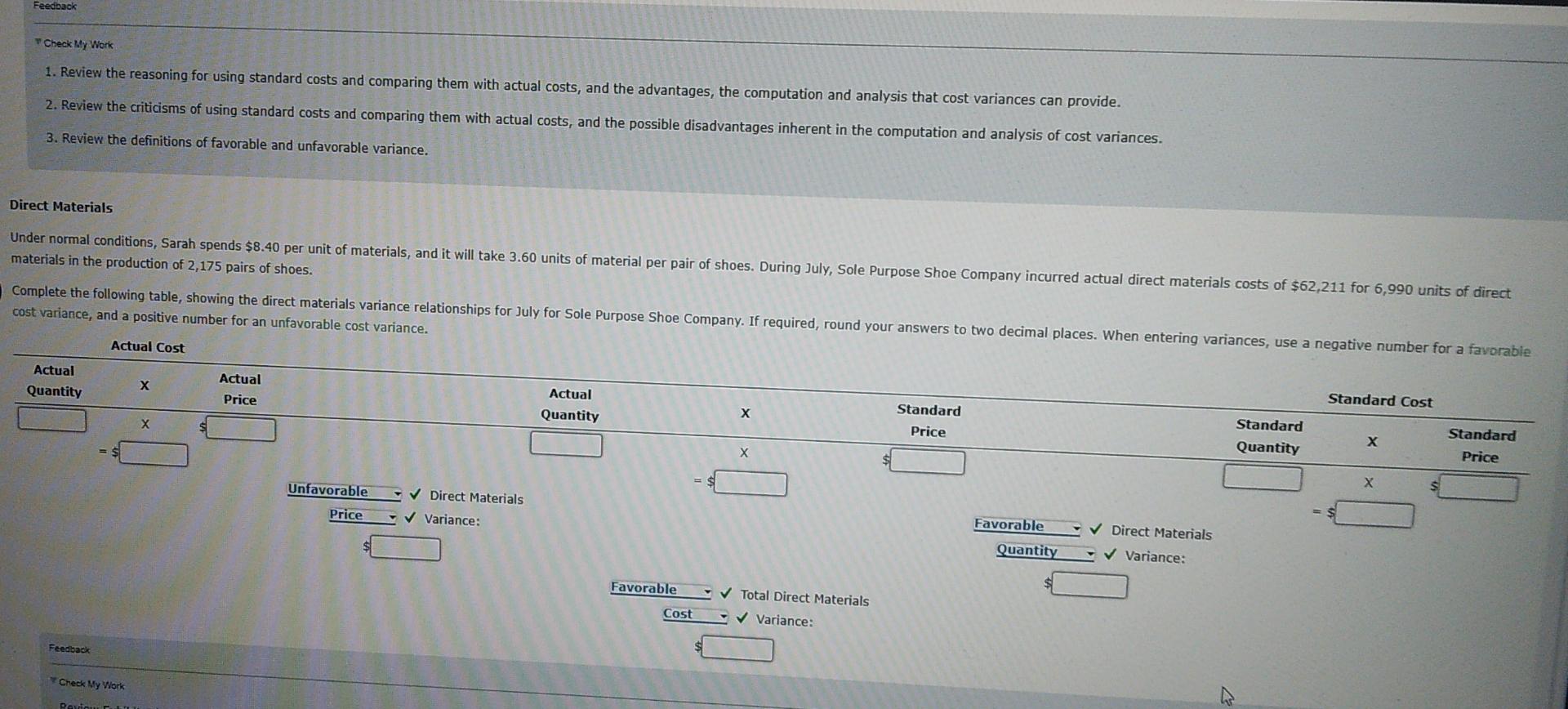
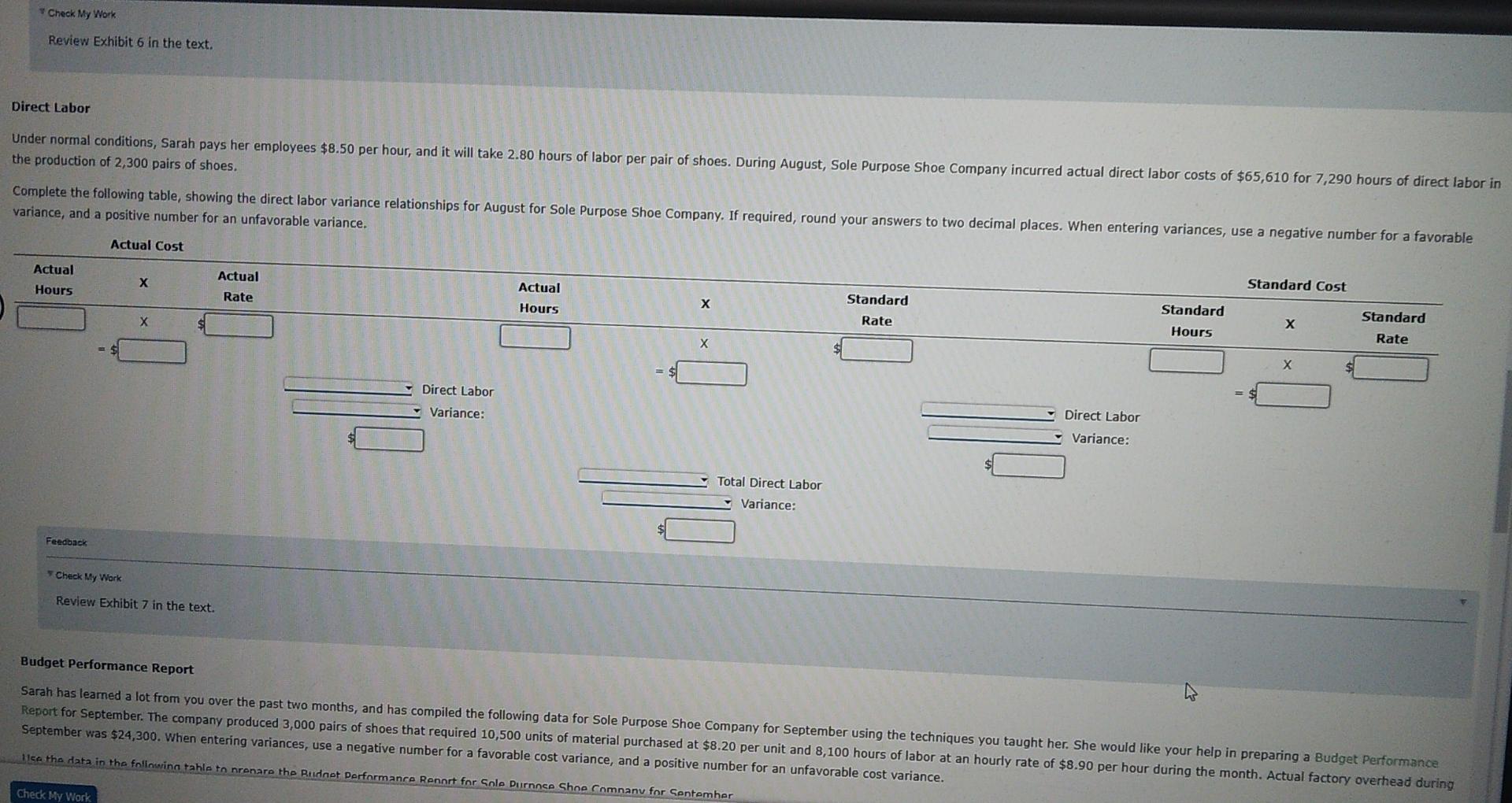
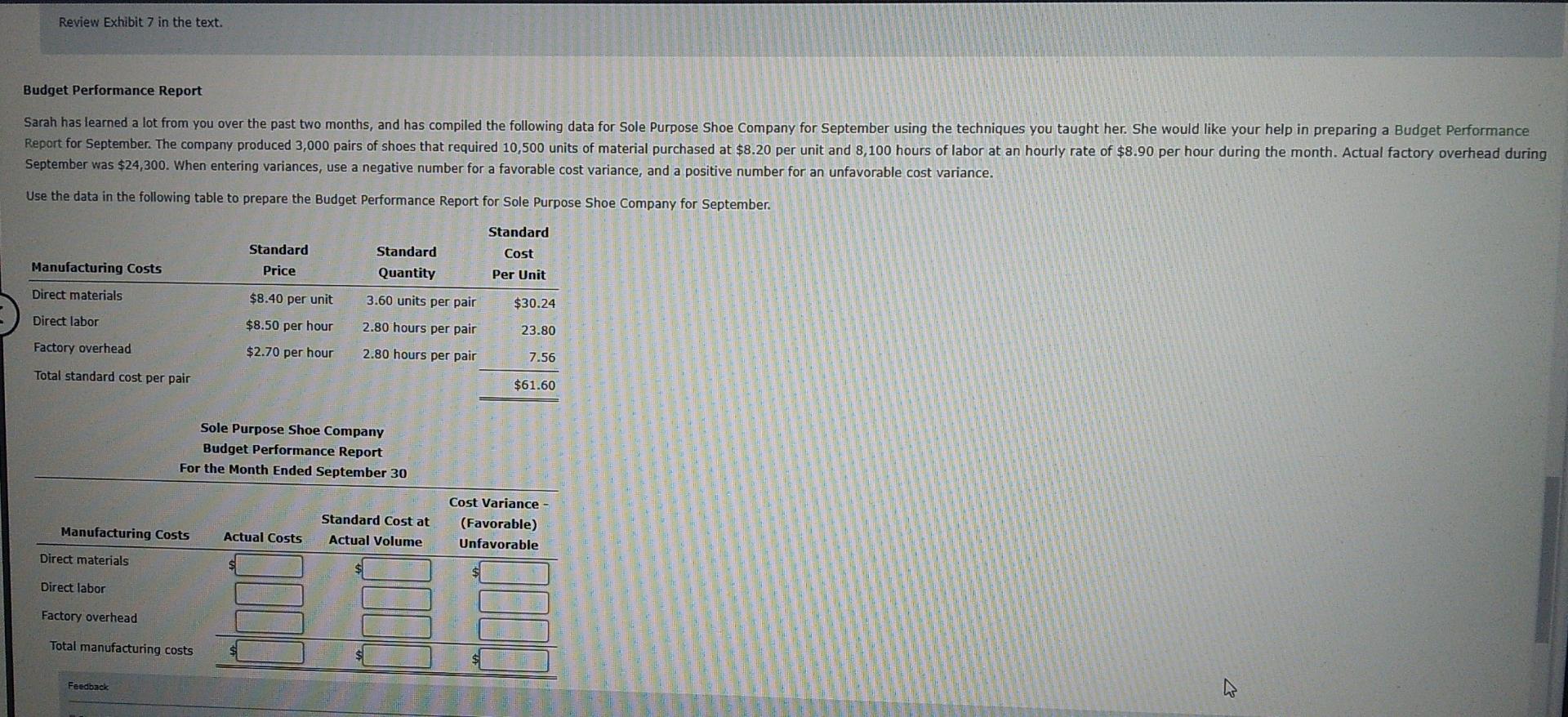
Mastery Problem: Evaluating Variances from Standard Costs Sole Purpose Shoe Company Sole Purpose Shoe Company is owned and operated by Sarah Charles. The company manufactures casual shoes, with manufacturing facilities in your state. Sarah began the business this year, and while she has a great deal of experience in manufacturing popular and comfortable shoes, she needs some help in evaluating her results for the year, and asks for your help. Starting Questions Sarah's first questions for you have to do with the general ideas and terminology used to evaluate variances. Provide answers to the following questions (1)-(3). 1. Why might Sarah want to use standard costs to compare with her actual costs? a. Standard costs give management a cost structure for products that is applicable for the entire life of the business. b. Standard costs allow management to motivate employees by comparing their performance to what it would be under perfect conditions. c. Management can evaluate the differences between standard costs and actual costs to focus on correcting the cost variances. C 2. What are some possible drawbacks to using standard costs that Sarah might consider? a. Standards limit operating improvements because employees may be discouraged from improving beyond the standards. b. Standards may become "stale" in a dynamic manufacturing environment. c. Employees may focus only on efficiency improvement and their own operations rather than considering the larger objectives of the organization. d. Since standards are impossible to attain, they are a distraction from the work at hand. e. Since standards never change, they do not reflect reality, a, b and c 3. Sarah wants to be sure she understands the basic definitions involved: Answer the following questions by selecting the correct words. A favorable variance occurs when the actual cost (what the product does cost) is less than lower V than expected. the standard cost (what the product should cost). A favorable variance is represented by a negative number, indicating that costs are the standard cost (what the product should cost). An unfavorable variance is represented by a positive number indicating An unfavorable variance occurs when the actual cost (what the product does cost) is greater than that costs are higher > than expected. Feedback Check My Work 1. Review the reasoning for using standard costs and comparing them with actual costs, and the advantages, the computation and analysis that cost variances can provide. 2. Review the criticisms of using standard costs and comparing them with actual costs, and the possible disadvantages inherent in the computation and analysis of cost variances. 3. Review the definitions of favorable and unfavorable variance. Direct Materials Under normal conditions, Sarah spends $8.40 per unit of materials, and it will take 3.60 units of material per pair of shoes. During July, Sole Purpose Shoe Company incurred actual direct materials costs of $62,211 for 6,990 units of direct materials in the production of 2,175 pairs of shoes. Complete the following table, showing the direct materials variance relationships for July for Sole Purpose Shoe Company. If required, round your answers to two decimal places. When entering variances, use a negative number for a favorable cost variance, and a positive number for an unfavorable cost variance. Actual Cost Actual Quantity Actual Price Actual Quantity Standard Cost X Standard Price Standard Quantity Standard Price Unfavorable Price Direct Materials Variance: Favorable - Direct Materials Quantity Variance: Favorable Total Direct Materials V Variance: Cost Feedback $ Check My Work Pavimu * Check My Work Review Exhibit 6 in the text. Direct Labor Under normal conditions, Sarah pays her employees $8.50 per hour, and it will take 2.80 hours of labor per pair of shoes. During August, Sole Purpose Shoe Company incurred actual direct labor costs of $65,610 for 7,290 hours of direct labor in the production of 2,300 pairs of shoes. Complete the following table, showing the direct labor variance relationships for August for Sole Purpose Shoe Company. If required, round your answers to two decimal places. When entering variances, use a negative number for a favorable variance, and a positive number for an unfavorable variance. Actual Cost Actual Hours Actual Rate Standard Cost Actual Hours Standard Standard Rate Standard X Hours Rate Direct Labor Variance: Direct Labor Variance: Total Direct Labor Variance: Feedback Check My Work Review Exhibit 7 in the text. Budget Performance Report Sarah has learned a lot from you over the past two months, and has compiled the following data for Sole Purpose Shoe Company for September using the techniques you taught her. She would like your help in preparing a Budget Performance Report for September. The company produced 3,000 pairs of shoes that required 10,500 units of material purchased at $8.20 per unit and 8,100 hours of labor at an hourly rate of $8.90 per hour during the month. Actual factory overhead during September was $24,300. When entering variances, use a negative number for a favorable cost variance, and a positive number for an unfavorable cost variance. Ilse the data in the following tahle to nrenare the Rudnet Performance Rennrt for Sole Durnnce Shoe Comnanv for Sentember Check My Work Review Exhibit 7 in the text. Budget Performance Report Sarah has learned a lot from you over the past two months, and has compiled the following data for Sole Purpose Shoe Company for September using the techniques you taught her. She would like your help in preparing a Budget Performance Report for September. The company produced 3,000 pairs of shoes that required 10,500 units of material purchased at $8.20 per unit and 8,100 hours of labor at an hourly rate of $8.90 per hour during the month. Actual factory overhead during September was $24,300. When entering variances, use a negative number for a favorable cost variance, and a positive number for an unfavorable cost variance. Use the data in the following table to prepare the Budget Performance Report for Sole Purpose Shoe Company for September. Standard Price Standard Cost Manufacturing Costs Standard Quantity Per Unit Direct materials $8.40 per unit 3.60 units per pair $30.24 Direct labor $8.50 per hour 2.80 hours per pair 23.80 Factory overhead $2.70 per hour 2.80 hours per pair 7.56 Total standard cost per pair $61.60 Sole Purpose Shoe Company Budget Performance Report For the Month Ended September 30 Cost Variance - (Favorable) Unfavorable Manufacturing Costs Standard Cost at Actual Volume Actual Costs Direct materials Direct labor Factory overhead Total manufacturing costs Feedback W
Step by Step Solution
There are 3 Steps involved in it

Get step-by-step solutions from verified subject matter experts