







Question: Mastery Problem: Net Present Value and Internal Rate of Return Part One Companies use capital investment analysis to evaluate long-term investments. Capital investment evaluation methods
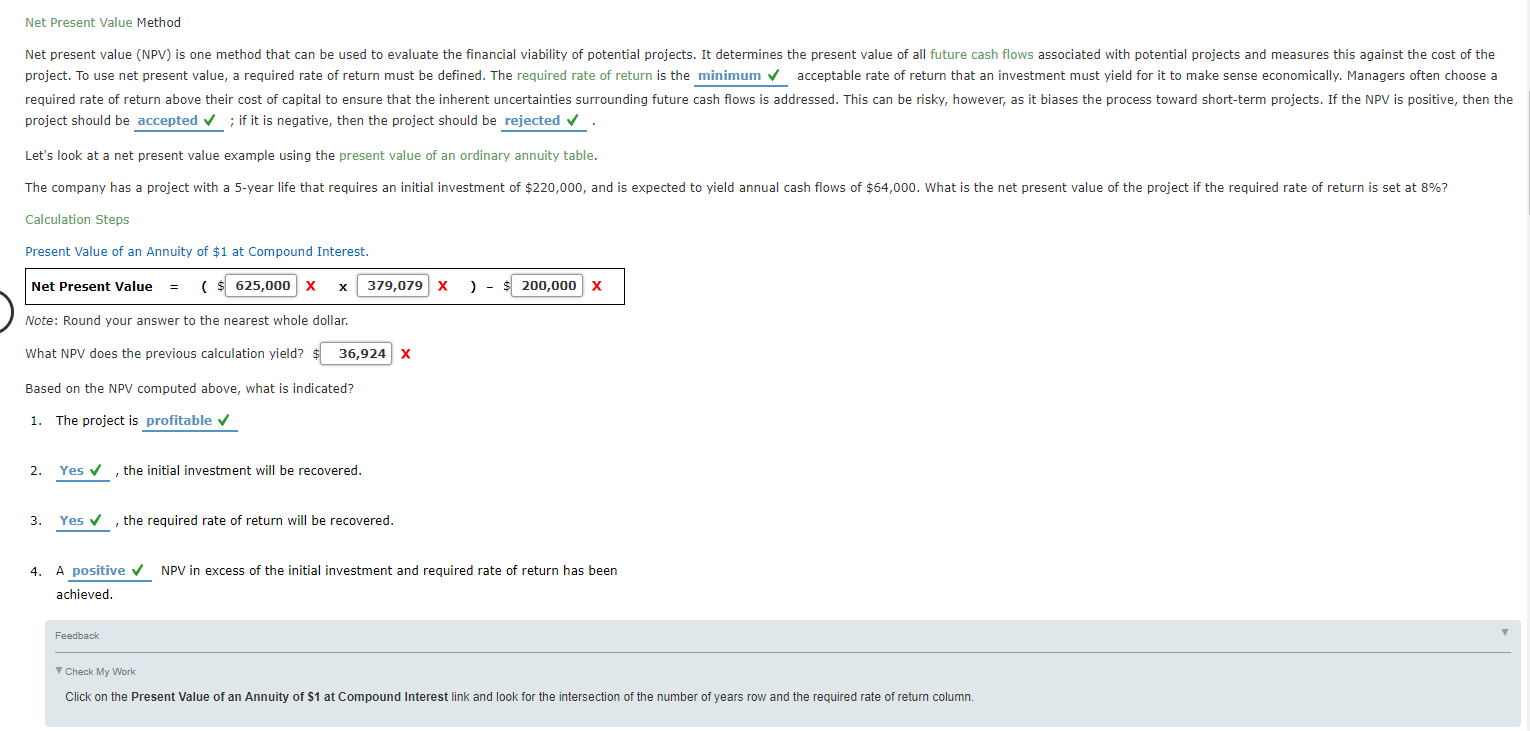
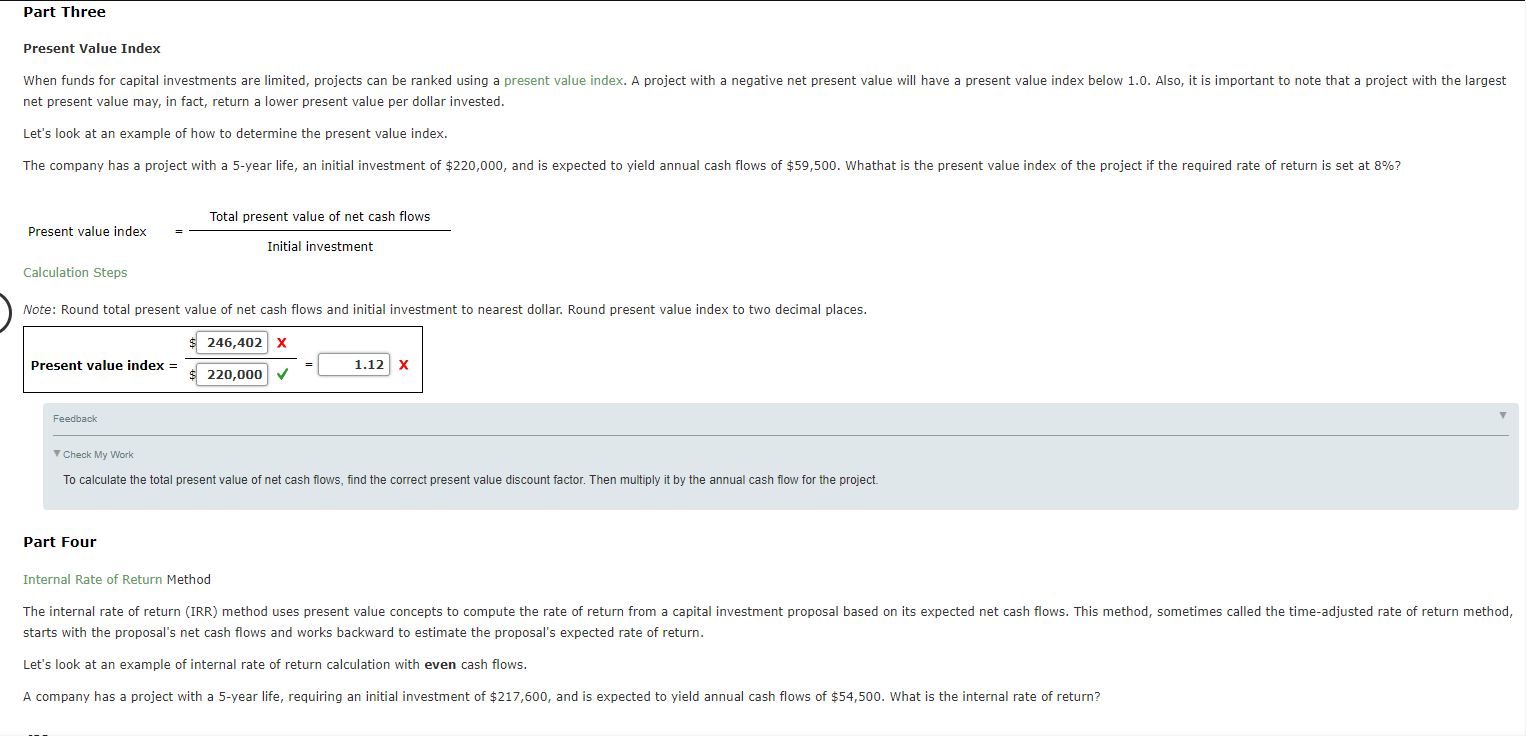
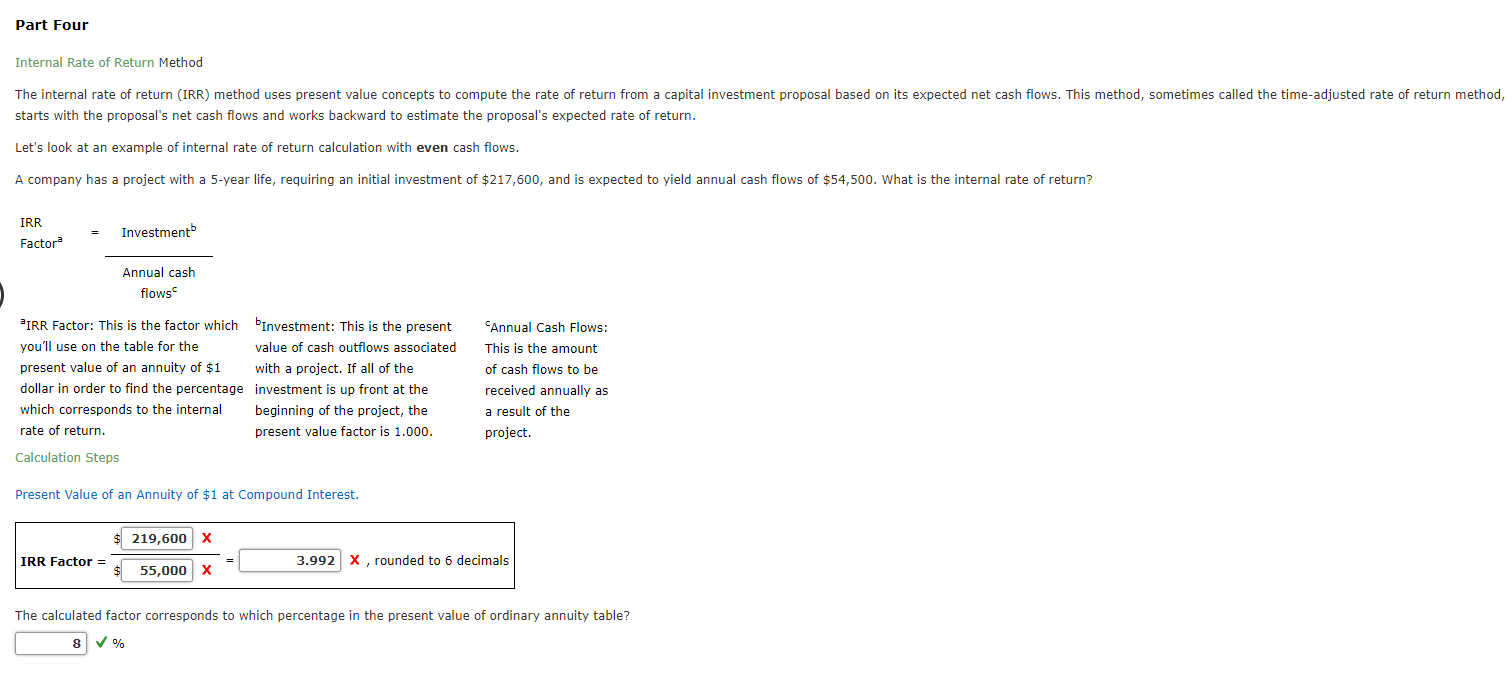
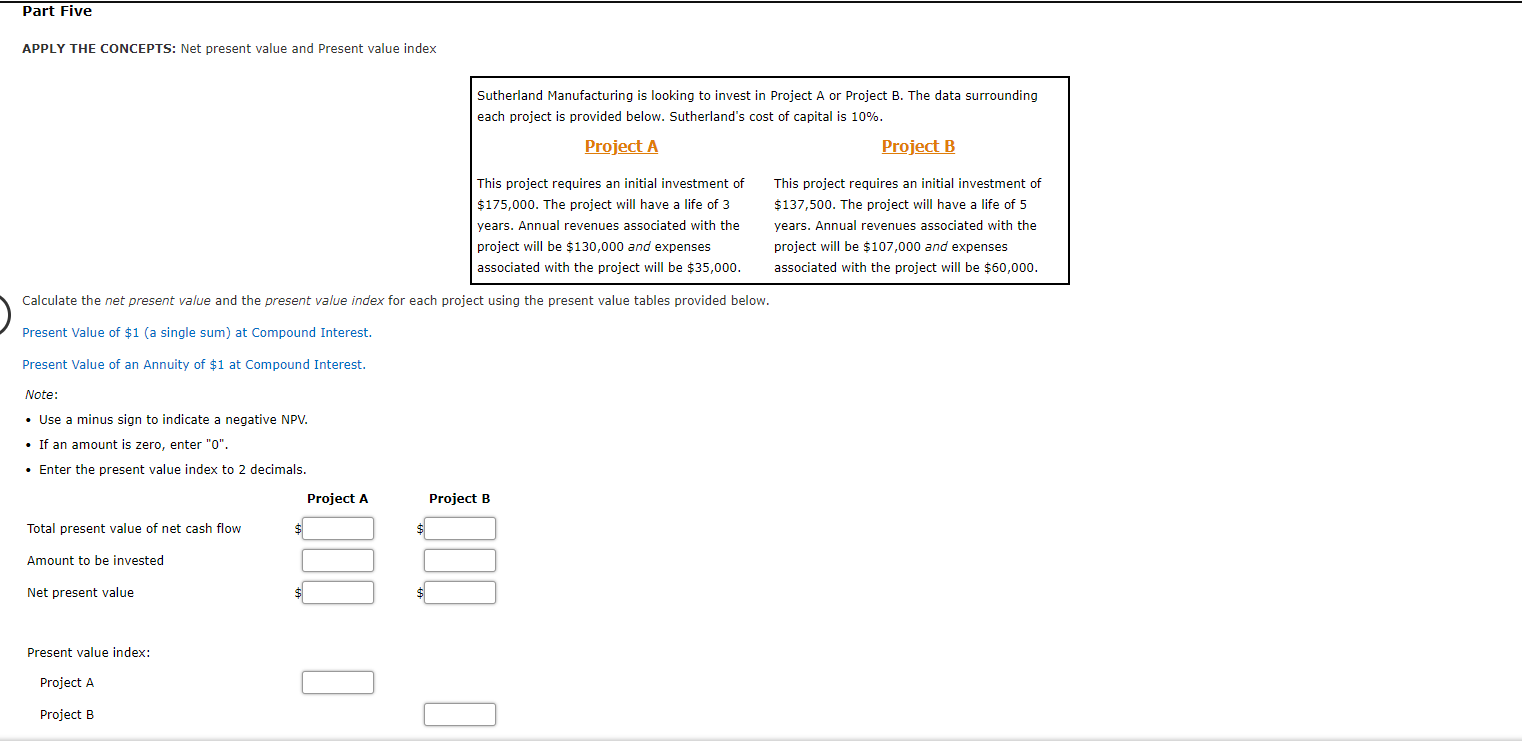
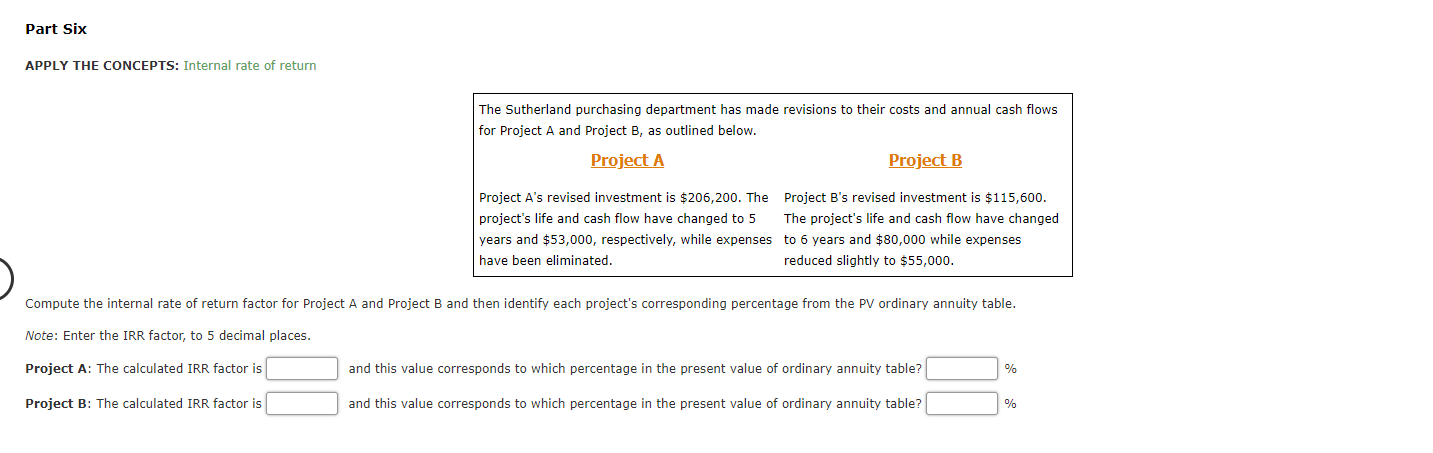
Mastery Problem: Net Present Value and Internal Rate of Return Part One Companies use capital investment analysis to evaluate long-term investments. Capital investment evaluation methods that use present values are (1) Net present value method (NPV) and (2) Internal rate of return (IRR) method. Methods That Use Present Values Of the two capital investment evaluation methods, a defining characteristic NPV and IRR is that they consider the time value of money. This means that money tomorrow is worth less than money today. And, that cash invested today has the potential to earn income and increase in value over time. True or False: When making an investment decision between two mutually exclusive projects, the project with the greatest return on investment should be chosen. True Feedback Check My Work Review the definition of Methods that use present value by rolling your mouse over the underlined item. Review the definition of Mutually Exclusive Projects by rolling your mouse over the underlined item. Part Two Net Present Value Method Net present value (NPV) is one method that can be used to evaluate the financial viability of potential projects. It determines the present value of all future cash flows associated with potential projects and measures this against the cost of the project. To use net present value, a required rate of return must be defined. The required rate of return is the minimum acceptable rate of return that an investment must yield for it to make sense economically. Managers often choose a required rate of return above their cost of capital to ensure that the inherent uncertainties surrounding future cash flows is addressed. This can be risky, however, as it biases the process toward short-term projects. If the NPV is positive, then the project should be accepted ; if it is negative, then the project should be rejected . Let's look at a net present value example using the present value of an ordinary annuity table. The company has a project with a 5-year life that requires an initial investment of $220,000, and is expected to yield annual cash flows of $64,000. What is the net present value of the project if the required rate of return is set at 8%? Calculation Steps Present Value of an Annuity of $1 at Compound Interest. Net Present Value = ($625.000 x 379.079 X $ 200.000 Net Present Value Method Net present value (NPV) is one method that can be used to evaluate the financial viability of potential projects. It determines the present value of all future cash flows associated with potential projects and measures this against the cost of the project. To use net present value, a required rate of return must be defined. The required rate of return is the minimum acceptable rate of return that an investment must yield for it to make sense economically. Managers often choose a required rate of return above their cost of capital to ensure that the inherent uncertainties surrounding future cash flows is addressed. This can be risky, however, as it biases the process toward short-term projects. If the NPV is positive, then the project should be accepted ; if it is negative, then the project should be rejected Let's look at a net present value example using the present value of an ordinary annuity table. The company has a project with a 5-year life that requires an initial investment of $220,000, and is expected to yield annual cash flows of $64,000. What is the net present value of the project if the required rate of return is set at 8%? Calculation Steps Present Value of an Annuity of $1 at Compound Interest. Net Present Value = ($625,000 x x 379,079 X ) Note: Round your answer to the nearest whole dollar. What NPV does the previous calculation yield? 36,924 X Based on the NPV computed above, what is indicated? 1. The project is profitable $ 200,000 2. Yes, the initial investment will be recovered. 3. Yes , the required rate of return will be recovered. 4. A positive NPV in excess of the initial investment and required rate of return has been achieved. Feedback Check My Work Click on the Present Value of an Annuity of $1 at Compound Interest link and look for the intersection of the number of years row and the required rate of return column. Part Three Present Value Index When funds for capital investments are limited, projects can be ranked using a present value index. A project with a negative net present value will have a present value index below 1.0. Also, it is important to note that a project with the largest net present value may, in fact, return a lower present value per dollar invested. Let's look at an example of how to determine the present value index. The company has a project with a 5-year life, an initial investment of $220,000, and is expected to yield annual cash flows of $59,500. Whathat is the present value index of the project if the required rate of return is set at 8%? Total present value of net cash flows Present value index Initial investment Calculation Steps Note: Round total present value of net cash flows and initial investment to nearest dollar. Round present value index to two decimal places. Present value index = 246,402 X 220,000 1.12 X Feedback Check My Work To calculate the total present value of net cash flows, find the correct present value discount factor. Then multiply it by the annual cash flow for the project. Part Four Internal Rate of Return Method The internal rate of return (IRR) method uses present value concepts to compute the rate of return from a capital investment proposal based on its expected net cash flows. This method, sometimes called the time-adjusted rate of return method, starts with the proposal's net cash flows and works backward to estimate the proposal's expected rate of return. Let's look at an example of internal rate of return calculation with even cash flows. A company has a project with a 5-year life, requiring an initial investment of $217,600, and is expected to yield annual cash flows of $54,500. What is the internal rate of return? Part Four Internal Rate of Return Method The internal rate of return (IRR) method uses present value concepts to compute the rate of return from a capital investment proposal based on its expected net cash flows. This method, sometimes called the time-adjusted rate of return method, starts with the proposal's net cash flows and works backward to estimate the proposal's expected rate of return. Let's look at an example of internal rate of return calculation with even cash flows. A company has a project with a 5-year life, requiring an initial investment of $217,600, and is expected to yield annual cash flows of $54,500. What is the internal rate of return? IRR Factor Investment Annual cash flows IRR Factor: This is the factor which you'll use on the table for the present value of an annuity of $1 dollar in order to find the percentage which corresponds to the internal rate of return. Calculation Steps "Investment: This is the present value of cash outflows associated with a project. If all of the investment is up front at the beginning of the project, the present value factor is 1.000. Present Value of an Annuity of $1 at Compound Interest. "Annual Cash Flows: This is the amount of cash flows to be received annually as a result of the project. $ 219,600 IRR Factor = 3.992 X, rounded to 6 decimals 55,000 X The calculated factor corresponds to which percentage in the present value of ordinary annuity table? 8% Part Five APPLY THE CONCEPTS: Net present value and Present value index Sutherland Manufacturing is looking to invest in Project A or Project B. The data surrounding each project is provided below. Sutherland's cost of capital is 10%. Project A This project requires an initial investment of $175,000. The project will have a life of 3 years. Annual revenues associated with the project will be $130,000 and expenses associated with the project will be $35,000. Calculate the net present value and the present value index for each project using the present value tables provided below. Present Value of $1 (a single sum) at Compound Interest. Present Value of an Annuity of $1 at Compound Interest. Note: Use a minus sign to indicate a negative NPV. If an amount is zero, enter "0". Enter the present value index to 2 decimals. Project B This project requires an initial investment of $137,500. The project will have a life of 5 years. Annual revenues associated with the project will be $107,000 and expenses associated with the project will be $60,000. Total present value of net cash flow Amount to be invested Net present value Present value index: Project A Project B Project A Project B Part Six APPLY THE CONCEPTS: Internal rate of return The Sutherland purchasing department has made revisions to their costs and annual cash flows for Project A and Project B, as outlined below. Project A Project A's revised investment is $206,200. The project's life and cash flow have changed to 5 years and $53,000, respectively, while expenses have been eliminated. Project B Project B's revised investment is $115,600. The project's life and cash flow have changed to 6 years and $80,000 while expenses reduced slightly to $55,000. Compute the internal rate of return factor for Project A and Project B and then identify each project's corresponding percentage from the PV ordinary annuity table. Note: Enter the IRR factor, to 5 decimal places. Project A: The calculated IRR factor is Project B: The calculated IRR factor is and this value corresponds to which percentage in the present value of ordinary annuity table? % and this value corresponds to which percentage in the present value of ordinary annuity table? %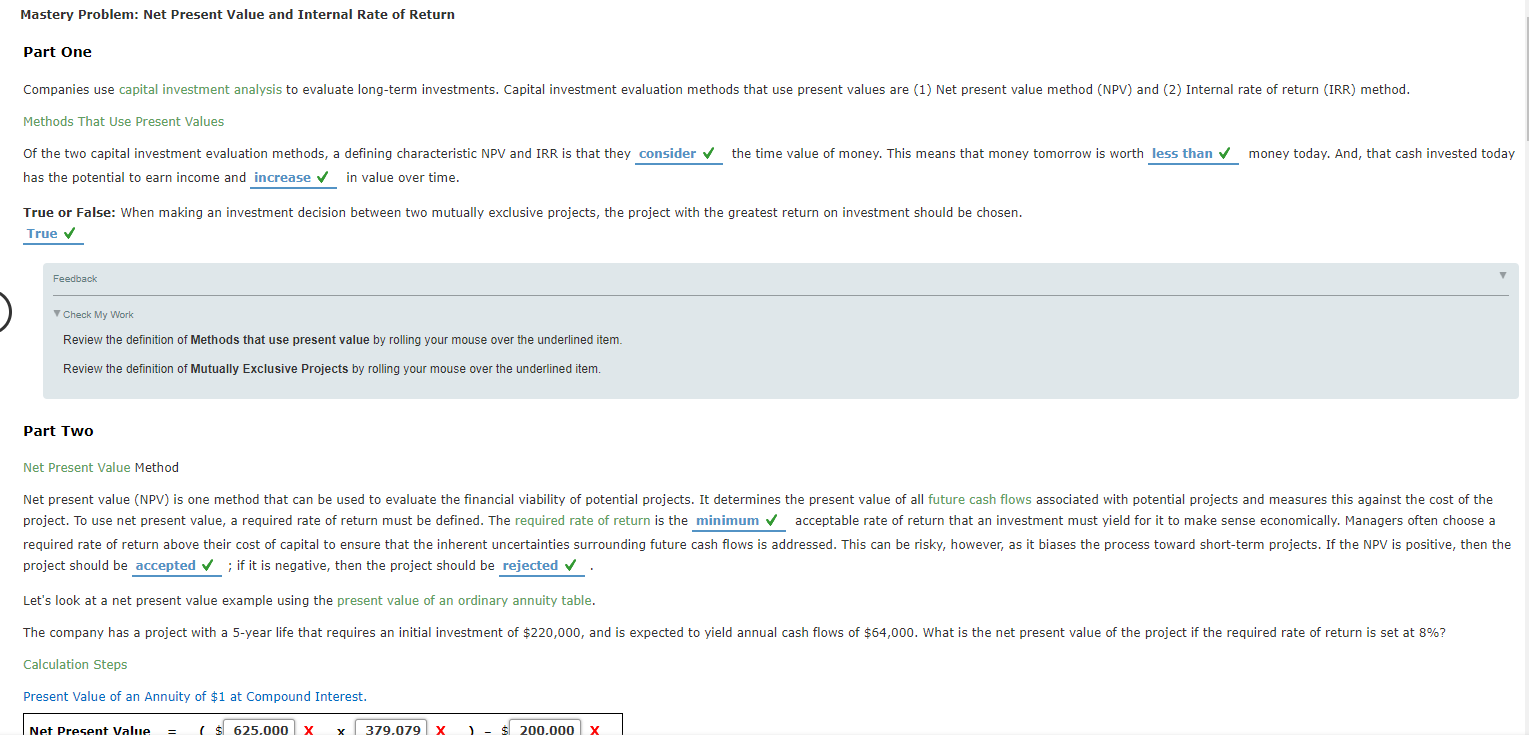
Step by Step Solution
There are 3 Steps involved in it

Get step-by-step solutions from verified subject matter experts
 Study Help