







Question: Mastery Problem: Return on Investment, margin, and turnover Return on Investment (ROI) The manager of an lI'VeStITE'Tt ter:er should be evaluated based on revenues, costs,
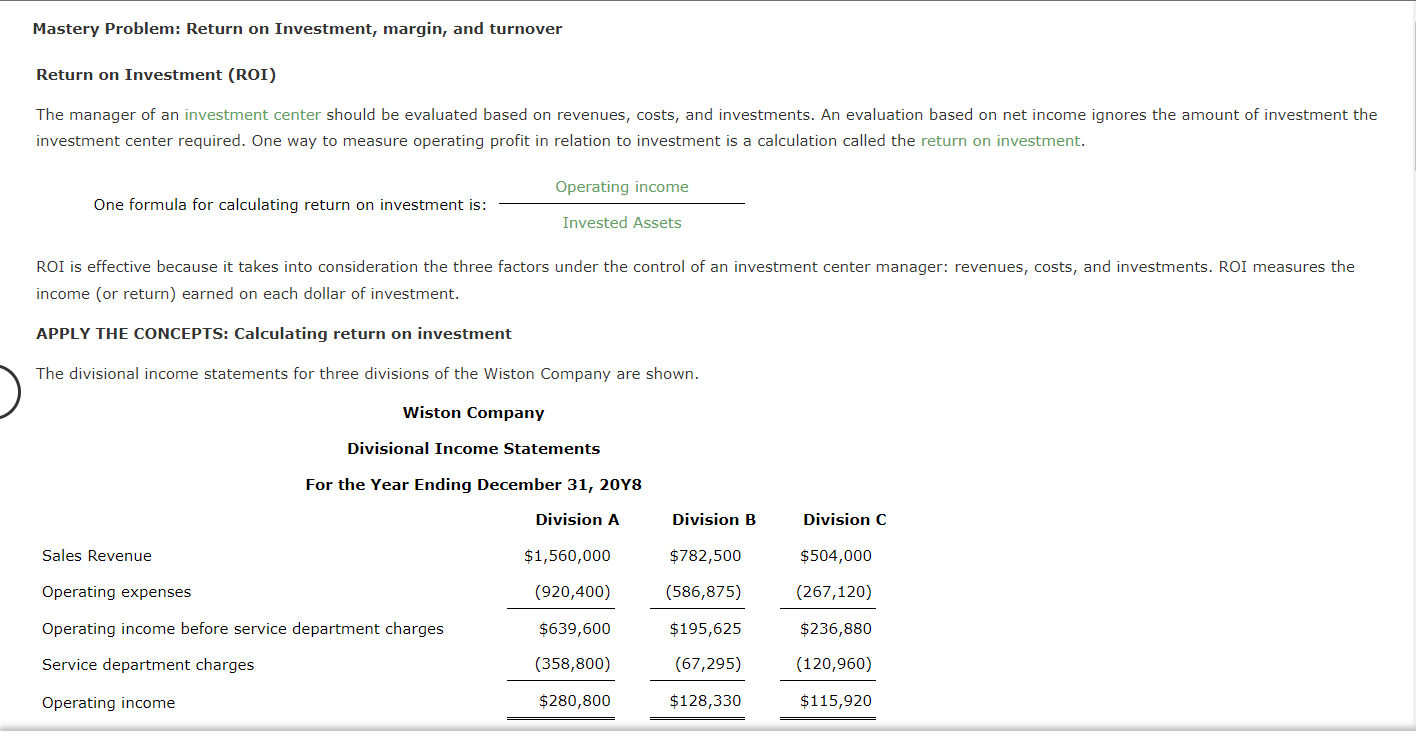
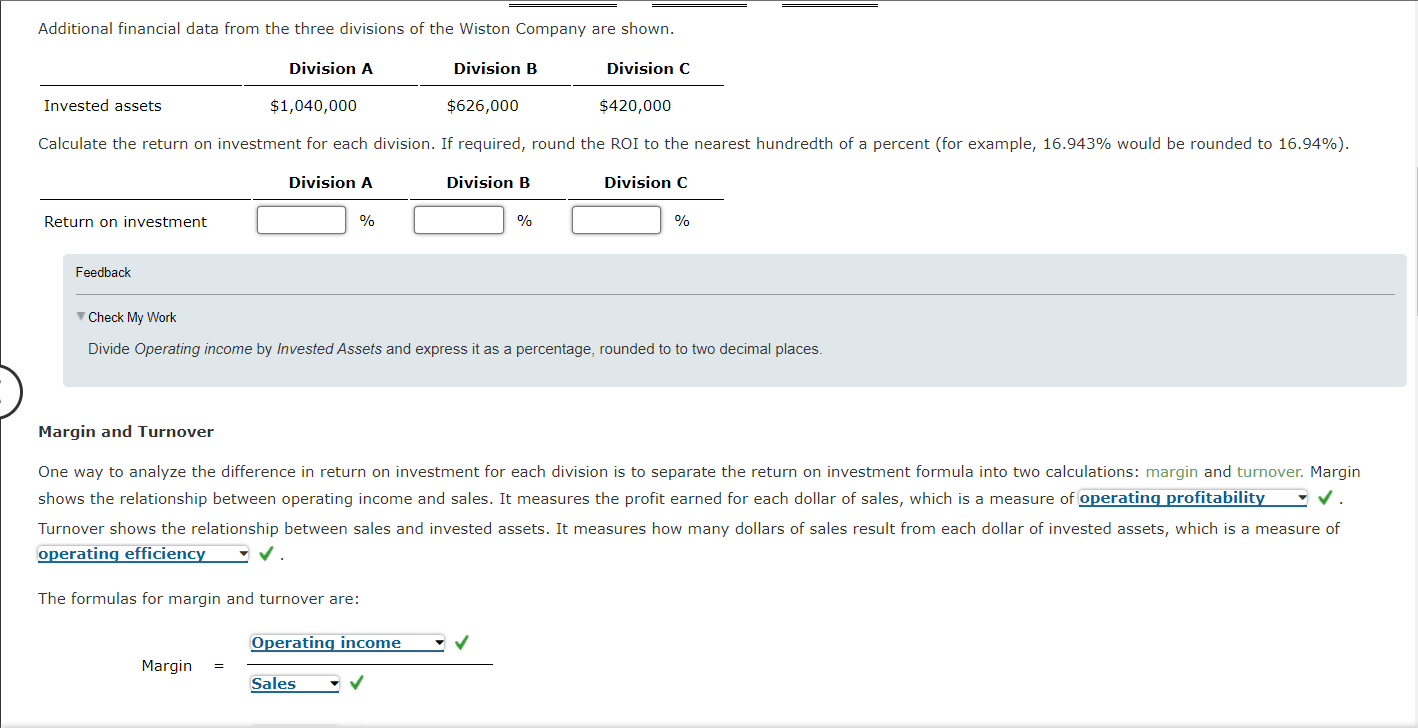
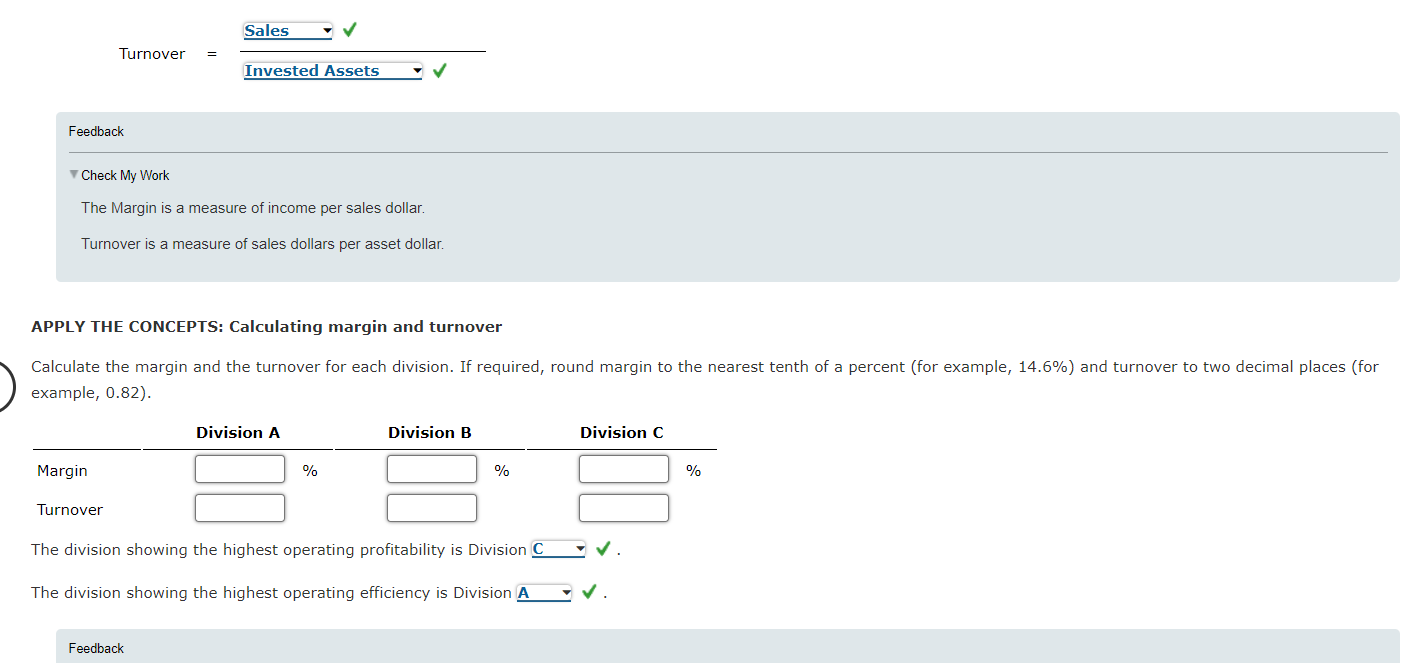
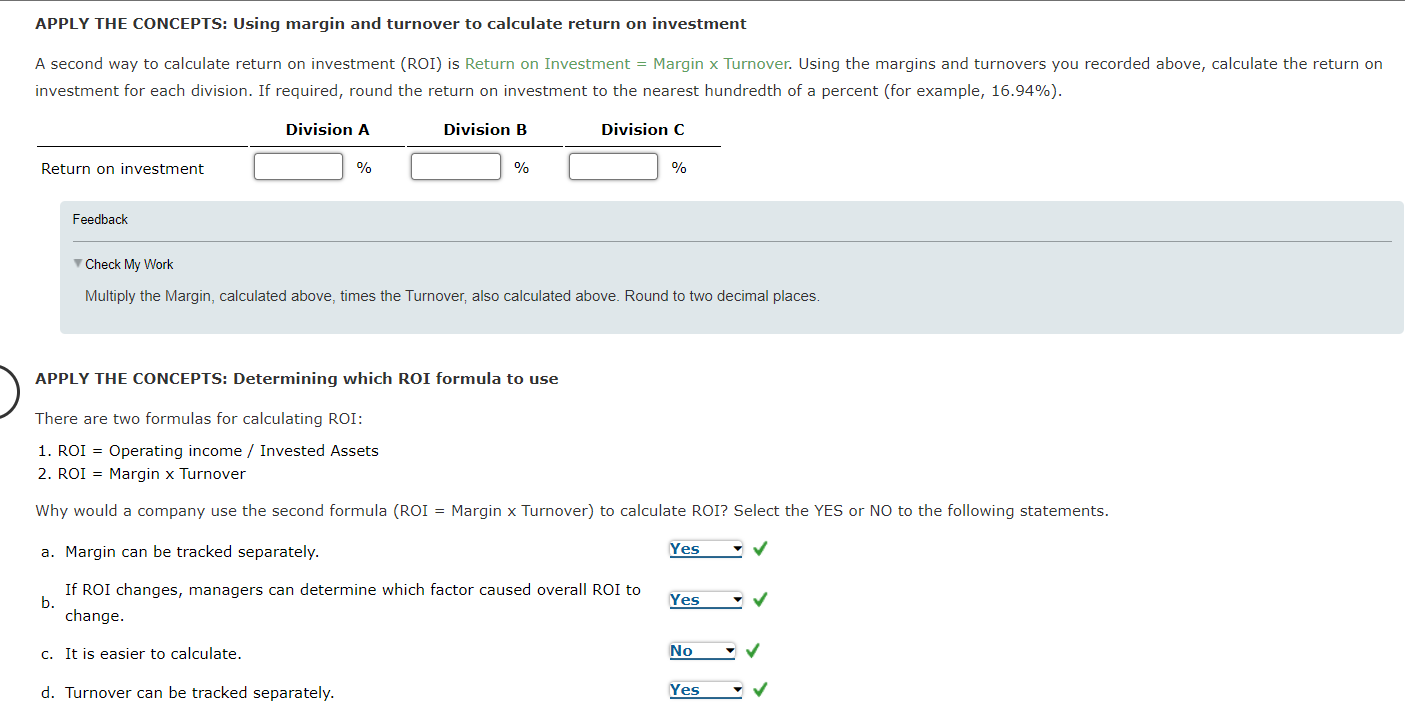
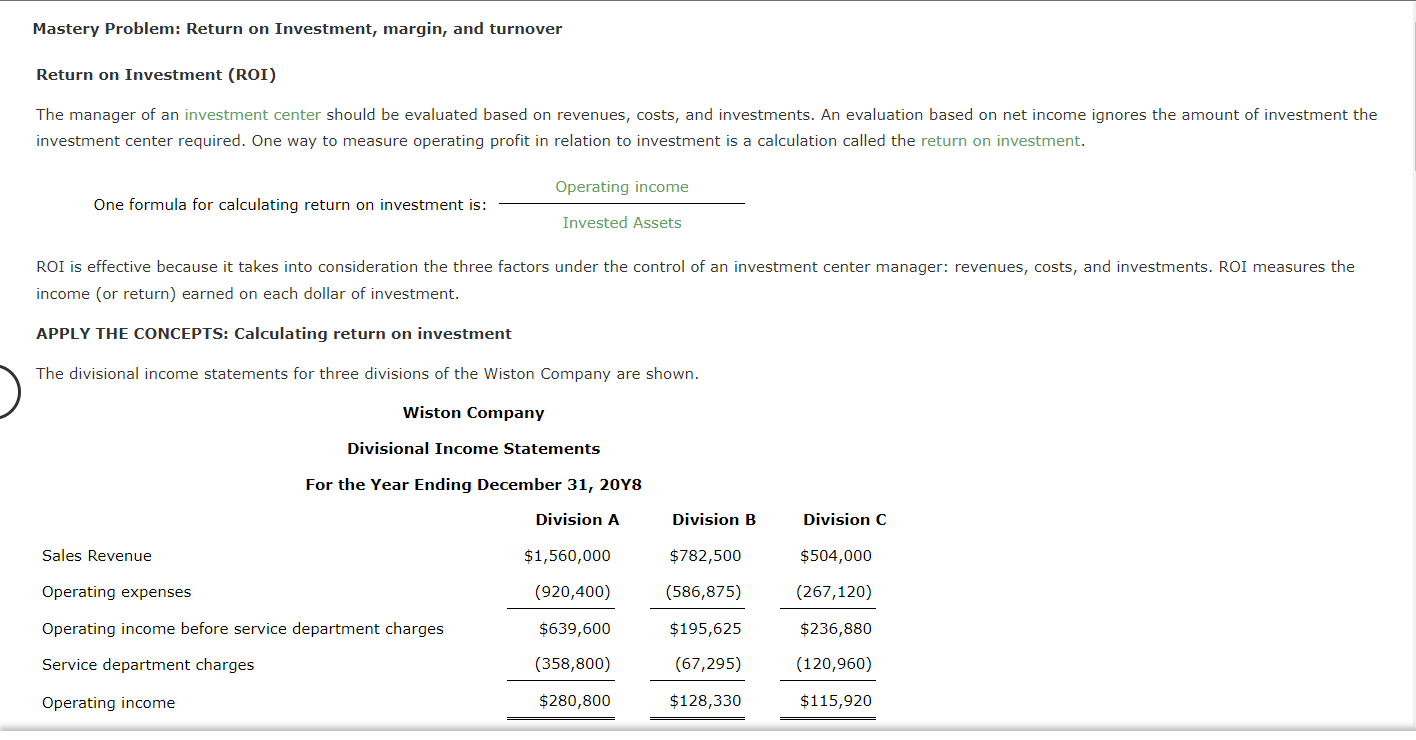
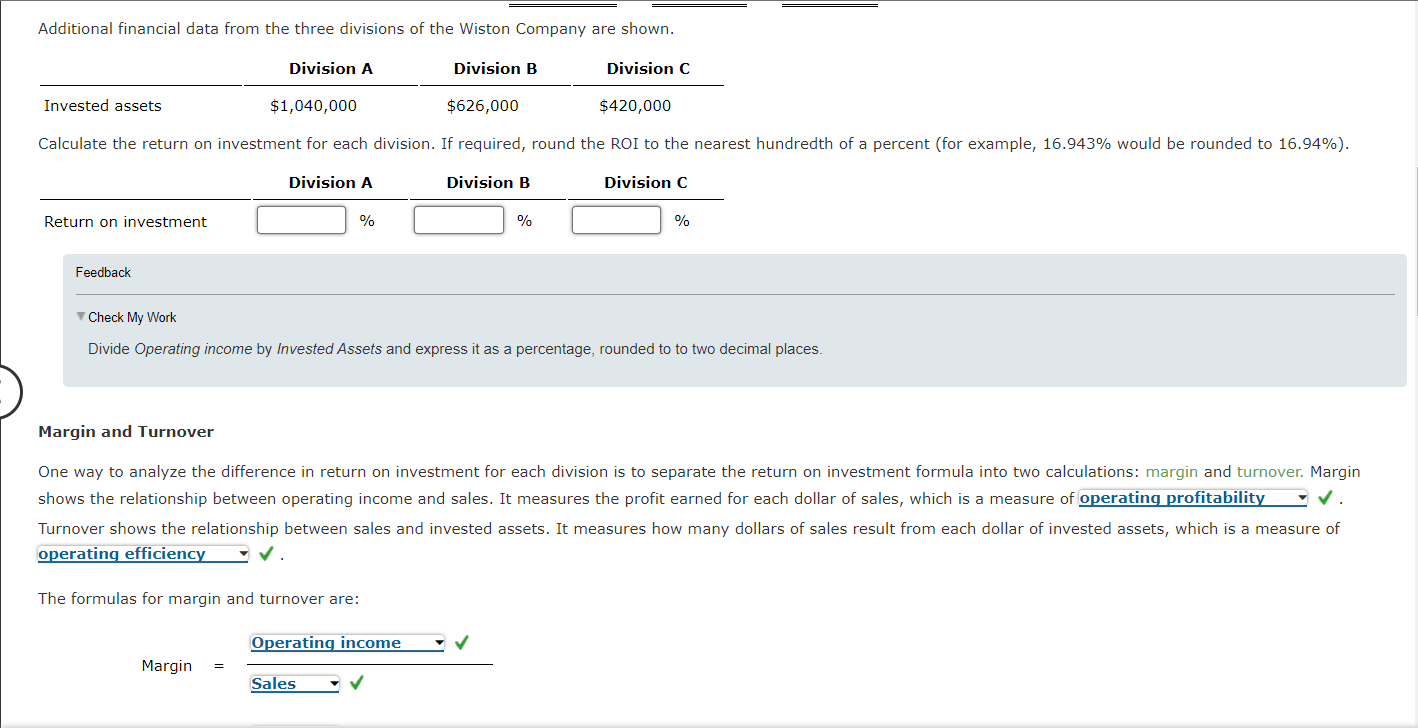
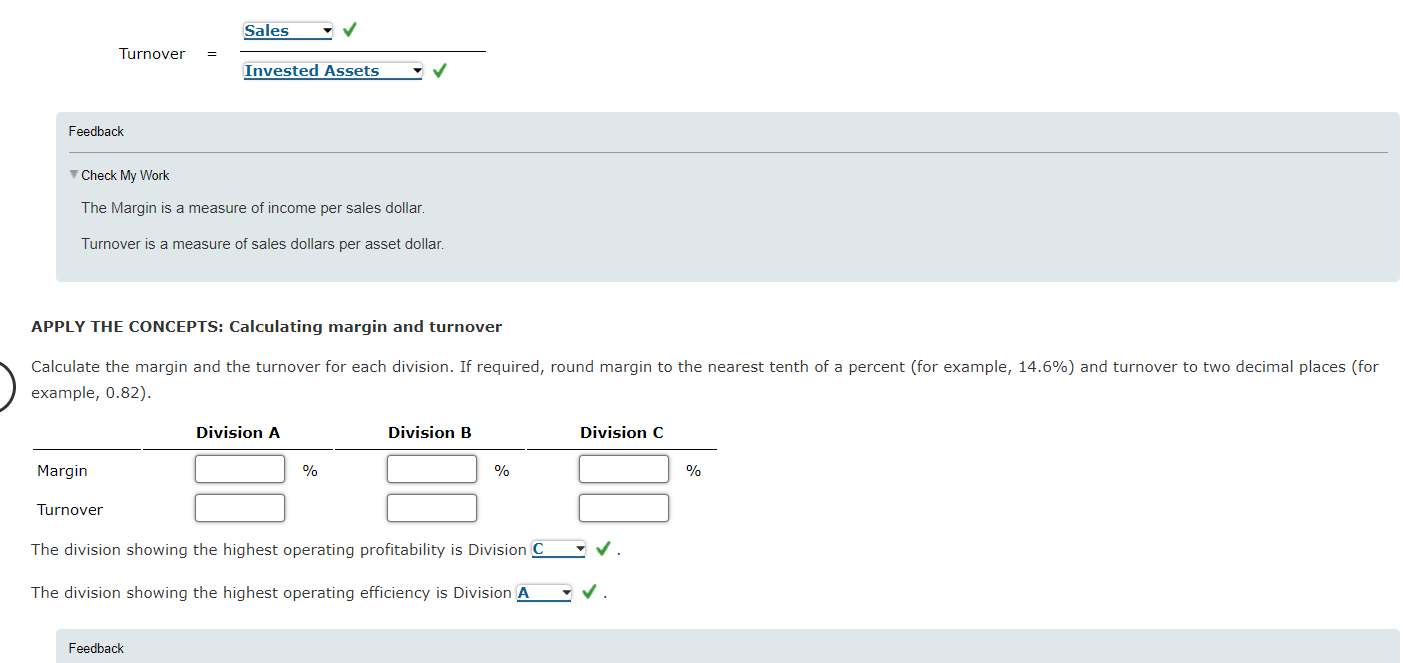
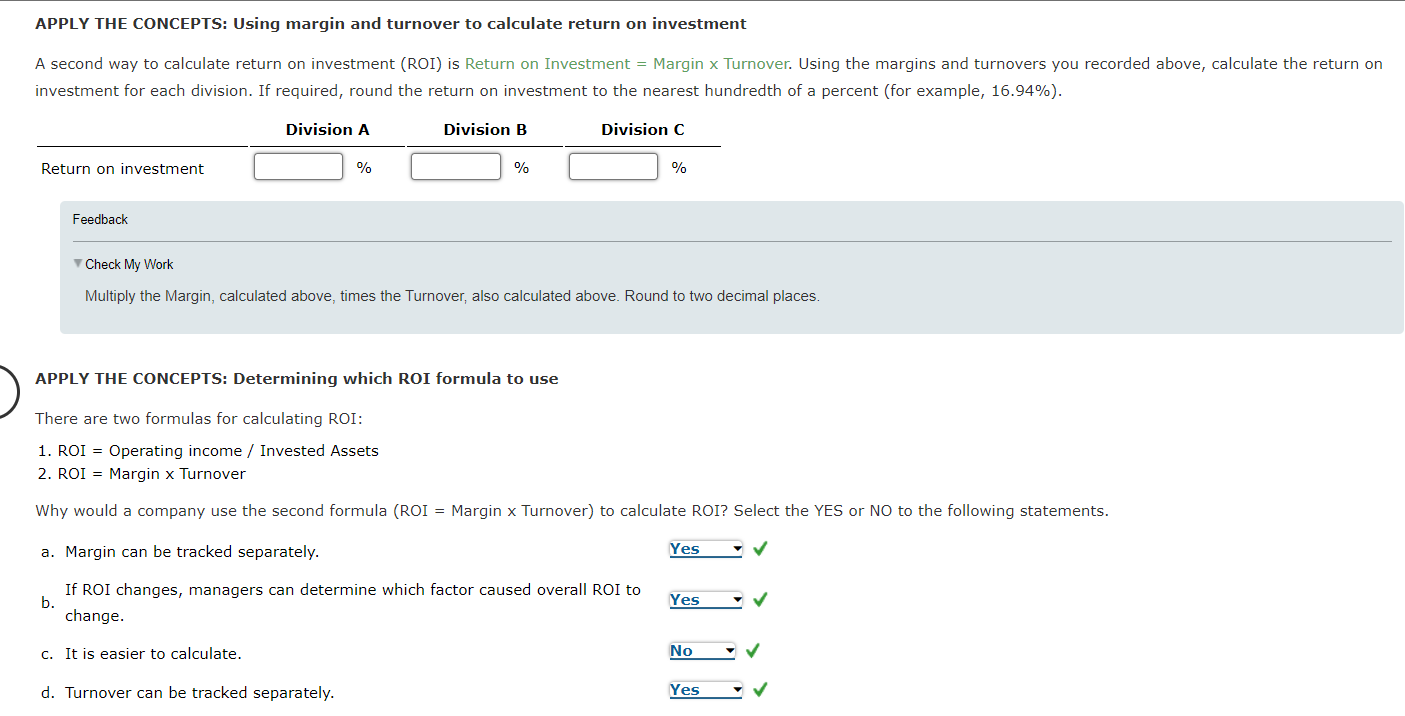
Mastery Problem: Return on Investment, margin, and turnover Return on Investment (ROI) The manager of an lI'VeStITE'Tt ter:er should be evaluated based on revenues, costs, and investments. An evaluation based on net income ignores the amount of investment the investment center required. One way to measure operating profit in relation to Investment is a calculation called the "eturi OT irvesti're-it. Clperatirg '1c0iTe One formula for calculating return on investment is: I-westet. Assets ROI is effective because it takes into consideration the three factors under the control of an investment center manager: revenues, costs, and investments. ROI measures the income (or return) earned on each dollar of investment. APPLY THE CONCEPTS: Calculating return on investment The divisional income statements for three divi5ions of the Wiston Company are shown. Wiston Company Divisional Income Statements For the Year Ending December 31, 20W! Division A Division B Division C Sales Revenue $1,560,000 $782,500 $504,000 Operating expenses (920,400) (586,825) (267,120) Operating income before service department charges $639,600 $195,625 $236,880 Semice department charges (358,800) (67,295) (120,960) Operating income $280,800 $128,330 $115,920 Additional financial data from the three divisions of the Wiston Company are shown. Division A Division B Division C Invested assets $1,040,000 $626,000 $420,000 Calculate the return on investment for each division. If required, round the ROI to the nearest hundredth of a percent (for example, 16.943% would be rounded to 16.94%). Division A Division B Division C Return on investment ' \"/u I ' \"/9 I \"/u Feedback ' Check My Work Diwde Operating income by investedssets and express il as a percentage. rounded to to two deCimai piaces, Margin and Turnover One way to anaiyze the difference in return on investment for each division is to separate the return on investment formuia into two calculations: r'iai'g'r and :JFFOVET Margin shows the relationship between operating income and sales. It measures the profit earned for each doliar of sales, which is a measure of DQerating Qrofitabilitx V J . Turnover shows the relationship between sales and invested assets. It measures how many dollars of sales result from each dollar of invested assetsr which is a measure of operating efficiency V J . The formulas for margin and turnover are: Generating income V / Margin = Sales V ~/ Sales V v' Turnover : Invested Assets V r] Feedback ' Check My Work The Margin is a measure of income per sales dollar Turnover is a measure ofsales dollars per asset dollar APPLY THE CONCEPTS: Calculating margin and turnover Calculate the margin and the turnover for each diviSion. If required, round margin to the nearest tenth of a percent (for example, 14.6%) and turnover to two decimal places (for example, 0.82). Division A Division B Division C Margin :1 % l:l Wu C] % :l [:1 :l Turnover The diviSion showing the highest operating profitability is DiVision C V J . The diviSion showing the highest operating efficiency is DiViSion A V J . Feedback APPLY THE CONCEPTS: Using margin and turnover to calculate return on investment A second way to calculate return on investment (ROI) IS Return on Investment = Margin x Turnover. Using the margins and turnovers you recorded above, calculate the return on investment for each division If required, round the return on investment to the nearest hundredth of a percent (for example, 16.94%). Division A Division B Division C Return on investment I \"/0 l I % I \"/0 Feedback " Check My Work Multiply the Margin. calculated above, limes the Turnover also calculated above. Round to two decimal places. ) APPLY THE CONCEPTS: Determining which ROI formula to use There are two formulas for calculating ROI: 1. R01 = Operating income] Invested Assets 2. R01 = Margin xTurnover Why would a company use the second formula (ROI = Margin x Turnover) to calculate ROI? Select the YES or NO to the tollowmg statements. a. Margin can be tracked separately. M J If ROI changes, managers can determine which factor caused overall R01 to b. Yes ' J change. c. It is easier to calculate. L if d. Turnover can be tracked separately. Yes ' J
Step by Step Solution
There are 3 Steps involved in it

Get step-by-step solutions from verified subject matter experts
 Study Help