







Question: . Match the correct term to the correct definition. aggregation class abstraction class encapsulation composition immutable class instance variables stack . this array list casting
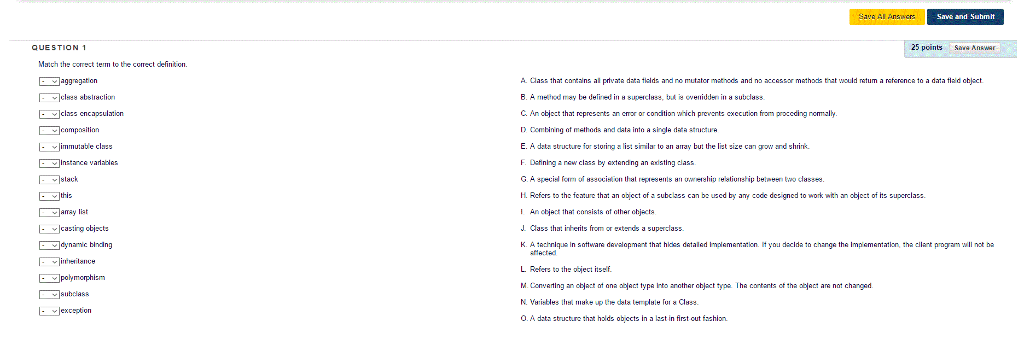
| . | Match the correct term to the correct definition. aggregation |
| class abstraction | |
| class encapsulation | |
| composition | |
| immutable class | |
| instance variables | |
| stack | |
| . | this |
| array list | |
| casting objects | |
| dynamic binding | |
| inheritance | |
| polymorphism | |
| subclass | |
| exception |
| A. | Class that contains all private data fields and no mutator methods and no accessor methods that would return a reference to a data field object. |
| B. | A method may be defined in a superclass, but is overridden in a subclass. |
| C. | An object that represents an error or condition which prevents execution from proceding normally. |
| D. | Combining of methods and data into a single data structure. |
| E. | A data structure for storing a list similar to an array but the list size can grow and shrink. |
| F. | Defining a new class by extending an existing class. |
| G. | A special form of association that represents an ownership relationship between two classes. |
| H. | Refers to the feature that an object of a subclass can be used by any code designed to work with an object of its superclass. |
| I. | An object that consists of other objects. |
| J. | Class that inherits from or extends a superclass. |
| K. | A technique in software development that hides detailed implementation. If you decide to change the implementation, the client program will not be affected. |
| L. | Refers to the object itself. |
| M. | Converting an object of one object type into another object type. The contents of the object are not changed. |
| N. | Variables that make up the data template for a Class. |
| O. | A data structure that holds objects in a last-in first-out fashion. |
Match the correct term to the correct definition. aggregation class abstraction class encapsulation composition immutable class instance variables stack this array list casting objects dynamic binding inheritance polymorphism subclass exception A. Class that contains all private data fields and no methods and no methods that would return a reference to a data field object. B. A method may be defined in a superclass, but is in a subclass. C. An object that represents an error or condition which prevents execution from preceding normally. D. Combining of methods and data into a single data structure. E. A data structure for storing a list similar to an array but the list size can grow and . F. Defining a new class by extending an existing class. G. A special form of that represents an ownership relationship between two classes. H. Refer to the feature that an object of a subclass can be used by any code designed to work with an object of superclass. I. An object that consists of other objects. J. Class that inherits from or extends a superclass. K. A technique in software development that hides detailed implementation. If you decide to change the implementation, the client program will not be affected. L. Refer to the object itself. M. Converting an object of one object type into another object type. The contents of the object are not changed. N. Variables that makes up the data template for a Class. O. A data structure that holds objects in a last in first out fashion
Step by Step Solution
There are 3 Steps involved in it

Get step-by-step solutions from verified subject matter experts
 Study Help