







Question: Match the definition with the term. 1). Capital Structure 2). Capital Budgeting 3). Working Capital 5). Agency Problem Balance Sheet 9). Liquidity 10). Income Statement
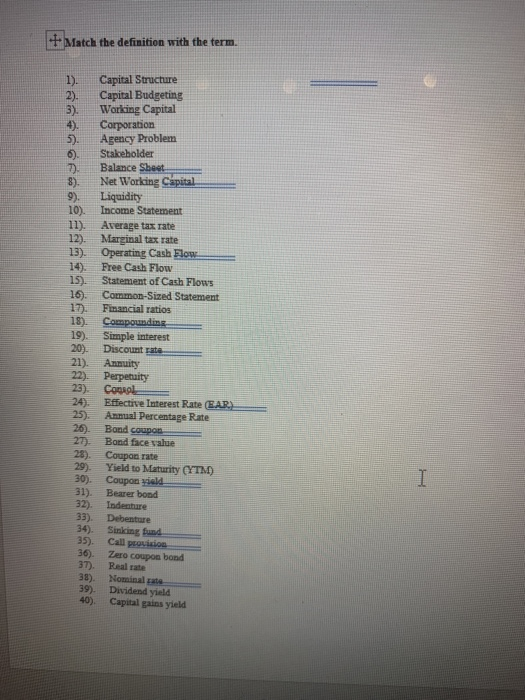
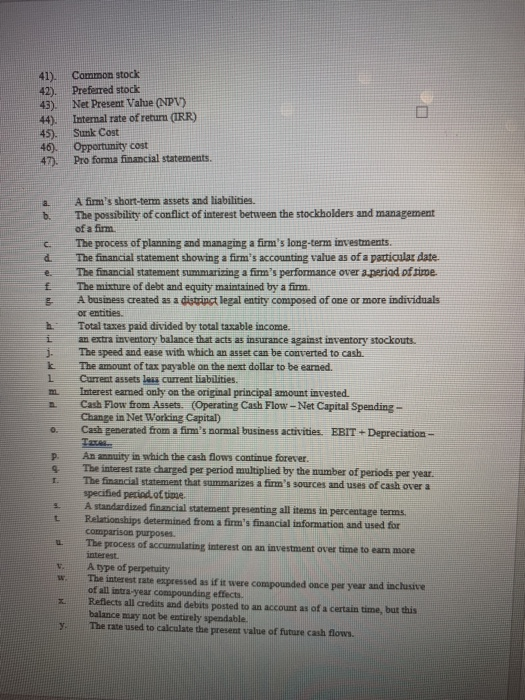
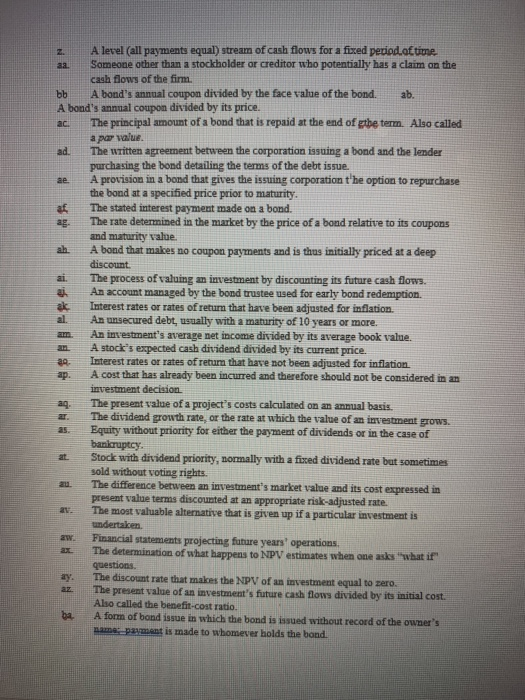
Match the definition with the term. 1). Capital Structure 2). Capital Budgeting 3). Working Capital 5). Agency Problem Balance Sheet 9). Liquidity 10). Income Statement 11). Average tax rate 12). Marginal tax rate 13). Operating Cash low 14). 15). 16). Free Cash Flow Statement of Cash Flows Common-Sized Statement 17. Fimancial ratios 18) Compounding 19) Simple interest 20). Discount rate 21). Anmuity 22) Perpetuity 24) Effective Interest Rate EAR 25) Anual Percentage Rate 26 Bond coupon 2) Bond face vahue 28). Coupon rate 29). Yield to Maturity (TA 30). Coupon vield 31). Bearer bond 32). Indenture 33). Debenture 34). Sinking fund 35). Call povirios 36). Zero coupon bond 37). Real rate 38). Nominal as 39). Dividend yield 40). Capital gains yield 41), Common stock 42). Preferred stock 43). Net Present Value ONPV 44). Internal rate of return (RR) 45). Sunk Cost 46), Opportumity cost 47). Pro forma financial statements. a.A fim's short-term assets and liabilities. b. The possibility of conflict of interest between the stockholders and management of a firm The process of planning and managing a firm's long-term investments. d The financial statement showing a firm's accounting value as of a patiaular date. e. The financial statement summarizing a finn's performance over a.period of time f The mixture of debt and equity maintained by a firm A business created as or entities. quppa legal entity composed of one or more individuals Total taxes paid divided by total taxable income. 1 an extra inventory balance that acts as insurance against inventory stockouts. j The speed and ease with which an asset can be converted to cash. k The amount of tax payable on the next dollar to be earned. 1 Current assets less curreat liabilities m Interest eamed only on tbe original principal amount invested. Cash Flow from Assets. (Operating Cash Flow- Net Capital Spending- o Cash generated from a firm's normal business activities. EBIT + Depreciation p. An annuity in swhich the cash flows continue forever 9 Change in Net Working Capital) The interest rate charged per period multiplied by the number of periods per year The financial statement that summarizes a firm's sources and uses of cash over a specified perind of time s. A standardized financial statement presenting all items in percentage terms t Relationships determined from a firm's financial information and used for L The process of accumulating interest on an investment over time to ean more v. interest A type of perpetuity The interest rate expressed as if it were compounded once per year and of all intra-year compounding effects. Reflects all credits and debits posted to an account as of a certain time, but this balance may not be entirely spendable. w. inchusive y The rate used to calculate the present value of future cash flows. z. A level (all payments equal) stream of cash flows for a fixed peiodof time aa. Someone other than a stockholder or creditor who potentially has a claim on the cash flows of the firm bb A bond's annual coupon divided by the face value of the bond. ab. A bond's annual coupon divided by its price. ac The principal amount of a bond that is repaid at the end of ghe term. Also called a par value purchasing the bond detailing the terms of the debt issue the bond at a specified price prior to maturity ad. The written agreement between the corporation issuing a bond and the lender ae. A provision in a bond that gives the issuing corporation t'he option to repurchase af The stated interest payment made on a bond. ag. The rate determined in the market by the price of a bond relative to its coupons and maturity value ah A bond that makes no coupon payments and is thus initially priced at a deep ai. The process of valuing an investment by discounting its future cash flowS. ai An account managed by the bond trustee used for early bond redemption ak Interest rates or rates of retura that have been adjusted for inflation. al. An unsecured debt, usually with a maturity of 10 years or more. am. An inv estment's average net income divided by its average book value. an A stock's expected cash dividend divided by its current price. a Interest rates or rates of return that have not been adjusted for inflation ap. A cost that has already been incurred and therefore should not be considered in an ag The present value of a project's costs calculated on an annual basis. ar. The dividend growth rate, or the rate at which the value of an investment grows. as. Equity without priority for either the payment of dividends or in the case of at. Stock with dividend priority, normally with a fixed dividend rate but sometimes au. The difference between an investment's market value and its cost expressed in av. The most valuable alternative that is given up if a particular investment is sold without voting rights. present value terms discounted at an appropriate risk-adjusted rate aw. Financial statements projecting funure years' operations ax. The determination of what happens to NPV estimates when one asks what if questions The discount rate that makes the NPV of an investment equal to zero. The present value of an investment's future cash flows divided by its initial cost Also called the benefit-cost ratio. A form of bond issue in which the bond is issued without record of the owner's aume payment is made to whomever holds the bond ay. az. ba
Step by Step Solution
There are 3 Steps involved in it

Get step-by-step solutions from verified subject matter experts
 Study Help