







Question: MATCHING (40 points: 2.5 points each except15:5 points)-Match the keyword with the esr corresponds to the keyword. Not all keywords will be used; no keyword
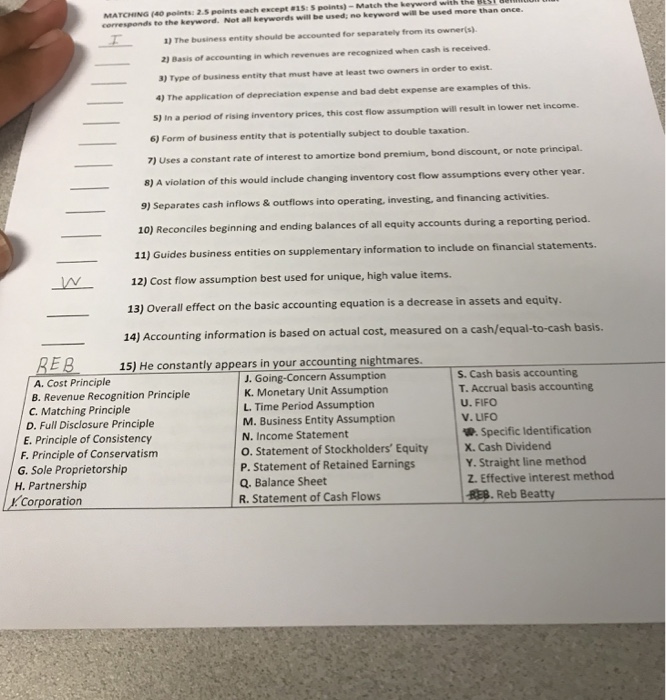
MATCHING (40 points: 2.5 points each except15:5 points)-Match the keyword with the esr corresponds to the keyword. Not all keywords will be used; no keyword will be used more than once. 1) The business entity should be accounted for separately from its ownerls) 2) Basis of accounting in which revenues are recognized when cash is received. 3) Type of business entity that must have at least two owners in order to exist 4) The application of depreciation expense and bad debt expense are examples of this. 5) In a period of rising inventory prices, this cost flow assumption will result in lower net income. 6) Form of business entity that is potentially subject to double taxation. 7) Uses a constant rate of interest to amortize bond premium, bond discount, or note principal. 8) A violation of this would include changing inventory cost flow assumptions every other year outflows into operating, investing, and financing activities 9) Separates cash inflows& operating. 10) Reconciles beginning and ending balances of all equity accounts during a reporting period. 11) Guides business entities on supplementary information to include on financial statements. W12) Cost flow assumption best used for unique, high value items. t on the basic accounting equation is a decrease in assets and equity. 13) Overall effec 14) Accounting information is based on actual cost, measured on a cash/equal-to-cash basis. 15) He constantly appears in your accounting nightmares REB J. Going-Concern Assumption K. Monetary Unit Assumption L. Time Period Assumption M. Business Entity Assumption N. Income Statement o. Statement of Stockholders' EquityX.Cash Dividend P. Statement of Retained Earnings S. Cash basis accounting T. Accrual basis accounting U.FIFO V.LIFO A. Cost Principle B. Revenue Recognition Principle C. Matching Principle D. Full Disclosure Principle E. Principle of Consistency F. Principle of Conservatism G. Sole Proprietorship H. Partnership KCorporation Q. Balance Sheet R. Statement of Cash Flows Y. Straight line method Z. Effective interest method RES.Reb Beatty
Step by Step Solution
There are 3 Steps involved in it

Get step-by-step solutions from verified subject matter experts
 Study Help