







Question: material balancing If cupric oxide (CuO) is exposed to reducing atmospheres at elevated temperatures, some of the Cu2+ ions will become Cu+. a. Under these
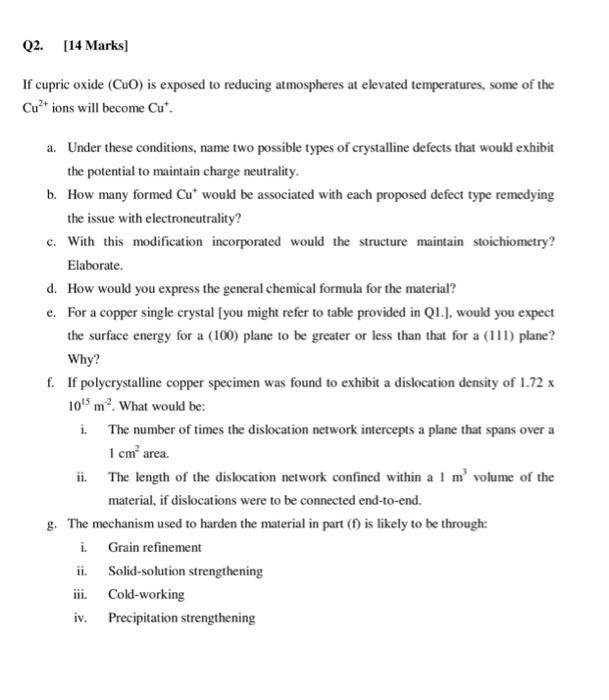
If cupric oxide (CuO) is exposed to reducing atmospheres at elevated temperatures, some of the Cu2+ ions will become Cu+. a. Under these conditions, name two possible types of crystalline defects that would exhibit the potential to maintain charge neutrality. b. How many formed Cu+would be associated with each proposed defect type remedying the issue with electroneutrality? c. With this modification incorporated would the structure maintain stoichiometry? Elaborate. d. How would you express the general chemical formula for the material? e. For a copper single crystal [you might refer to table provided in Q1.], would you expect the surface energy for a (100) plane to be greater or less than that for a (111) plane? Why? f. If polycrystalline copper specimen was found to exhibit a dislocation density of 1.72x 10¹⁵m2. What would be: i. The number of times the dislocation network intercepts a plane that spans over a 1cm2 area. ii. The length of the dislocation network confined within a 1m3 volume of the material, if dislocations were to be connected end-to-end. g. The mechanism used to harden the material in part (f) is likely to be through: i. Grain refinement ii. Solid-solution strengthening ii. Cold-working iv. Precipitation strengthening
Step by Step Solution
There are 3 Steps involved in it

Get step-by-step solutions from verified subject matter experts
 Study Help