Question: Materials -three cylindrically shaped objects, for example, a pop can, a wooden dowel, and an empty paper towel roll (take pictures of what you used)
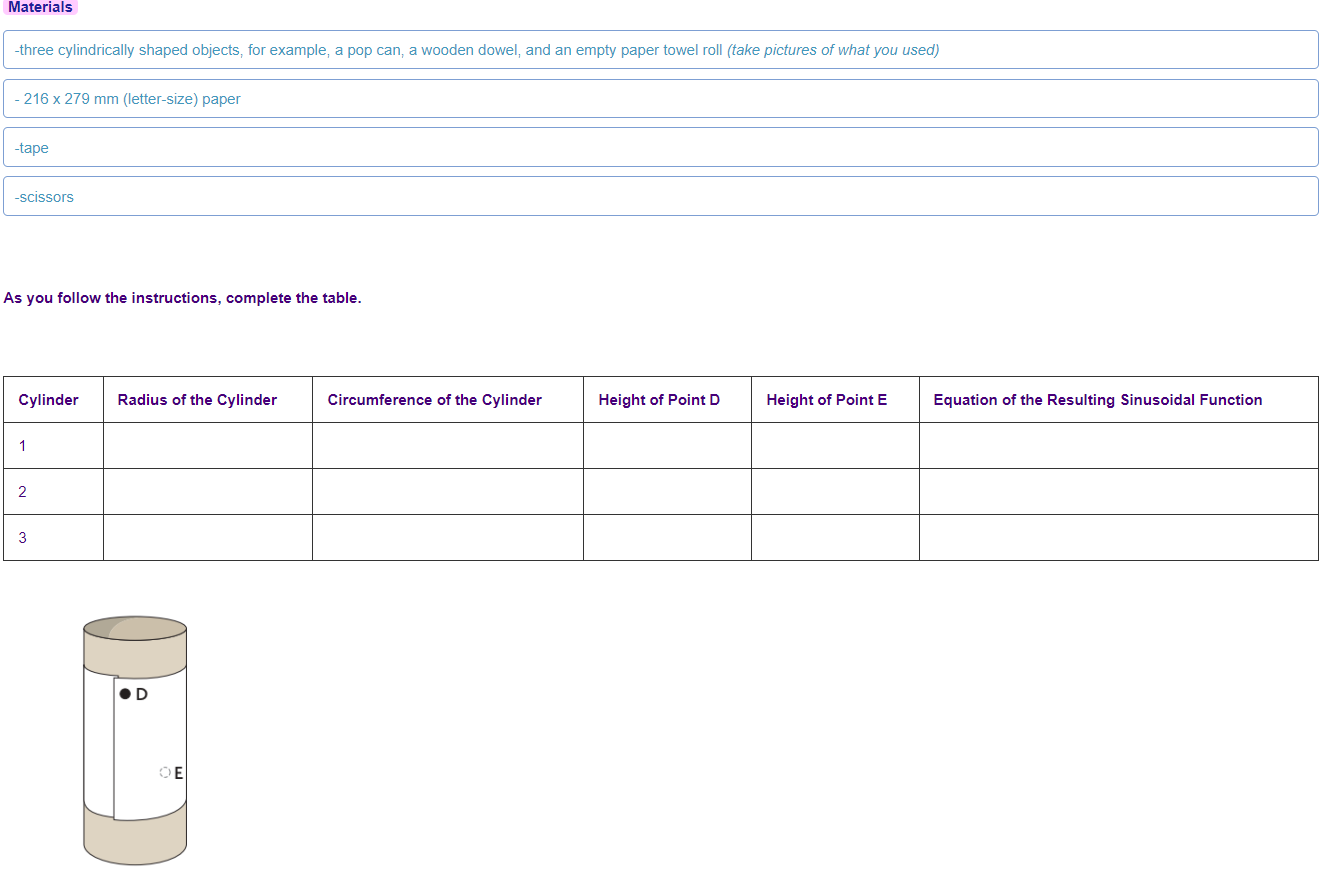
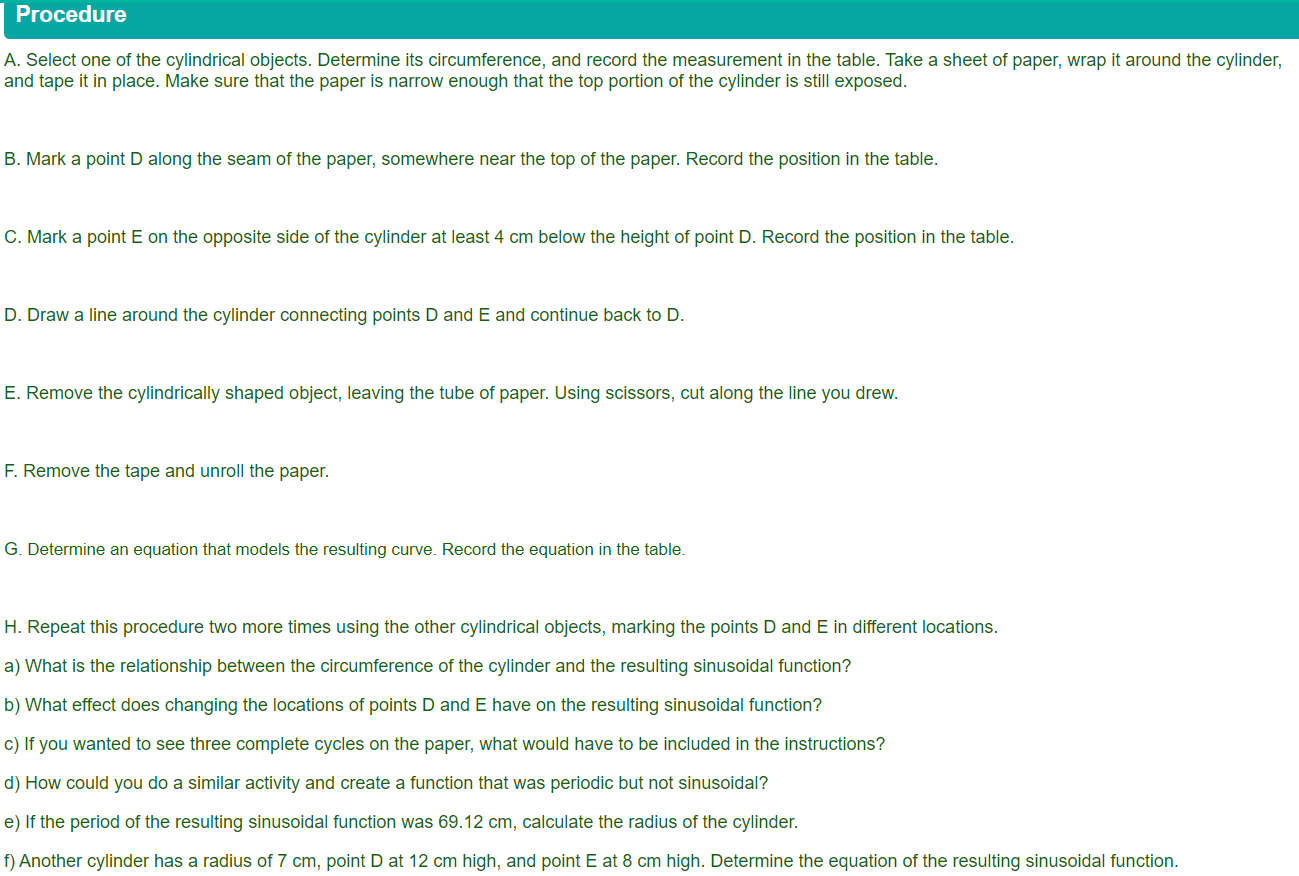
Materials -three cylindrically shaped objects, for example, a pop can, a wooden dowel, and an empty paper towel roll (take pictures of what you used) - 216 x 279 mm (letter-size) paper -tape -scissors As you follow the instructions, complete the table. Cylinder Radius of the Cylinder Circumference of the Cylinder Height of Point D Height of Point E Equation of the Resulting Sinusoidal Function 2 3 .D OEProcedure A. Select one of the cylindrical objects. Delennine its circumference, and record the measurement in the table. Take a sheet of paper, wrap it around the cylinder, and tape it in place. Make sure that the paper is narrow enough that the top portion of the cylinder is still exposed. B. Mark a point D along the seam of the paper, somewhere near the top of the paper. Record the position in the table. C. Mark a point E on the opposite side of the cylinder at least 4 cm below the height of point D. Record the position in the table. D. Draw a line around the cylinder connecting points D and E and continue back to D. E. Remove the cylindrically shaped object, leaving the tube of paper. Using scissors, cut along the line you drew. F. Remove the tape and unroll the paper. 6. Determine an equation that models the resulting curve. Record the equation in the table, H. Repeat this procedure two more times using the other cylindrical objects, marking the points D and E in different locations. a} What is the relationship between the circumference of the cylinder and the resulting sinusoidal function? b} What effect does changing the locations of points D and E have on the resulting sinusoidal function? c} If you wanted to see three complete cycles on the paper, what would have to be included in the instructions? d} How could you do a similar activity and create a function that was periodic but not sinusoidal? e} If the period of the resulting sinusoidal function was 69.12 cm, calculate the radius of the cylinder. Another cylinder has a radius of 7 cm, point D at 12 cm high, and point E at 8 cm high. Determine the equation of the resulting sinusoidal function
Step by Step Solution
There are 3 Steps involved in it
1 Expert Approved Answer
Step: 1 Unlock
Question Has Been Solved by an Expert!
Get step-by-step solutions from verified subject matter experts
Step: 2 Unlock
Step: 3 Unlock
Students Have Also Explored These Related Mathematics Questions!









 Study Help