





Question: Math 0130 Tutorial 10 A Finding a Blood Pressure Model (Assume No Phase Shift) A hypertensive person has a pulse rate of 80 heartbeats per
Math 0130 Tutorial 10 A Finding a Blood PressureMath 0130 Tutorial 10 A Finding a Blood PressureMath 0130 Tutorial 10 A Finding a Blood Pressure
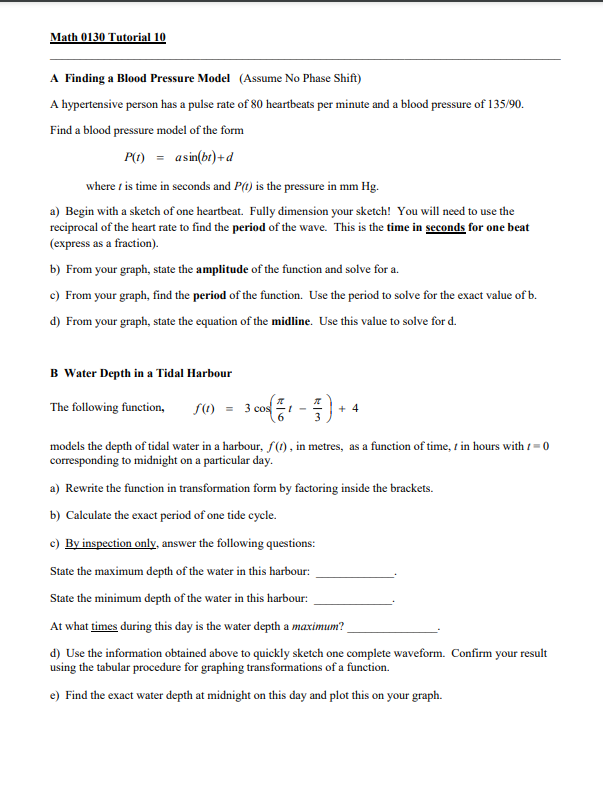
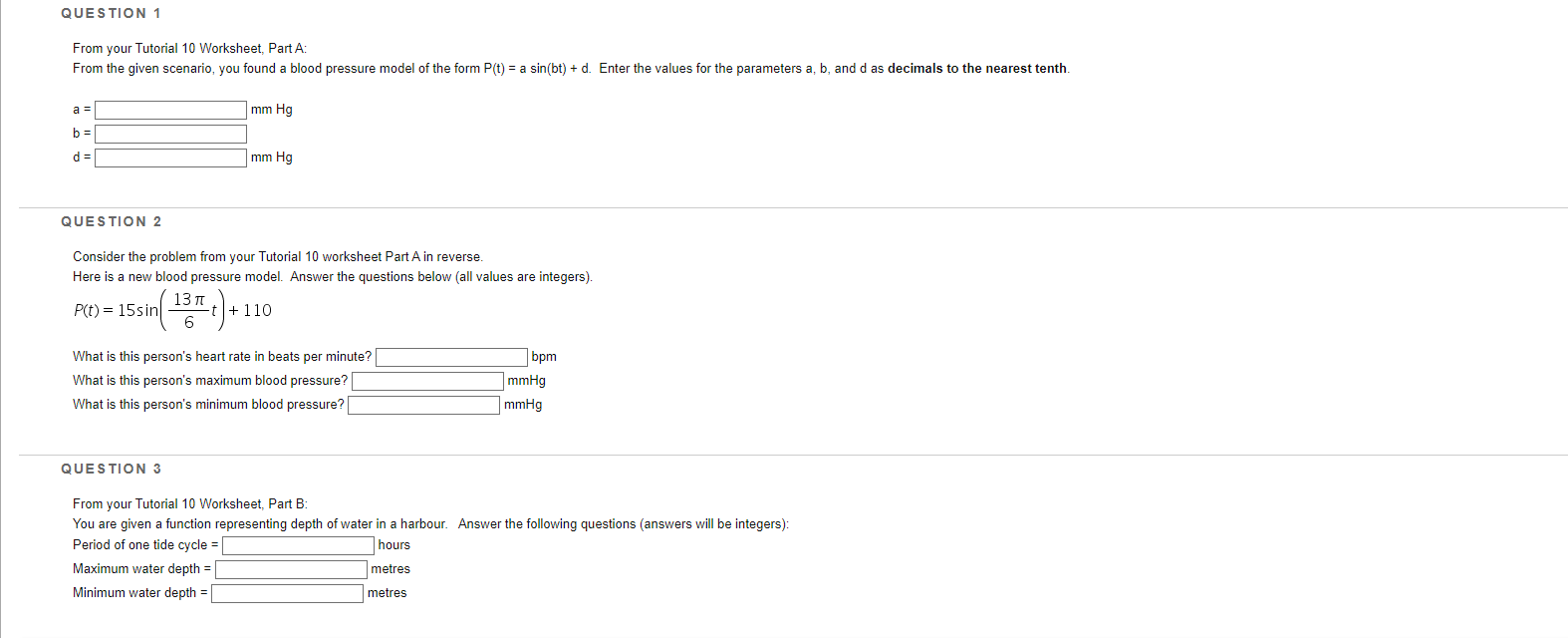
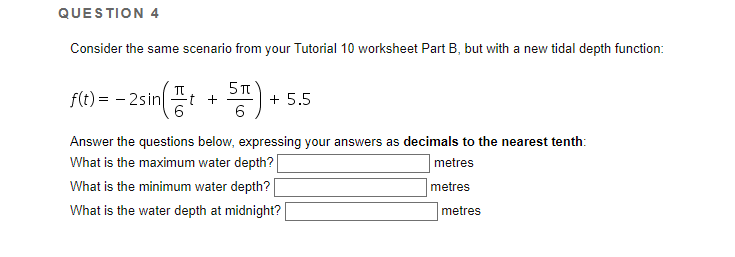
Math 0130 Tutorial 10 A Finding a Blood Pressure Model (Assume No Phase Shift) A hypertensive person has a pulse rate of 80 heartbeats per minute and a blood pressure of 135/90. Find a blood pressure model of the form P(1) = asin(br)+d where / is time in seconds and P(f) is the pressure in mm Hg. a) Begin with a sketch of one heartbeat. Fully dimension your sketch! You will need to use the reciprocal of the heart rate to find the period of the wave. This is the time in seconds for one beat (express as a fraction). b) From your graph, state the amplitude of the function and solve for a. c) From your graph, find the period of the function. Use the period to solve for the exact value of b. d) From your graph, state the equation of the midline. Use this value to solve for d. B Water Depth in a Tidal Harbour The following function, f(1) = 3 cos - 1 - 7+ 4 models the depth of tidal water in a harbour, (() , in metres, as a function of time, / in hours with / = 0 corresponding to midnight on a particular day. a) Rewrite the function in transformation form by factoring inside the brackets. b) Calculate the exact period of one tide cycle. c) By inspection only, answer the following questions: State the maximum depth of the water in this harbour: State the minimum depth of the water in this harbour: At what times during this day is the water depth a maximum? d) Use the information obtained above to quickly sketch one complete waveform. Confirm your result using the tabular procedure for graphing transformations of a function. e) Find the exact water depth at midnight on this day and plot this on your graph.QUESTION 1 From your Tutorial 10 Worksheet, Part A: From the given scenario, you found a blood pressure model of the form P(t) = a sin(bt) + d. Enter the values for the parameters a, b, and d as decimals to the nearest tenth. a mm Hg b = d = mm Hg QUESTION 2 Consider the problem from your Tutorial 10 worksheet Part A in reverse. Here is a new blood pressure model. Answer the questions below (all values are integers). P(t) = 15sin 137+ + 110 What is this person's heart rate in beats per minute? bpm What is this person's maximum blood pressure? mmHg What is this person's minimum blood pressure? mmHg QUESTION 3 From your Tutorial 10 Worksheet, Part B: You are given a function representing depth of water in a harbour. Answer the following questions (answers will be integers): Period of one tide cycle = hours Maximum water depth = metres Minimum water depth = metresQUESTION 4 Consider the same scenario from your Tutorial 10 worksheet Part B, but with a new tidal depth function: f (t) = - 2sin IT 5 TI + + 5.5 Answer the questions below, expressing your answers as decimals to the nearest tenth: What is the maximum water depth? metres What is the minimum water depth? metres What is the water depth at midnight? metres
Step by Step Solution

There are 3 Steps involved in it

1 Expert Approved Answer
Step: 1 Unlock blur-text-image

Question Has Been Solved by an Expert!

Get step-by-step solutions from verified subject matter experts

Step: 2 Unlock
Step: 3 Unlock

Students Have Also Explored These Related Mathematics Questions!