







Question: Math 113, Chapters 5 & 6 How does our understanding of integration and the Fundamental Theorem of Calculus allow us to compare income inequality? The
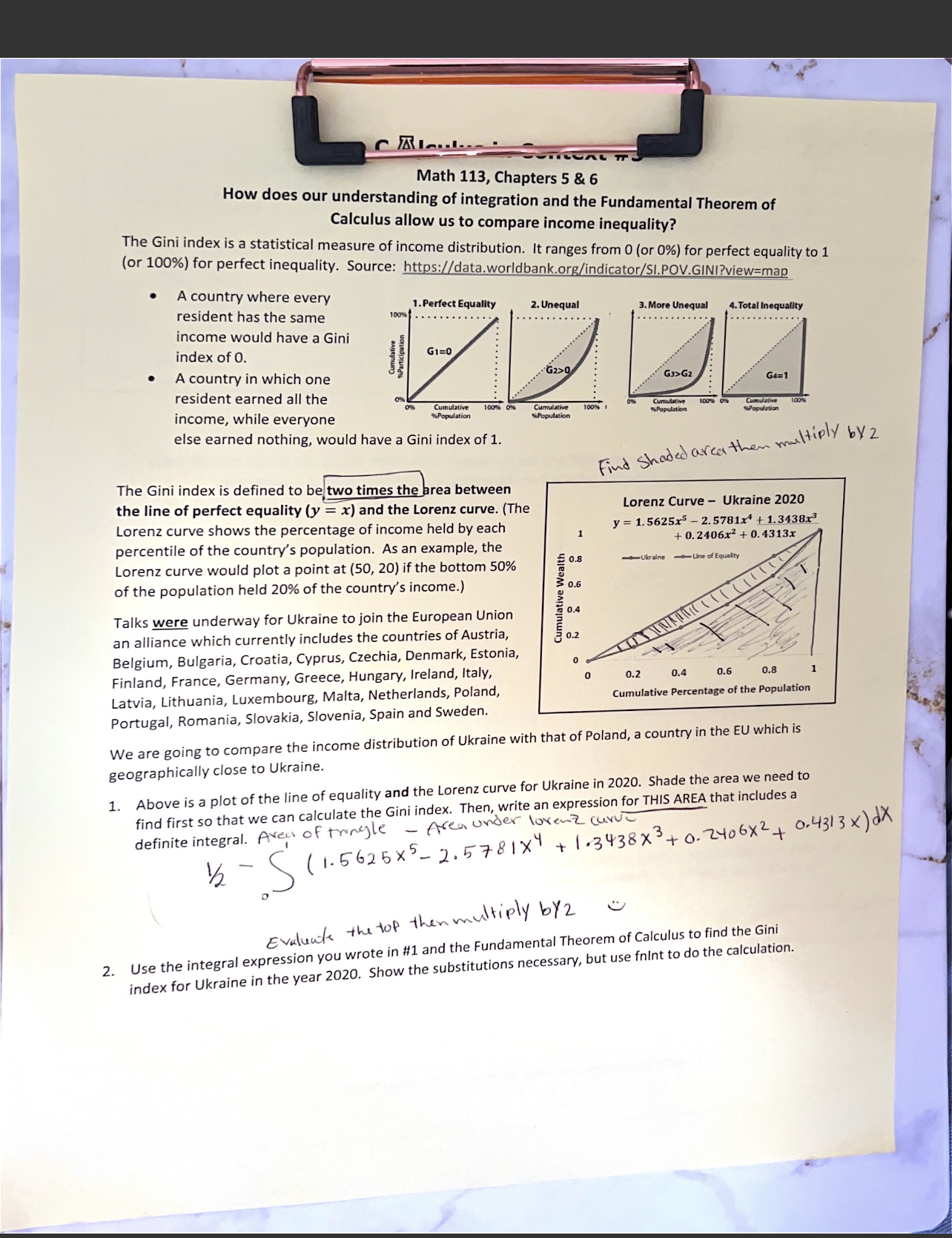
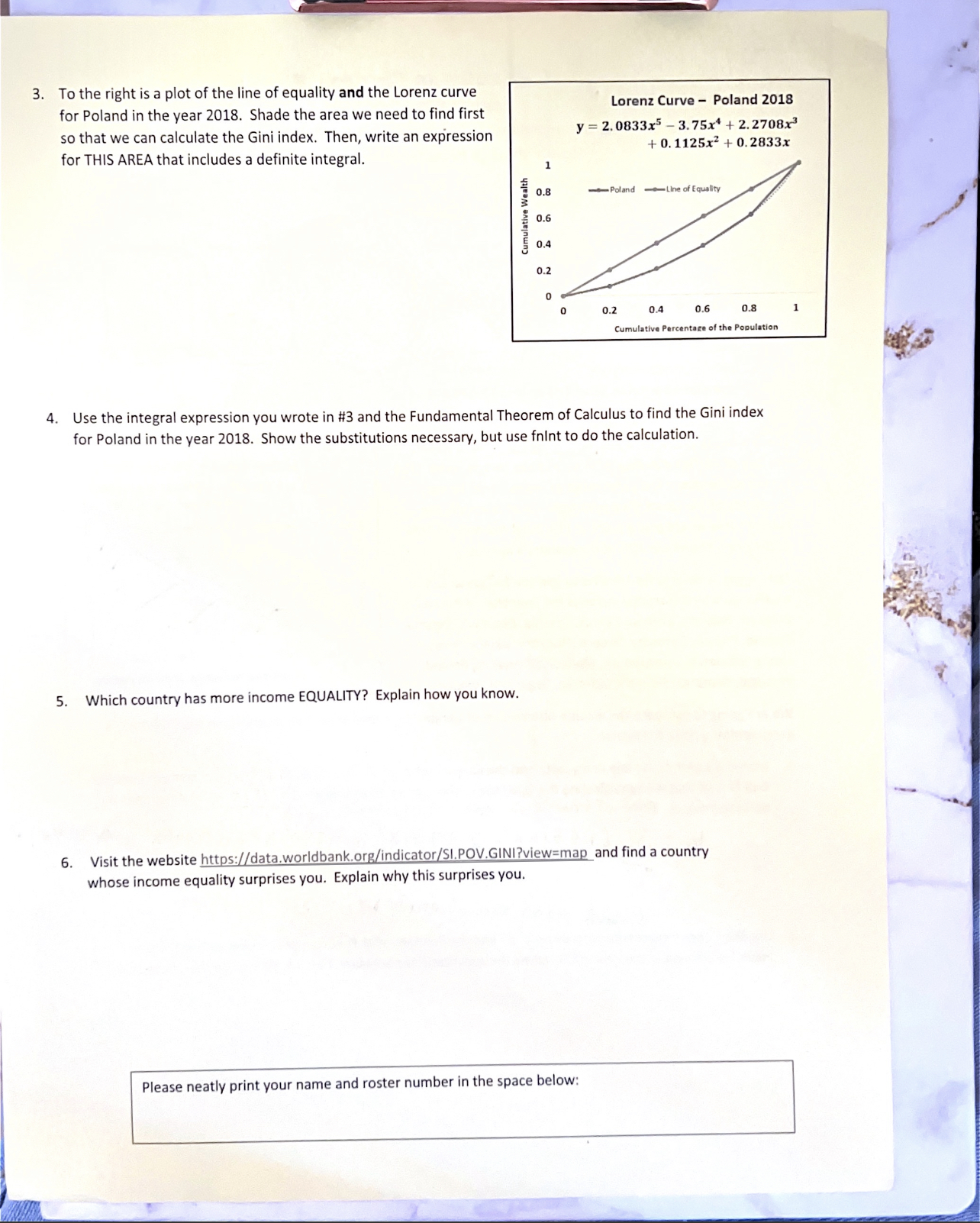
Math 113, Chapters 5 & 6 How does our understanding of integration and the Fundamental Theorem of Calculus allow us to compare income inequality? The Gini index is a statistical measure of income distribution. It ranges from 0 (or 0%) for perfect equality to 1 (or 100%) for perfect inequality. Source: https://data.worldbank.org/indicator/SI.POV.GINI?view=map . A country where every 1. Perfect Equality resident has the same 2. Unequal 3. More Unequal of . . . . . . . . . . . .. 4. Total Inequality . . . . . . . . . . . . . . . . . . . . . ... . . . . . . . . . ... income would have a Gini index of 0. G1=0 A country in which one 3> G2 . . . . . . G4=1 resident earned all the 10076 On income, while everyone Population Population else earned nothing, would have a Gini index of 1. Find shaded area then multiply by 2 The Gini index is defined to be two times the area between the line of perfect equality (y = x) and the Lorenz curve. (The Lorenz Curve - Ukraine 2020 Lorenz curve shows the percentage of income held by each y = 1.5625x5 - 2.5781x* + 1.3438x3 + 0. 2406x2 + 0.4313x percentile of the country's population. As an example, the orenz curve would plot a point at (50, 20) if the bottom 50% = 0.8 -Ukraine -Line of Equality of the population held 20% of the country's income.) 3 0.6 Talks were underway for Ukraine to join the European Union Cumulative V 8 0. an alliance which currently includes the countries of Austria, 0.2 Belgium, Bulgaria, Croatia, Cyprus, Czechia, Denmark, Estonia, Finland, France, Germany, Greece, Hungary, Ireland, Italy, 0 0.4 0.6 0.8 Latvia, Lithuania, Luxembourg, Malta, Netherlands, Poland, Cumulative Percentage of the Population Portugal, Romania, Slovakia, Slovenia, Spain and Sweden. We are going to compare the income distribution of Ukraine with that of Poland, a country in the EU which is geographically close to Ukraine. 1. Above is a plot of the line of equality and the Lorenz curve for Ukraine in 2020. Shade the area we need to find first so that we can calculate the Gini index. Then, write an expression for THIS AREA that includes a definite integral. Area of triangle - Area under lorenz curve 12 - 5 (1.5625 x 5 - 2.5781X4 + 1.3438 x3+ 0. 2406* 2 + 0.4313 x) dx Evaluate the top then multiply by2 2. Use the integral expression you wrote in #1 and the Fundamental Theorem of Calculus to find the Gini index for Ukraine in the year 2020. Show the substitutions necessary, but use faint to do the calculation.3. To the right is a plot of the line of equality and the Lorenz curve for Poland in the year 2018. Shade the area we need to find first Lorenz Curve - Poland 2018 so that we can calculate the Gini index. Then, write an expression y = 2. 0833x5 - 3. 75x* + 2.2708x3 for THIS AREA that includes a definite integral. + 0. 1125x2 + 0.2833x 0.8 Poland Line of Equality Cumulative Wealth 0. 0.4 0.2 0.4 0.6 0.8 Cumulative Percentage of the Population 4. Use the integral expression you wrote in #3 and the Fundamental Theorem of Calculus to find the Gini index for Poland in the year 2018. Show the substitutions necessary, but use fnint to do the calculation. 5. Which country has more income EQUALITY? Explain how you know. 6. Visit the website https://data.worldbank.org/indicator/SI.POV.GINI?view=map_and find a country whose income equality surprises you. Explain why this surprises you. Please neatly print your name and roster number in the space below
Step by Step Solution
There are 3 Steps involved in it

Get step-by-step solutions from verified subject matter experts
 Study Help