







Question: Math 122 Lab 6: Taylor Series Lab Guidelines: . You may work on this lab alone, or with one other person from our class. If
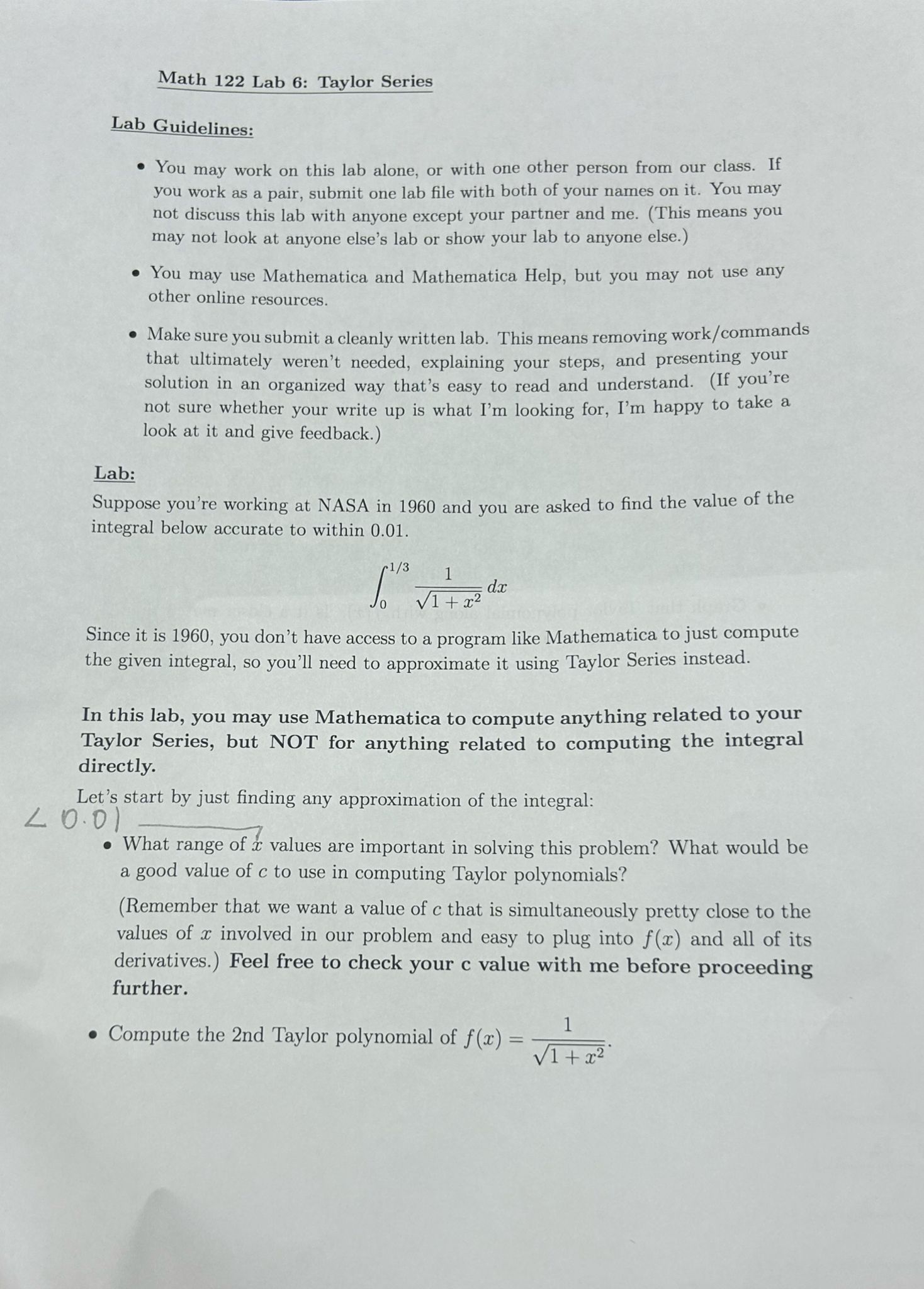
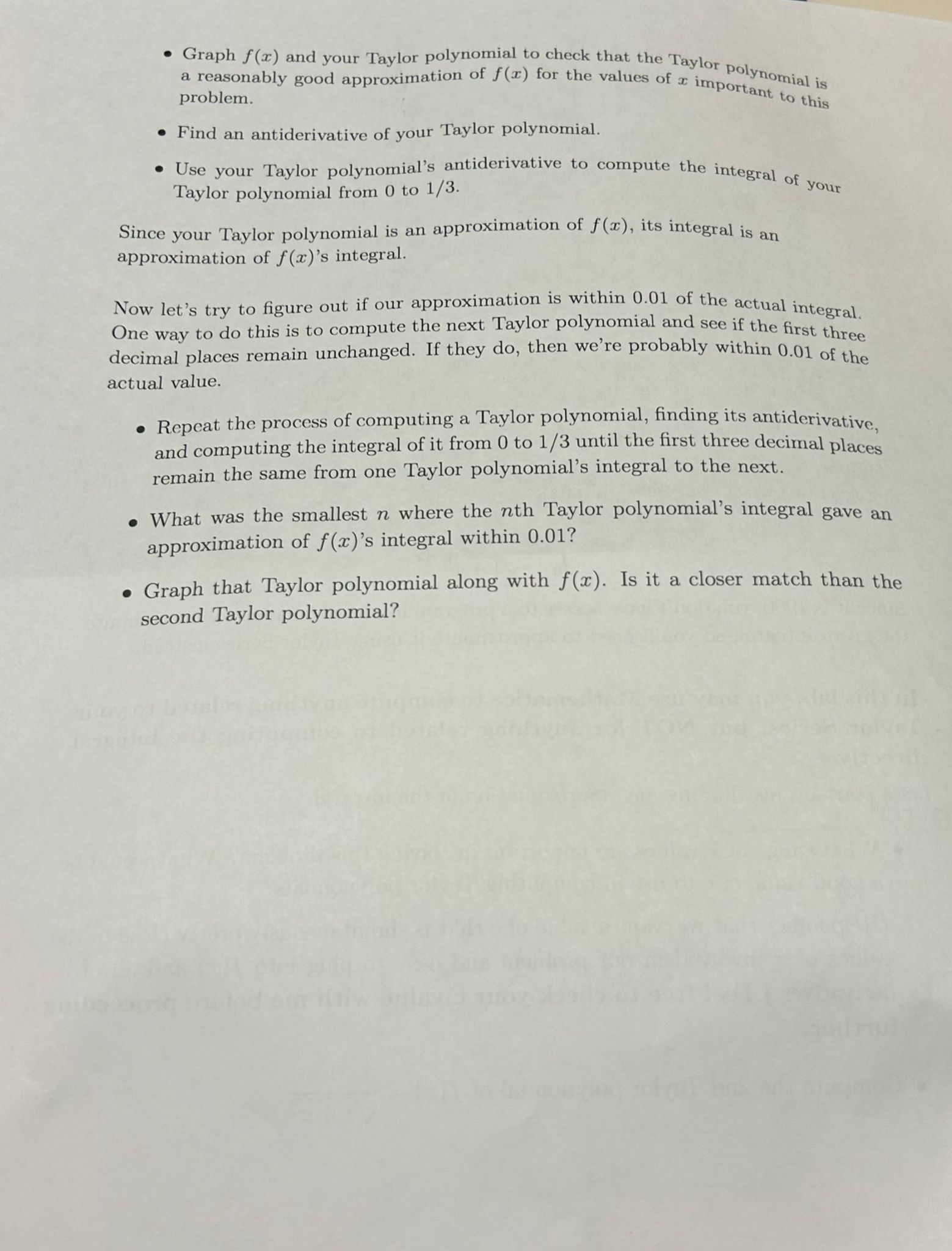
Math 122 Lab 6: Taylor Series Lab Guidelines: . You may work on this lab alone, or with one other person from our class. If you work as a pair, submit one lab file with both of your names on it. You may not discuss this lab with anyone except your partner and me. (This means you may not look at anyone else's lab or show your lab to anyone else.) You may use Mathematica and Mathematica Help, but you may not use any other online resources. . Make sure you submit a cleanly written lab. This means removing work/commands that ultimately weren't needed, explaining your steps, and presenting your solution in an organized way that's easy to read and understand. (If you're not sure whether your write up is what I'm looking for, I'm happy to take a look at it and give feedback.) Lab: Suppose you're working at NASA in 1960 and you are asked to find the value of the integral below accurate to within 0.01. Since it is 1960, you don't have access to a program like Mathematica to just compute the given integral, so you'll need to approximate it using Taylor Series instead. In this lab, you may use Mathematica to compute anything related to your Taylor Series, but NOT for anything related to computing the integral directly. Let's start by just finding any approximation of the integral: 2 0.0) . What range of r values are important in solving this problem? What would be a good value of c to use in computing Taylor polynomials? (Remember that we want a value of c that is simultaneously pretty close to the values of x involved in our problem and easy to plug into f(x) and all of its derivatives.) Feel free to check your c value with me before proceeding further. . Compute the 2nd Taylor polynomial of f(x) = VI+ 2 2. Graph f(x) and your Taylor polynomial to check that the Taylor polynomial is problem. a reasonably good approximation of f(x) for the values of a important to this . Find an antiderivative of your Taylor polynomial. Use your Taylor polynomial's antiderivative to compute the integral of your Taylor polynomial from 0 to 1/3. Since your Taylor polynomial is an approximation of f(T), its integral is an approximation of f(x)'s integral. Now let's try to figure out if our approximation is within 0.01 of the actual integral. One way to do this is to compute the next Taylor polynomial and see if the first three decimal places remain unchanged. If they do, then we're probably within 0.01 of the actual value. . Repeat the process of computing a Taylor polynomial, finding its antiderivative, and computing the integral of it from 0 to 1/3 until the first three decimal places remain the same from one Taylor polynomial's integral to the next. . What was the smallest n where the nth Taylor polynomial's integral gave an approximation of f(x)'s integral within 0.01? . Graph that Taylor polynomial along with f(x). Is it a closer match than the second Taylor polynomial
Step by Step Solution
There are 3 Steps involved in it

Get step-by-step solutions from verified subject matter experts
 Study Help