







Question: MATH 1426 Lab 7 Summer 2022 Indeterminate form types 0, co, and 1 are not powers of numbers but descriptions of limits. These indeterminate forms
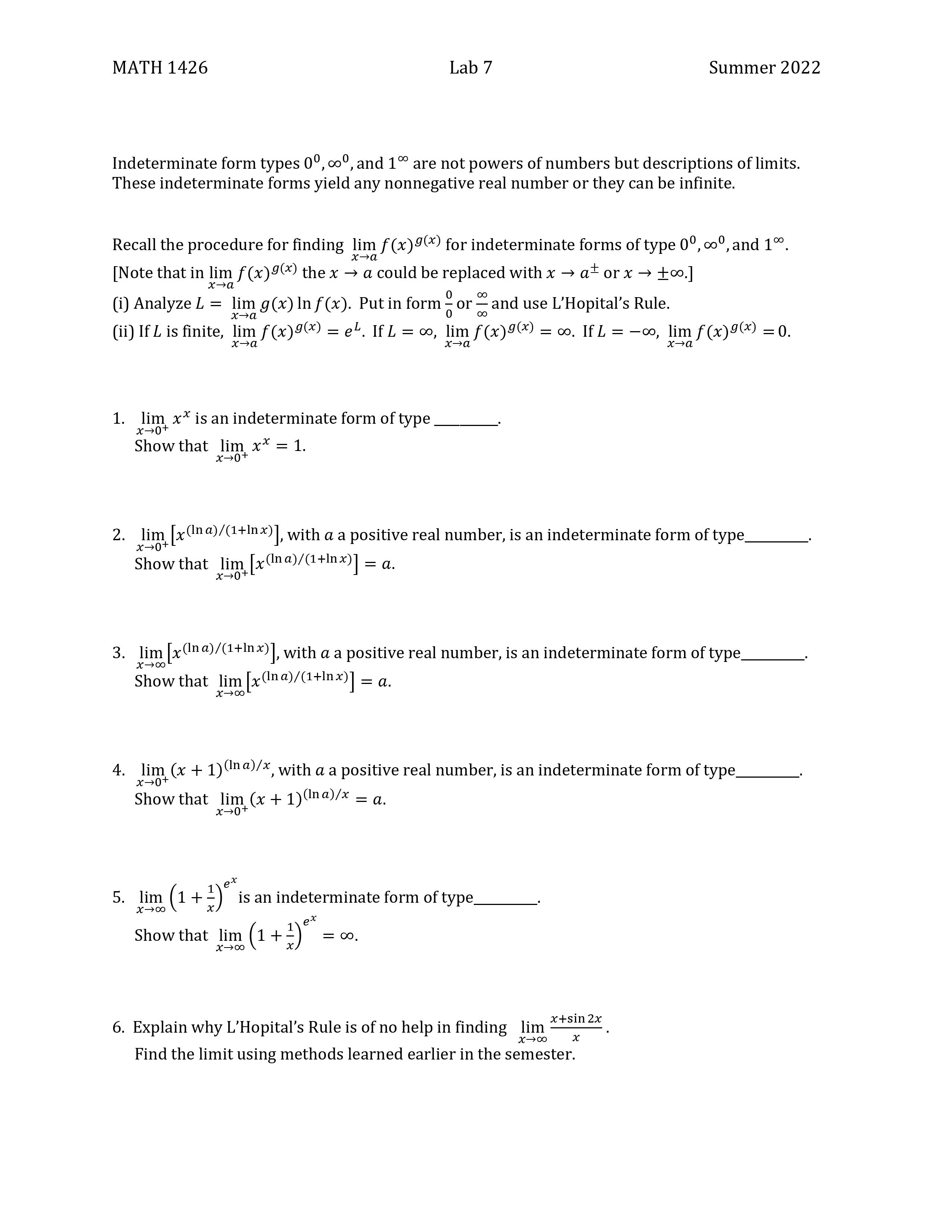
MATH 1426 Lab 7 Summer 2022 Indeterminate form types 0, co, and 1" are not powers of numbers but descriptions of limits. These indeterminate forms yield any nonnegative real number or they can be infinite. Recall the procedure for finding lim f(x)9(*) for indeterminate forms of type 0, co, and 10. [Note that in lim f (x)9() the x - a could be replaced with x - at or x - too.] (i) Analyze L = lim g(x) In f(x). Put in form . or - and use L'Hopital's Rule. (ii) If L is finite, lim f (x)9(*) = eh. If L = co, lim f (x)9(x) = co. If L = -co, lim f (x) 9(x) =0. x - 0+ 1. lim x* is an indeterminate form of type Show that lim x* = 1. x - ot 2. lim [x (Ina)/(1+Inx)], with a a positive real number, is an indeterminate form of type. * - 0+ 1 Show that lim [x(Ina)/(1+Inx)] = a. 3. lim [x (Ina)/(1+In>)], with a a positive real number, is an indeterminate form of type. Show that lim [x (Ina)/(1+inx)] = a. 4. lim (x + 1) (Ina)/x, with a a positive real number, is an indeterminate form of type_ Show that lim (x + 1) (Ina)/x = a. 5. lim (1 + ) is an indeterminate form of type_ Show that lim (1 + ! ) = 0. 6. Explain why L'Hopital's Rule is of no help in finding lim x+sin 2x x Find the limit using methods learned earlier in the semester
Step by Step Solution
There are 3 Steps involved in it

Get step-by-step solutions from verified subject matter experts
 Study Help