





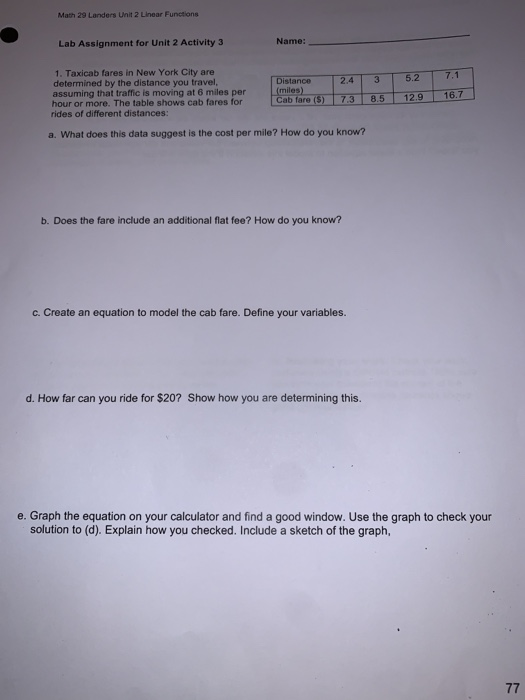
Question: Math 29 Landers Unit 2 Linear Functions Lab Assignment for Unit 2 Activity 3 Name: 3 52 7.1 8.5 12.9 16.7 1. Taxicab fares in
Math 29 Landers Unit 2 Linear Functions Lab
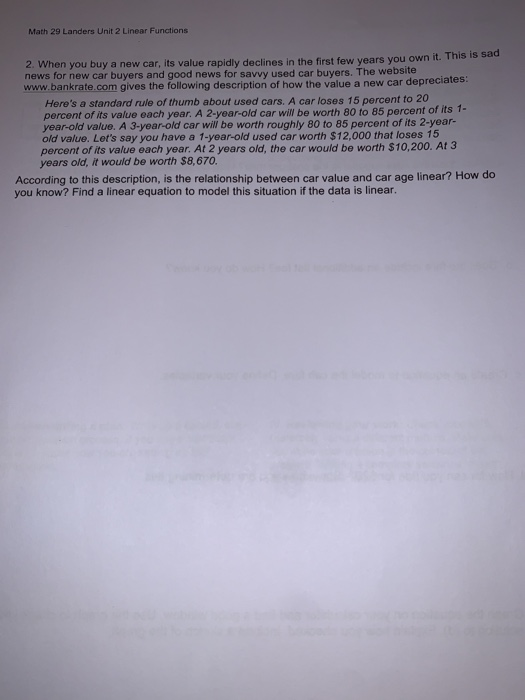
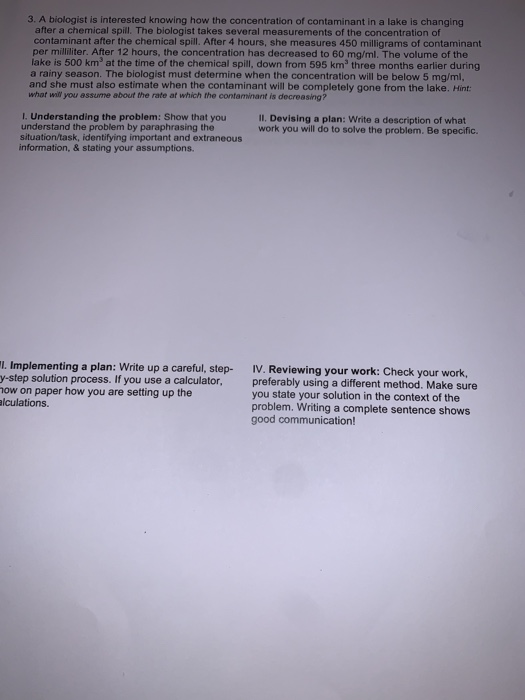
Math 29 Landers Unit 2 Linear Functions Lab Assignment for Unit 2 Activity 3 Name: 3 52 7.1 8.5 12.9 16.7 1. Taxicab fares in New York City are determined by the distance you travel, Distance 2.4 assuming that traffic is moving at 6 miles per (miles) hour or more. The table shows cab fares for Cab fare (S) 7.3 rides of different distances: a. What does this data suggest is the cost per mile? How do you know? b. Does the fare include an additional flat fee? How do you know? c. Create an equation to model the cab fare. Define your variables. d. How far can you ride for $207 Show how you are determining this. e. Graph the equation on your calculator and find a good window. Use the graph to check your solution to (d). Explain how you checked. Include a sketch of the graph, 77 Math 29 Landers Unit 2 Linear Functions 2. When you buy a new car, its value rapidly declines in the first few years you own it. This is sad news for new car buyers and good news for savvy used car buyers. The website www.bankrate.com gives the following description of how the value a new car depreciates: Here's a standard rule of thumb about used cars. A car loses 15 percent to 20 percent of its value each year. A 2-year-old car will be worth 80 to 85 percent of its 1- year-old value. A 3-year-old car will be worth roughly 80 to 85 percent of its 2-year- old value. Let's say you have a 1-year-old used car worth $12,000 that loses 15 percent of its value each year. At 2 years old, the car would be worth $10,200. At 3 years old, it would be worth $8,670. According to this description, is the relationship between car value and car age linear? How do you know? Find a linear equation to model this situation if the data is linear. 3. A biologist is interested knowing how the concentration of contaminant in a lake is changing after a chemical spill. The biologist takes several measurements of the concentration of contaminant after the chemical spill. After 4 hours, she measures 450 milligrams of contaminant per milliliter. After 12 hours, the concentration has decreased to 60 mg/ml. The volume of the lake is 500 km at the time of the chemical spill, down from 595 km three months earlier during a rainy season. The biologist must determine when the concentration will be below 5 mg/ml, and she must also estimate when the contaminant will be completely gone from the lake. Hint: what will you assume about the rate at which the contaminant is decreasing? 1. Understanding the problem: Show that you II. Devising a plan: Write a description of what understand the problem by paraphrasing the work you will do to solve the problem. Be specific. situation/task, identifying important and extraneous information, & stating your assumptions. 1. Implementing a plan: Write up a careful, step- y-step solution process. If you use a calculator, how on paper how you are setting up the alculations. IV. Reviewing your work: Check your work, preferably using a different method. Make sure you state your solution in the context of the problem. Writing a complete sentence shows good communication
Step by Step Solution

There are 3 Steps involved in it

1 Expert Approved Answer
Step: 1 Unlock blur-text-image

Question Has Been Solved by an Expert!

Get step-by-step solutions from verified subject matter experts

Step: 2 Unlock
Step: 3 Unlock

Students Have Also Explored These Related General Management Questions!