







Question: MATH 5120 / 6120 - Fall, 2020 - Test 2 u ( 40) 1 , Urns It and U contain 15K 45 2. C red
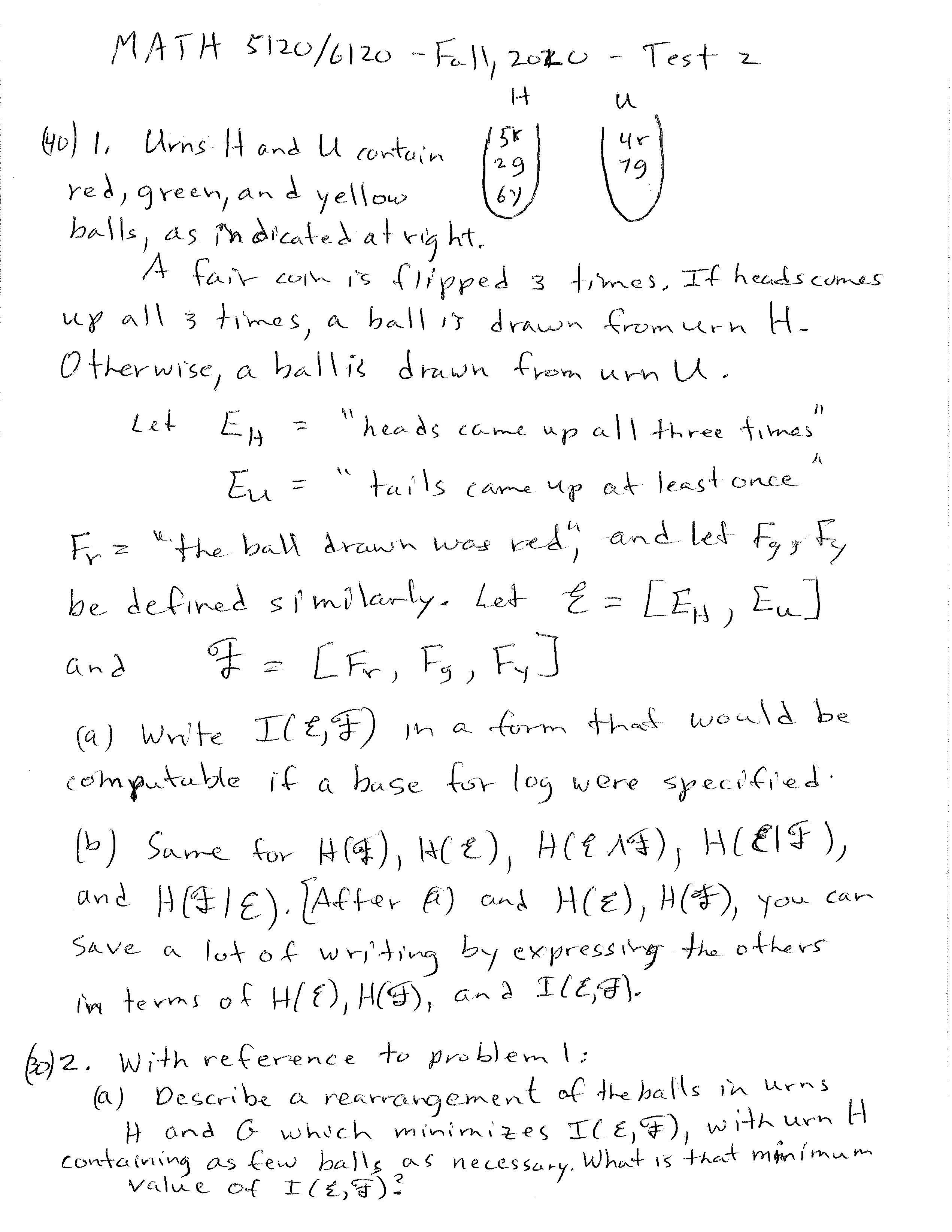
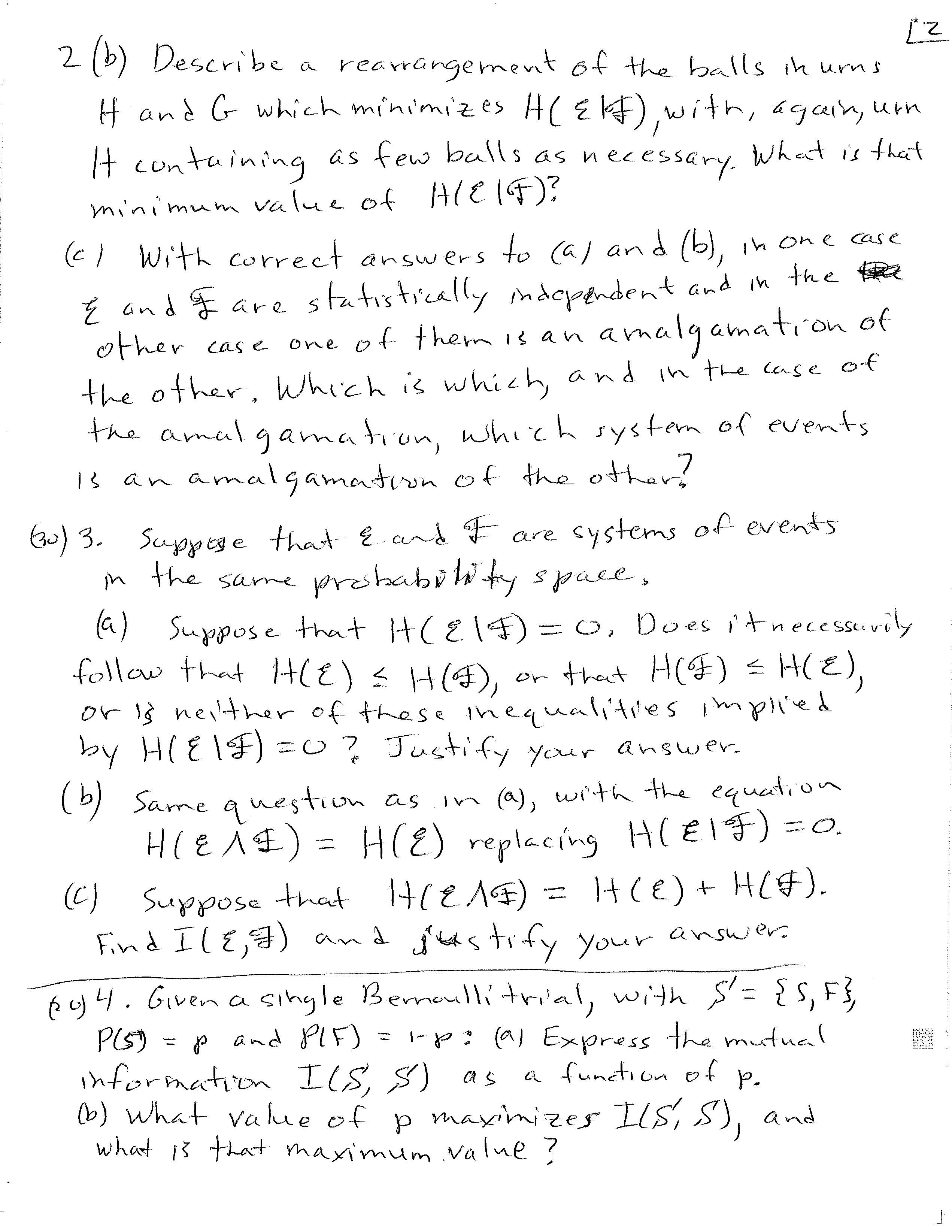
MATH 5120 / 6120 - Fall, 2020 - Test 2 u ( 40) 1 , Urns It and U contain 15K 45 2. C red , green , and yellow 79 67 ) balls, as indicated at right. A fair coin is flipped 3 times, If heads comes up all 3 times, a ball is drawn fromurn H. Otherwise , a ballis drawn from urn U. Let Ey = " heads came up all three times " Eu = " tails came up at least once Fr z "the ball drawn was red, and let Fay Fy be defined similarly. het & = LE,s , End and f = [ Fr, Fs , FyJ ( a) write I(E, F ) in a form that would be computable if a base for log were specified. ( b ) Same for HIGH ) , H(E ) , H(EAS ) , H(EIJ ) , and H ( I/ E ) . ( After () and H(E ), H ( F ), you can Save a lot of writing by expressing the others i'm terms of H (8 ) , H (J ), and I (E, J ). 80/ 2. With reference to problem 1: (a) Describe a rearrangement of the balls in Urns It and a which minimizes I ( E, F), with urn H containing as few balls as necessary . What is that minimum value of I(E , J ) ?2 ( b ) Describe a rearrangement of the balls in urns I and G which minimizes H ( EFF ) with , again , urn It containing as few bulls as necessary . What is that minimum value of Hle (FF ) ? ( " ) With correct answers to (a) and ( b), in one case I and I are statistically independent and in the other case one of them is an amalgamation of the other , Which is which, and in the case of the amalgamation , which system of events Is an amalgamation of the other? (30) 3. Suppose that E and I are systems of events in the same probability space. ( 9) suppose that H ( E 1 J ) = 0, Does it necessarily follow that H(E ) s H (OF), or that H( OF ) = H(E), or is neither of these inequalities implied by HIE I F ) = O? Justify your answer. ( b ) Samequestion as in ( 9 ) , with the equation H ( EAT ) = H (E ) replacing H(EIJ) = 0. ( ( ) Suppose that H(ENOF ) = H(E )+ H (F ) . Find I ( E , 4 ) and justify your answer. (o) 4 . Given a single Bernoullitrial, with S'= ES, FS, P (5 ) = p and PIF ) = 1-p: (al Express the mutual information I(S, S ) as a function of p . ( b) what value of p maximizes I(S, S), and what is that maximum value
Step by Step Solution
There are 3 Steps involved in it

Get step-by-step solutions from verified subject matter experts
 Study Help