







Question: math grade 10 Knowledge and Understanding: A rectangle is defined by the vertices /(10, 0), K(-8, 6), L(-12, -6), and M(6, -12). Show that the
math grade 10
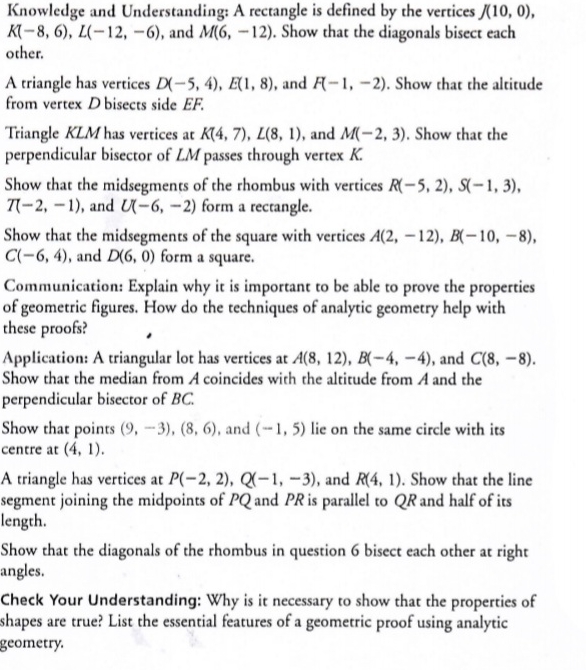
Knowledge and Understanding: A rectangle is defined by the vertices /(10, 0), K(-8, 6), L(-12, -6), and M(6, -12). Show that the diagonals bisect each other. A triangle has vertices DX(-5, 4), E(1, 8), and A(-1, -2). Show that the altitude from vertex D bisects side EF. Triangle KLM has vertices at K(4, 7), Z(8, 1), and M(-2, 3). Show that the perpendicular bisector of LM passes through vertex K. Show that the midsegments of the rhombus with vertices R(-5, 2), S(-1, 3), 7(-2, -1), and U-6, -2) form a rectangle. Show that the midsegments of the square with vertices A(2, -12), B(-10, -8), C(-6, 4), and D(6, 0) form a square. Communication: Explain why it is important to be able to prove the properties of geometric figures. How do the techniques of analytic geometry help with these proofs? Application: A triangular lot has vertices at A(8, 12), B(-4, -4), and C(8, -8). Show that the median from A coincides with the altitude from A and the perpendicular bisector of BC. Show that points (9, -3), (8, 6), and (- 1, 5) lie on the same circle with its centre at (4, 1). A triangle has vertices at P(-2, 2), Q(-1, -3), and R(4, 1). Show that the line segment joining the midpoints of PQ and PR is parallel to QR and half of its length. Show that the diagonals of the rhombus in question 6 bisect each other at right angles. Check Your Understanding: Why is it necessary to show that the properties of shapes are true? List the essential features of a geometric proof using analytic geometry
Step by Step Solution
There are 3 Steps involved in it

Get step-by-step solutions from verified subject matter experts
 Study Help