







Question: Math Question of perfect secrecy (cryptography) Problem 1.3 (10 points). Consider an encryption scheme in which M = {a, b, c), K = (Kl, K2,K3}
Math Question of perfect secrecy (cryptography)
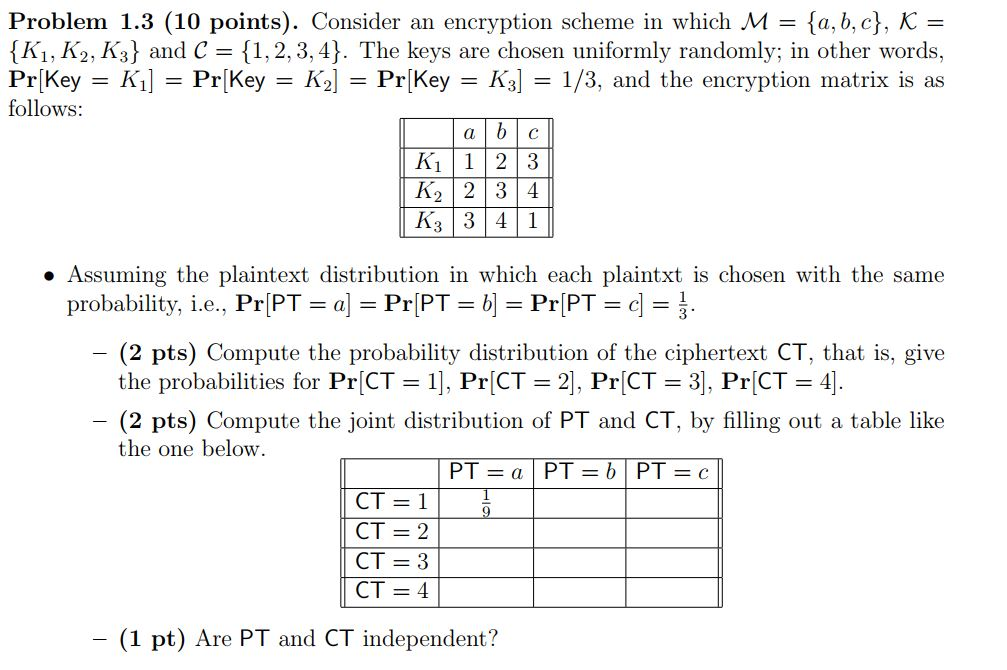
Problem 1.3 (10 points). Consider an encryption scheme in which M = {a, b, c), K = (Kl, K2,K3} and C = {1, 2, 3, 4} . The keys are chosen uniformly randomly, in other words, PrKey = K!! = PrKey = K21 = PrKey K31 = 1/3, and the encryption matrix is as follows: K1 123 K2 23 4 K3 3 41 . Assuming the plaintext distribution in which each plaintxt is chosen with the same probability, i.e., Pr PT = a] = PrPT = b] = PrPT = c] = (2 pts) Compute the probability distribution of the ciphertext CT, that is, give the probabilities fo (2 pts) Compute the joint distribution of PT and CT, by filling out a table like the one below. CT = 1 CT=3 CT=4 (1 pt) Are PT and CT independent
Step by Step Solution
There are 3 Steps involved in it

Get step-by-step solutions from verified subject matter experts
 Study Help