







Question: Mathematica Mathematica 3: DSolve and NDSolve Description: Have a tedious differential equation to solve? Try to use DSolve and NDSolve to solve differential equations in
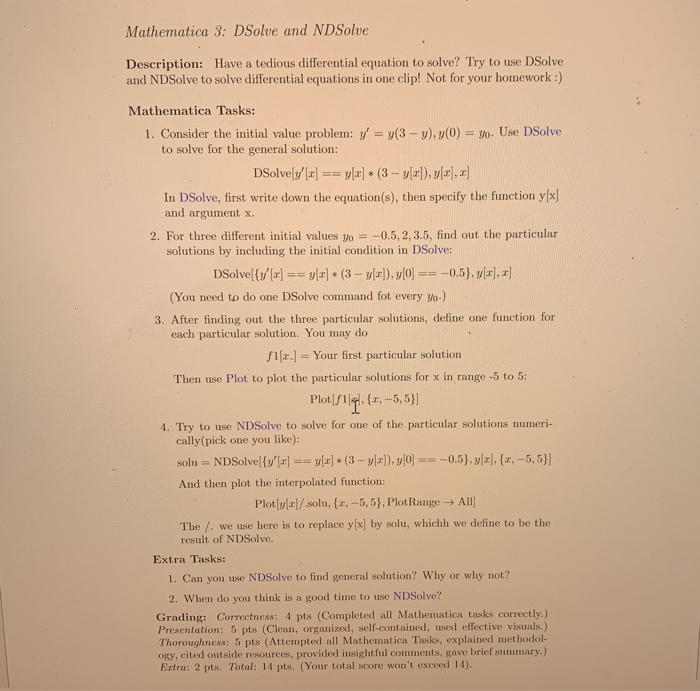
Mathematica 3: DSolve and NDSolve Description: Have a tedious differential equation to solve? Try to use DSolve and NDSolve to solve differential equations in one clip! Not for; your homework :) Mathematica Tasks: 1. Consider the initial value problem: y'= y(3-y), y(0) = 3o. Use DSolve to solve for the general solution: DSolve[y'[r]==y[x]. (3-y[x]), y[z], x] In DSolve, first write down the equation(s), then specify the function y[x] and argument x. 2. For three different initial values yo = -0.5, 2, 3.5, find out the particular solutions by including the initial condition in DSolve: DSolve[{y'[r]==y[x] (3-y[x]), y[0] == -0.5},y[],a] * (You need to do one DSolve command fot every 30-) 3. After finding out the three particular solutions, define one function for each particular solution. You may do fl[r]= Your first particular solution Then use Plot to plot the particular solutions for x in range -5 to 5: Plot/1. {x, -5,5}] 4. Try to use NDSolve to solve for one of the particular solutions numeri- cally (pick one you like): solu = NDSolve[{y'[r]==y[x]. (3-y[x]), v[0] = -0.5), y[z], {z, -5,5}] And then plot the interpolated function: Plotly[r]/.solu, {r, -5,5), Plot Range All] The /. we use here is to replace y[x] by solu, whichh we define to be the result of NDSolve. Extra Tasks: 1. Can you use NDSolve to find general solution? Why or why not? 2. When do you think is a good time to use NDSolve? Grading: Correctness: 4 pts (Completed all Mathematica tasks correctly.) Presentation: 5 pts (Clean, organized, self-contained, used effective visuals.) Thoroughness: 5 pts (Attempted all Mathematica Tasks, explained methodol- ogy, cited outside resources, provided insightful comments, gave brief summary.) Extra: 2 pts. Total: 14 pts. (Your total score won't exceed 14).
Step by Step Solution
3.44 Rating (157 Votes )
There are 3 Steps involved in it
1 Consider the initial value problem y y3y y0 0 Use DSolve to solve for the general solution DSolvey... View full answer

Get step-by-step solutions from verified subject matter experts
 Study Help