







Question: Mathematical Modeling and Data Analysis Proportionality/Geometric Similarity Modeling and Model Fitting PURPOSE: To provide the student the opportunity to develop proportionality arguments and test them
Mathematical Modeling and Data Analysis
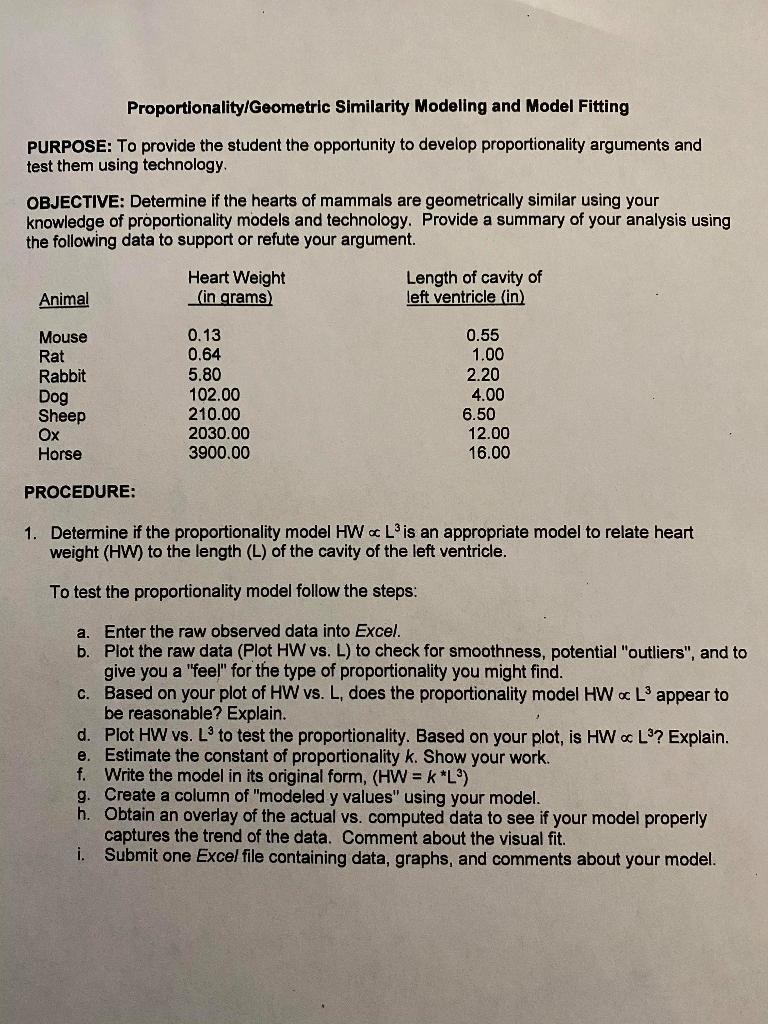
Proportionality/Geometric Similarity Modeling and Model Fitting PURPOSE: To provide the student the opportunity to develop proportionality arguments and test them using technology, OBJECTIVE: Determine if the hearts of mammals are geometrically similar using your knowledge of proportionality models and technology. Provide a summary of your analysis using the following data to support or refute your argument. Heart Weight (in grams Length of cavity of left ventricle (in) Animal Mouse Rat Rabbit Dog Sheep Horse 0.13 0.64 5.80 102.00 210.00 2030.00 3900.00 0.55 1.00 2.20 4.00 6.50 12.00 16.00 PROCEDURE: 1. Determine if the proportionality model HWL is an appropriate model to relate heart weight (HW) to the length (L) of the cavity of the left ventricle. To test the proportionality model follow the steps: a. Enter the raw observed data into Excel. b. Plot the raw data (Plot HW vs. L) to check for smoothness, potential "outliers", and to give you a "feel" for the type of proportionality you might find. c. Based on your plot of HW vs. L, does the proportionality model HW oc L' appear to be reasonable? Explain. d. Plot HW vs. L to test the proportionality. Based on your plot, is HW L? Explain. e. Estimate the constant of proportionality k. Show your work. f. Write the model in its original form, (HW = k *L) g. Create a column of "modeled y values" using your model. h. Obtain an overlay of the actual vs. computed data to see if your model properly captures the trend of the data. Comment about the visual fit. i. Submit one Excel file containing data, graphs, and comments about your model. Proportionality/Geometric Similarity Modeling and Model Fitting PURPOSE: To provide the student the opportunity to develop proportionality arguments and test them using technology, OBJECTIVE: Determine if the hearts of mammals are geometrically similar using your knowledge of proportionality models and technology. Provide a summary of your analysis using the following data to support or refute your argument. Heart Weight (in grams Length of cavity of left ventricle (in) Animal Mouse Rat Rabbit Dog Sheep Horse 0.13 0.64 5.80 102.00 210.00 2030.00 3900.00 0.55 1.00 2.20 4.00 6.50 12.00 16.00 PROCEDURE: 1. Determine if the proportionality model HWL is an appropriate model to relate heart weight (HW) to the length (L) of the cavity of the left ventricle. To test the proportionality model follow the steps: a. Enter the raw observed data into Excel. b. Plot the raw data (Plot HW vs. L) to check for smoothness, potential "outliers", and to give you a "feel" for the type of proportionality you might find. c. Based on your plot of HW vs. L, does the proportionality model HW oc L' appear to be reasonable? Explain. d. Plot HW vs. L to test the proportionality. Based on your plot, is HW L? Explain. e. Estimate the constant of proportionality k. Show your work. f. Write the model in its original form, (HW = k *L) g. Create a column of "modeled y values" using your model. h. Obtain an overlay of the actual vs. computed data to see if your model properly captures the trend of the data. Comment about the visual fit. i. Submit one Excel file containing data, graphs, and comments about your model
Step by Step Solution
There are 3 Steps involved in it

Get step-by-step solutions from verified subject matter experts
 Study Help