







Question: Mathematical oncologists sometimes approximate tumors with the bumpy sphere model given by the family of curves: p=a + b[cos(m*theta) sin(n+phi)] which gives different shapes and
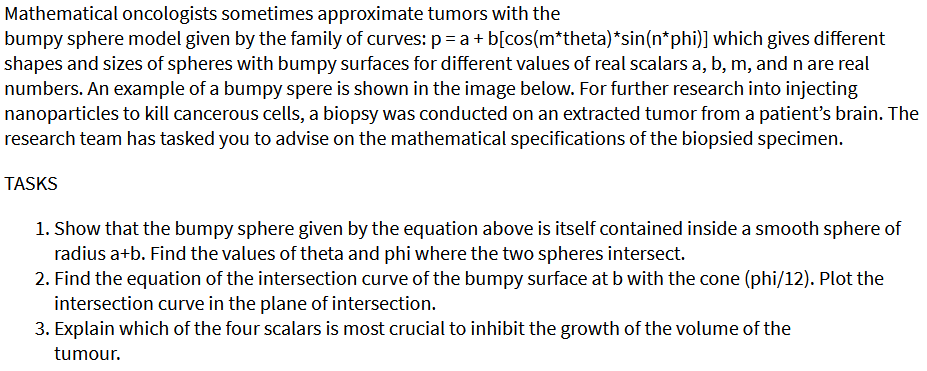
Mathematical oncologists sometimes approximate tumors with the bumpy sphere model given by the family of curves: p=a + b[cos(m*theta) sin(n+phi)] which gives different shapes and sizes of spheres with bumpy surfaces for different values of real scalars a, b, m, and n are real numbers. An example of a bumpy spere is shown in the image below. For further research into injecting nanoparticles to kill cancerous cells, a biopsy was conducted on an extracted tumor from a patient's brain. The research team has tasked you to advise on the mathematical specifications of the biopsied specimen. TASKS 1. Show that the bumpy sphere given by the equation above is itself contained inside a smooth sphere of radius a+b. Find the values of theta and phi where the two spheres intersect. 2. Find the equation of the intersection curve of the bumpy surface at b with the cone (phi/12). Plot the intersection curve in the plane of intersection. 3. Explain which of the four scalars is most crucial to inhibit the growth of the volume of the tumour
Step by Step Solution
There are 3 Steps involved in it

Get step-by-step solutions from verified subject matter experts
 Study Help