







Question: Mathematically, a simple low-pass filter can be modeled by the differential equation di y(1) + K-2 = V(1). (LPF) with the initial condition y(0) =0,
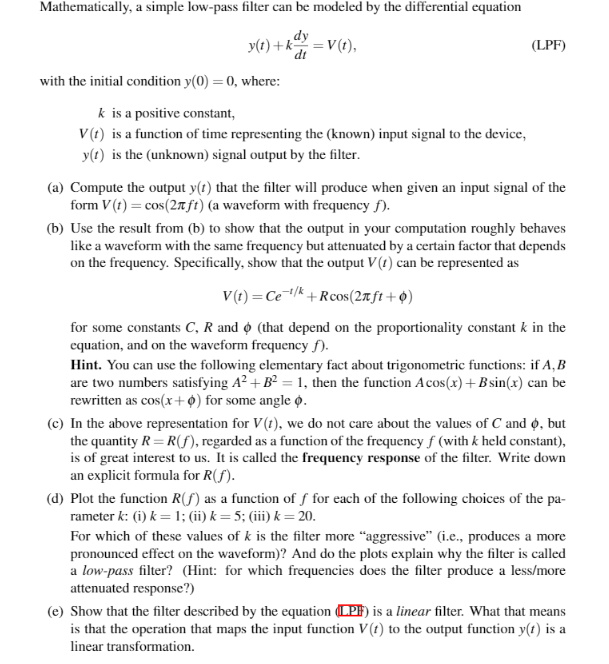
Mathematically, a simple low-pass filter can be modeled by the differential equation di y(1) + K-2 = V(1). (LPF) with the initial condition y(0) =0, where: k is a positive constant, V(t) is a function of time representing the (known) input signal to the device, y(4) is the (unknown) signal output by the filter. (a) Compute the output y(t) that the filter will produce when given an input signal of the form V(1) = cos(2n ft) (a waveform with frequency f). (b) Use the result from (b) to show that the output in your computation roughly behaves like a waveform with the same frequency but attenuated by a certain factor that depends on the frequency. Specifically, show that the output V() can be represented as V(1) = Ce-1/* + Roos(2aft +0) for some constants C. R and o (that depend on the proportionality constant & in the equation, and on the waveform frequency f). Hint. You can use the following elementary fact about trigonometric functions: if A, B are two numbers satisfying A2 + B" = 1, then the function Acos(x) + Bsin(x) can be rewritten as cos(x+ 0) for some angle o. (c) In the above representation for V(), we do not care about the values of C and o, but the quantity R = R(f), regarded as a function of the frequency f (with & held constant), is of great interest to us. It is called the frequency response of the filter. Write down an explicit formula for R(f). (d) Plot the function R(f) as a function of f for each of the following choices of the pa- rameter &: (i) k = 1; (ii) k =5; (iii) k = 20. For which of these values of & is the filter more "aggressive" (i.e., produces a more pronounced effect on the waveform)? And do the plots explain why the filter is called a low-pass filter? (Hint: for which frequencies does the filter produce a less/more attenuated response?) (e) Show that the filter described by the equation (CPP) is a linear filter. What that means is that the operation that maps the input function V() to the output function y(t) is a linear transformation
Step by Step Solution
There are 3 Steps involved in it

Get step-by-step solutions from verified subject matter experts
 Study Help