







Question: Mathlab code needed To get started: Open a new Matlab script and save it as In715|ab2.m Download the file temperature.mat which contains average temperatures for
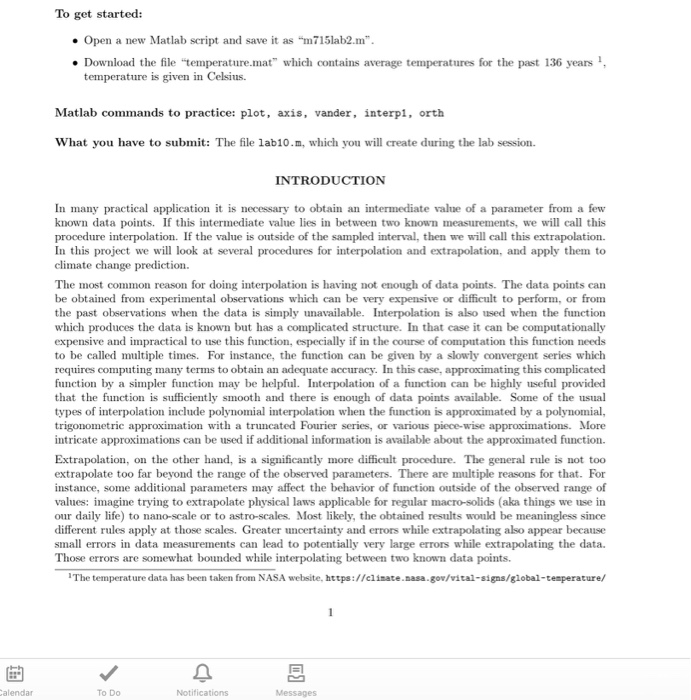
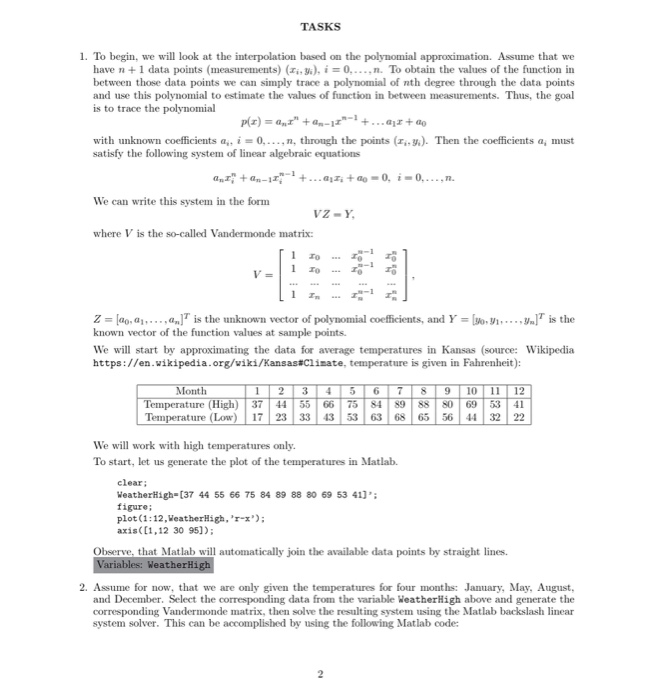
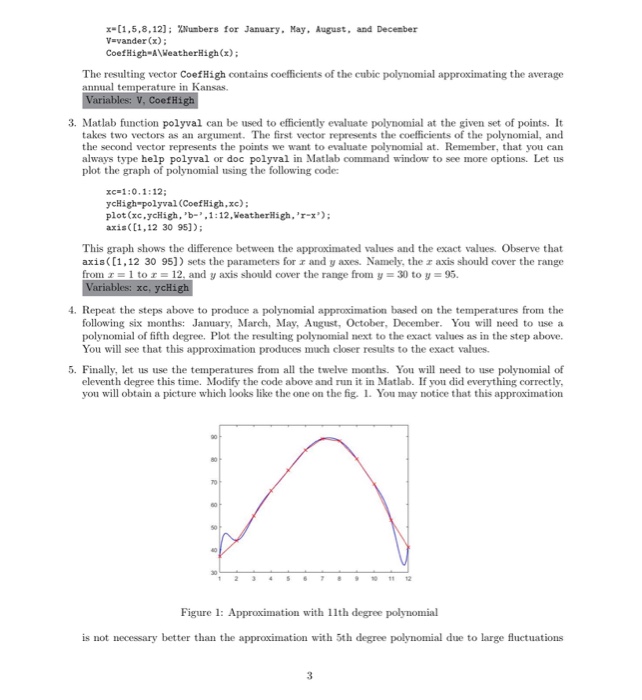
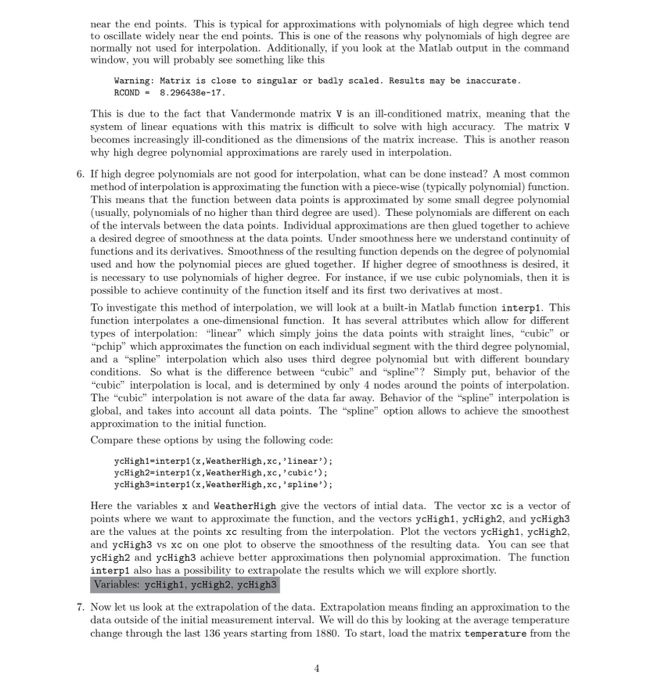
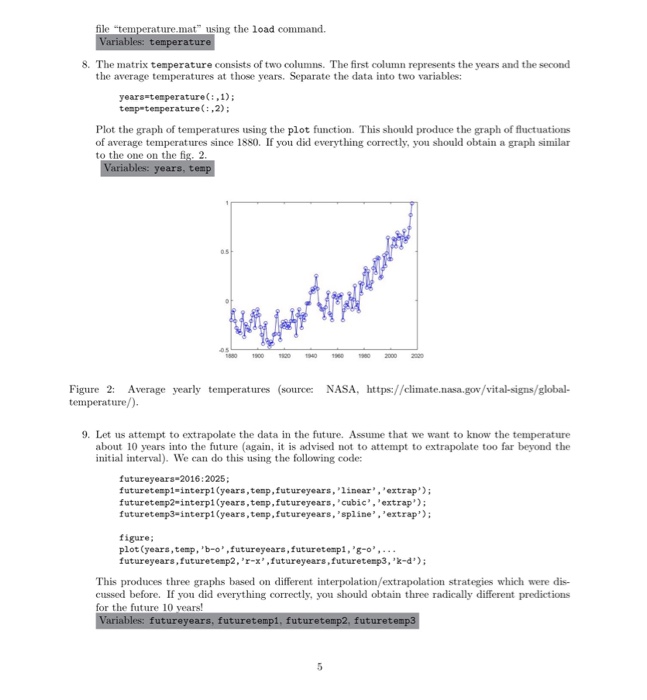
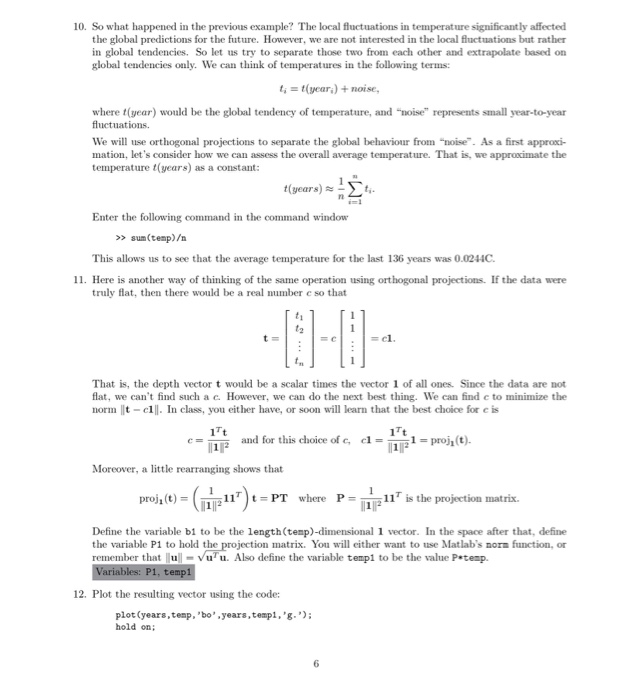
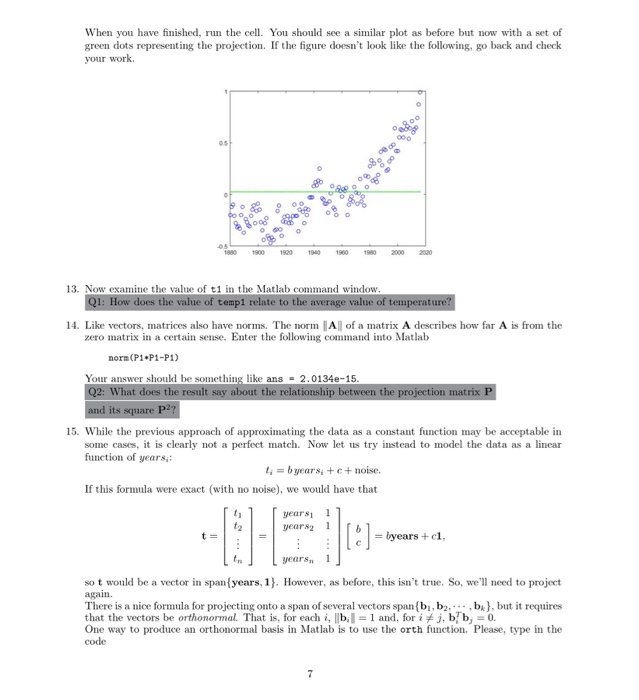
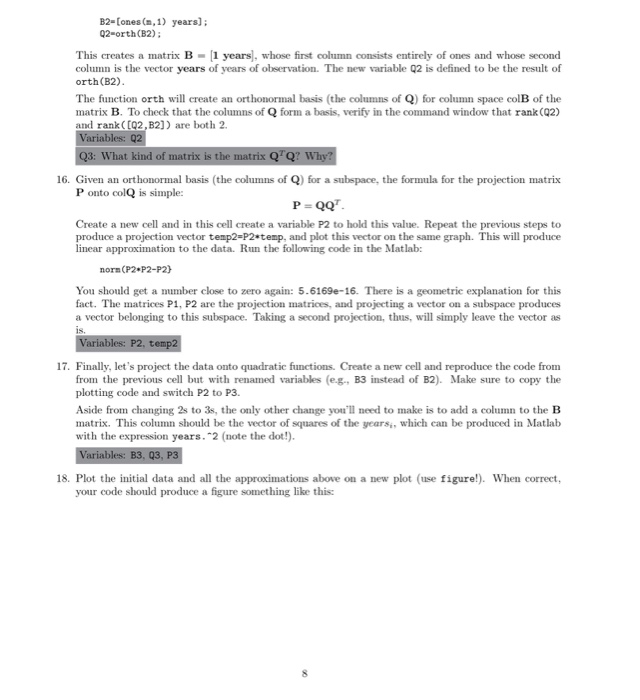
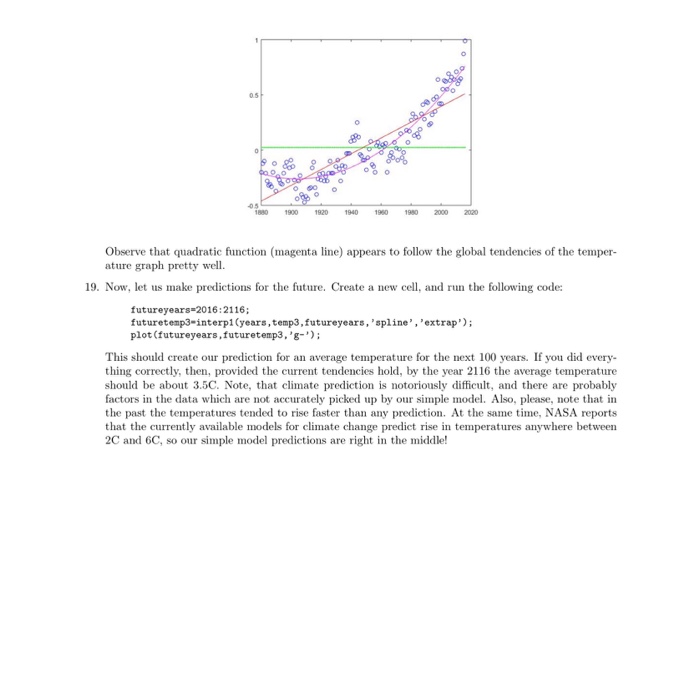
To get started: Open a new Matlab script and save it as "In715|ab2.m Download the file temperature.mat" which contains average temperatures for the past 136 years 1 temperature is given in Celsius Matlab commands to practice: plot, axis, vander, interp, orth What you have to submit: The file lab10.m, which you will create during the lab session. INTRODUCTION In many practical application it is necessary to obtain an intermediate value of a parameter from a few known data points. If this intermediate value lies in between two known measurements, we wil call this procedure interpolation. If the value is outside of the sampled interval, then we will call this extrapolation. In this project we will look at several procedures for interpolation and extrapolation, and apply them to climate change prediction The most common reason for doing interpolation is having not enough of data points. The data points can be obtained from experimental observations which can be very expensive or difficult to perform, or from the past observations when the data is simply unavailable Interpolation is also used when the function which produces the data is known but has a complicated structure. In that case it can be computationally expensive and impractical to use this function, especially if in the course of computation this function needs to be called multiple times. For instance, the function can be given by a slowly convergent series which requires computing many terms to obtain an adequate accuracy. In this case, approximating this complicated function by a simpler function may be helpfu Interpolation of a function can be highly useful provided that the function is sufficiently smooth and there is enough of data points available. Some of the usual types of interpolation include polynomial interpolation when the function is approximated by a polynomial, trigonometric approximation with a truncated Fourier series, or various piece-wise approximations. More intricate approximations can be used if additional information is available about the approximated function Extrapolation, on the other hand, is a significantly more difficult procedure. The general rule is not too extrapolate too far beyond the range of the observed parameters. There are multiple reasons for that. For instance, some additional parameters may affect the behavior of function outside of the observed range of values: imagine trying to extrapolate physical laws applicable for regular macro-solids (aka things we use in our daily life) to nano-scale or to astro-scales. Most likely, the obtained results woud be meaningless since different rules apply at those scales. Greater uncertainty and errors while extrapolating also appear because small errors in data measurements can lead to potentially very large errors while extrapolating the data. Those errors are somewhat bounded while interpolating between two known data points. The temperature data has been taken from NASA website, https://clinate.nasa.gov/vital-signs/global-temperature/ alenda To Do Notifications Messages To get started: Open a new Matlab script and save it as "In715|ab2.m Download the file temperature.mat" which contains average temperatures for the past 136 years 1 temperature is given in Celsius Matlab commands to practice: plot, axis, vander, interp, orth What you have to submit: The file lab10.m, which you will create during the lab session. INTRODUCTION In many practical application it is necessary to obtain an intermediate value of a parameter from a few known data points. If this intermediate value lies in between two known measurements, we wil call this procedure interpolation. If the value is outside of the sampled interval, then we will call this extrapolation. In this project we will look at several procedures for interpolation and extrapolation, and apply them to climate change prediction The most common reason for doing interpolation is having not enough of data points. The data points can be obtained from experimental observations which can be very expensive or difficult to perform, or from the past observations when the data is simply unavailable Interpolation is also used when the function which produces the data is known but has a complicated structure. In that case it can be computationally expensive and impractical to use this function, especially if in the course of computation this function needs to be called multiple times. For instance, the function can be given by a slowly convergent series which requires computing many terms to obtain an adequate accuracy. In this case, approximating this complicated function by a simpler function may be helpfu Interpolation of a function can be highly useful provided that the function is sufficiently smooth and there is enough of data points available. Some of the usual types of interpolation include polynomial interpolation when the function is approximated by a polynomial, trigonometric approximation with a truncated Fourier series, or various piece-wise approximations. More intricate approximations can be used if additional information is available about the approximated function Extrapolation, on the other hand, is a significantly more difficult procedure. The general rule is not too extrapolate too far beyond the range of the observed parameters. There are multiple reasons for that. For instance, some additional parameters may affect the behavior of function outside of the observed range of values: imagine trying to extrapolate physical laws applicable for regular macro-solids (aka things we use in our daily life) to nano-scale or to astro-scales. Most likely, the obtained results woud be meaningless since different rules apply at those scales. Greater uncertainty and errors while extrapolating also appear because small errors in data measurements can lead to potentially very large errors while extrapolating the data. Those errors are somewhat bounded while interpolating between two known data points. The temperature data has been taken from NASA website, https://clinate.nasa.gov/vital-signs/global-temperature/ alenda To Do Notifications Messages
Step by Step Solution
There are 3 Steps involved in it

Get step-by-step solutions from verified subject matter experts
 Study Help