







Question: Matlab code using my two matlab code for already created signals (1 point) Scale your dither signals so that its RMS value is 1/2 of
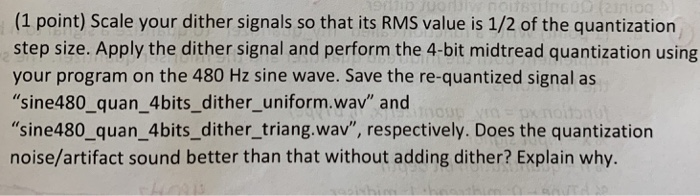
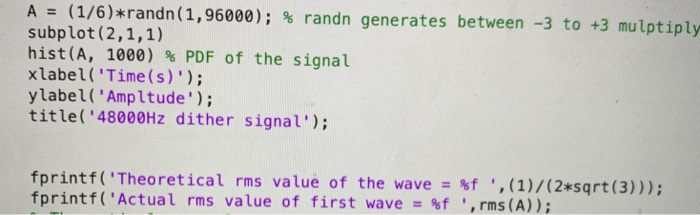
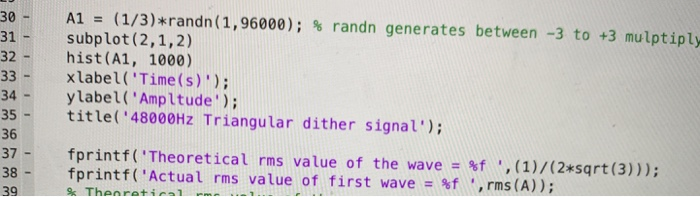
(1 point) Scale your dither signals so that its RMS value is 1/2 of the quantization step size. Apply the dither signal and perform the 4-bit midtread quantization using your program on the 480 Hz sine wave. Save the re-quantized signal as "sine480_quan_4bits_dither_uniform.wav" and "sine480_quan_4bits_dither_triang.wav", respectively. Does the quantization noise/artifact sound better than that without adding dither? Explain why. A- (1/6)*randn(1,96000); % randn generates between -3 to +3 mulptiply subplot (2,1,1) hist(A, 1000) % PDF of the signal xlabel( 'Time(s)'); ylabel( 'Ampltude); title('48000Hz dither signal); fprintf 'Theoretical rms value of the wave f , (1)/(2*sqrt (3))); fprintf ( 'Actual rms value of first wave ' rms (A)): A1- (1/3)*randn(1,96000); % randn generates between -3 to +3 mulptiply subplot (2,1,2) hist (A1, 1000) 30- 32 - 33- xlabel( 'Time (s)); 34 ylabel('Ampltude) 35title( 48000Hz Triangular dither signal); 36 37- fprintf( Theoretical rms value of the wave f (1)/2sqrt (3))); fprintf('Actual rms value of first wave %f ,,rms (A)); 38- 39
Step by Step Solution
There are 3 Steps involved in it

Get step-by-step solutions from verified subject matter experts
 Study Help