







Question: Matlab exercise 26. Let U = {arithmetic, algebra, calculus, geometry, trig- onometry, analysis, topology, statistics), B = {analysis, topology, calculus), C = {algebra, calculus, trigonom-
Matlab exercise
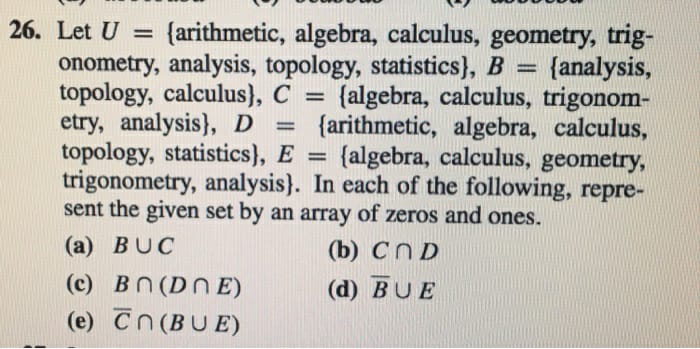
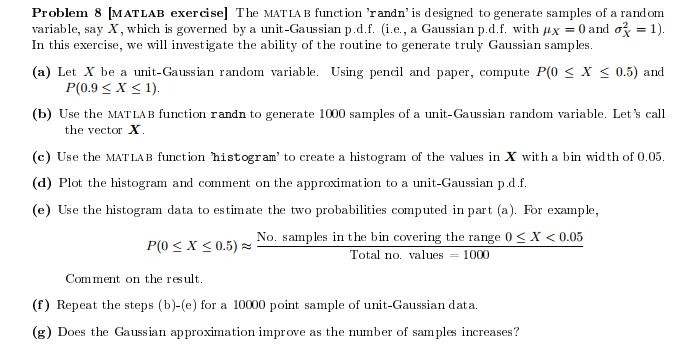

26. Let U = {arithmetic, algebra, calculus, geometry, trig- onometry, analysis, topology, statistics), B = {analysis, topology, calculus), C = {algebra, calculus, trigonom- etry, analysis}, D = {arithmetic, algebra, calculus, topology, statistics), E = {algebra, calculus, geometry, trigonometry, analysis). In each of the following, repre- sent the given set by an array of zeros and ones. (a) BUC (b) CnD (c) BO(DOE) (d) BUE (e) Cn(BUE)Problem 8 [MATLAB exercise] The MATLAB function 'randn' is designed to generate samples of a random variable, say X, which is governed by a unit-Gaussian p.d.f. (i.e., a Gaussian p.d.f. with #x = 0 and of =1). In this exercise, we will investigate the ability of the routine to generate truly Gaussian samples. (a) Let X be a unit-Gaussian random variable. Using pencil and paper, compute P(0
Step by Step Solution
There are 3 Steps involved in it

Get step-by-step solutions from verified subject matter experts
 Study Help