







Question: MATLAB help please using matlab please show steps clearly will rate Microso't Word EEE45 C D file:// U/Users/rober/Downloads EEE4510 Computer Project%20(1).pdf In this project you
MATLAB
help please using matlab please show steps clearly will rate
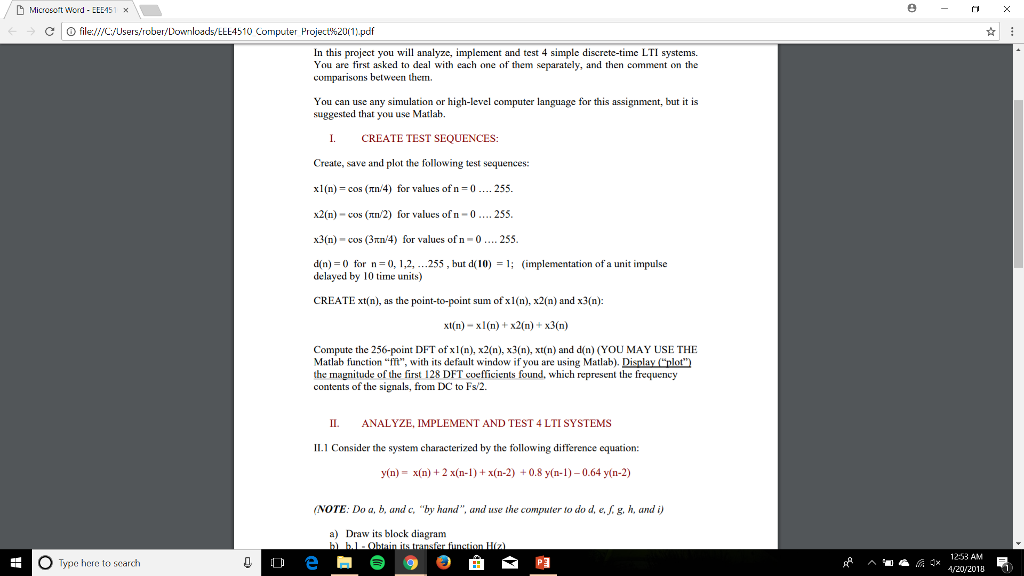
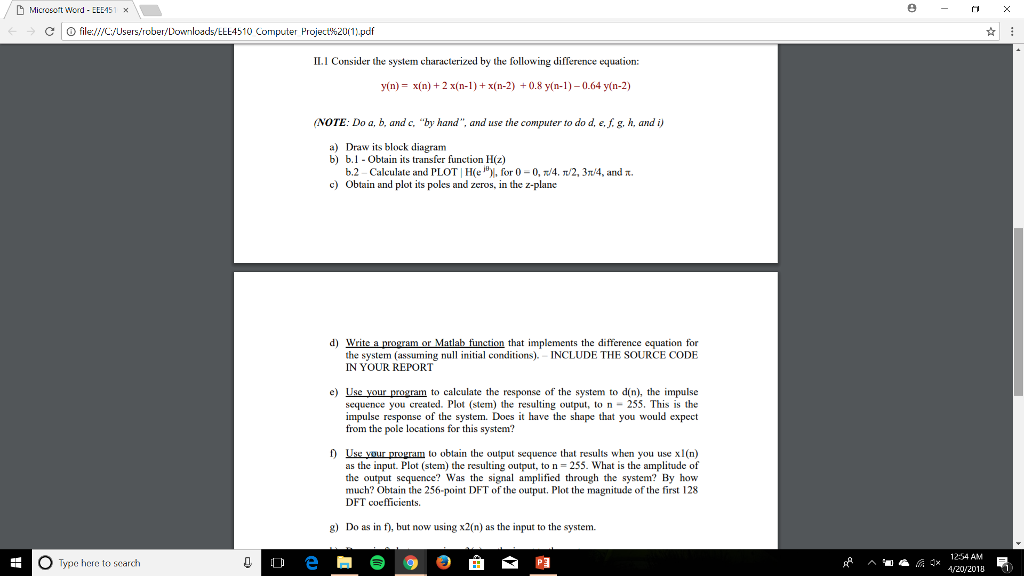
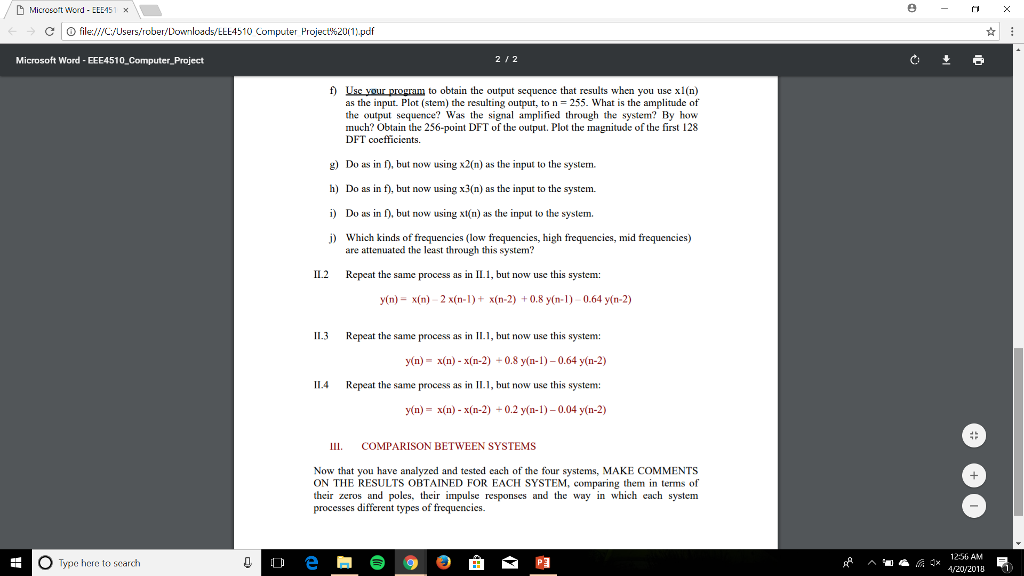
Microso't Word EEE45 C D file:// U/Users/rober/Downloads EEE4510 Computer Project%20(1).pdf In this project you will analyze, implement and test 4 simple discrete-time LTI systems. You are first asked to deal with each one of them separately, and then comment on the comparisons between them. You can use any simulation or high-level computer language for this assignment, but it is suggested that you use Matlah. I. CREATE TEST SEQUENCES: Create, save and plot the following test sequences: xl(n) cos (n4) for values ofn-0.... 255 x2(n) os (Tn2) for values ofn-0 255 x3n) cos 34) for values of n-0 255 din) = O for n = 0, 1,2, 255 , but d(10) = 1; (implementation of a unit impulse delayed by 10 time units) CREATE xt(n), as the point-to-point sum of xl(n). x2(n) and x3n: xl(n)-xl(n) +x2(n)+ x3n) Compute the 256-point DFT ofxl(n), x2(n), x3(n), xt(n) and d(n) (YOU MAY USE THE Matlab function "fft", with its default window if you are using Matlab). Display ("plot" the magnitude of the first 128 DFT coefficients found, which represent the frequency contents of the signals, from DC to Fs2. IL ANALYZE, IMPLEMENT AND TEST 4 LTI SYSTEMS IL.1 Consider the system characterized by the following difference equation: y(n) = x(n) + 2 x(n-l ) + x(n-2) + 0.8 y(n-l)-0.64 y(n-2) NOTE: Do a, b, and c "by hand", and use the computer to do d, e,s g, h, and i) a) Draw its block diagram 1253 AM O Type here to search Microso't Word EEE45 C D file:// U/Users/rober/Downloads EEE4510 Computer Project%20(1).pdf In this project you will analyze, implement and test 4 simple discrete-time LTI systems. You are first asked to deal with each one of them separately, and then comment on the comparisons between them. You can use any simulation or high-level computer language for this assignment, but it is suggested that you use Matlah. I. CREATE TEST SEQUENCES: Create, save and plot the following test sequences: xl(n) cos (n4) for values ofn-0.... 255 x2(n) os (Tn2) for values ofn-0 255 x3n) cos 34) for values of n-0 255 din) = O for n = 0, 1,2, 255 , but d(10) = 1; (implementation of a unit impulse delayed by 10 time units) CREATE xt(n), as the point-to-point sum of xl(n). x2(n) and x3n: xl(n)-xl(n) +x2(n)+ x3n) Compute the 256-point DFT ofxl(n), x2(n), x3(n), xt(n) and d(n) (YOU MAY USE THE Matlab function "fft", with its default window if you are using Matlab). Display ("plot" the magnitude of the first 128 DFT coefficients found, which represent the frequency contents of the signals, from DC to Fs2. IL ANALYZE, IMPLEMENT AND TEST 4 LTI SYSTEMS IL.1 Consider the system characterized by the following difference equation: y(n) = x(n) + 2 x(n-l ) + x(n-2) + 0.8 y(n-l)-0.64 y(n-2) NOTE: Do a, b, and c "by hand", and use the computer to do d, e,s g, h, and i) a) Draw its block diagram 1253 AM O Type here to search
Step by Step Solution
There are 3 Steps involved in it

Get step-by-step solutions from verified subject matter experts
 Study Help