







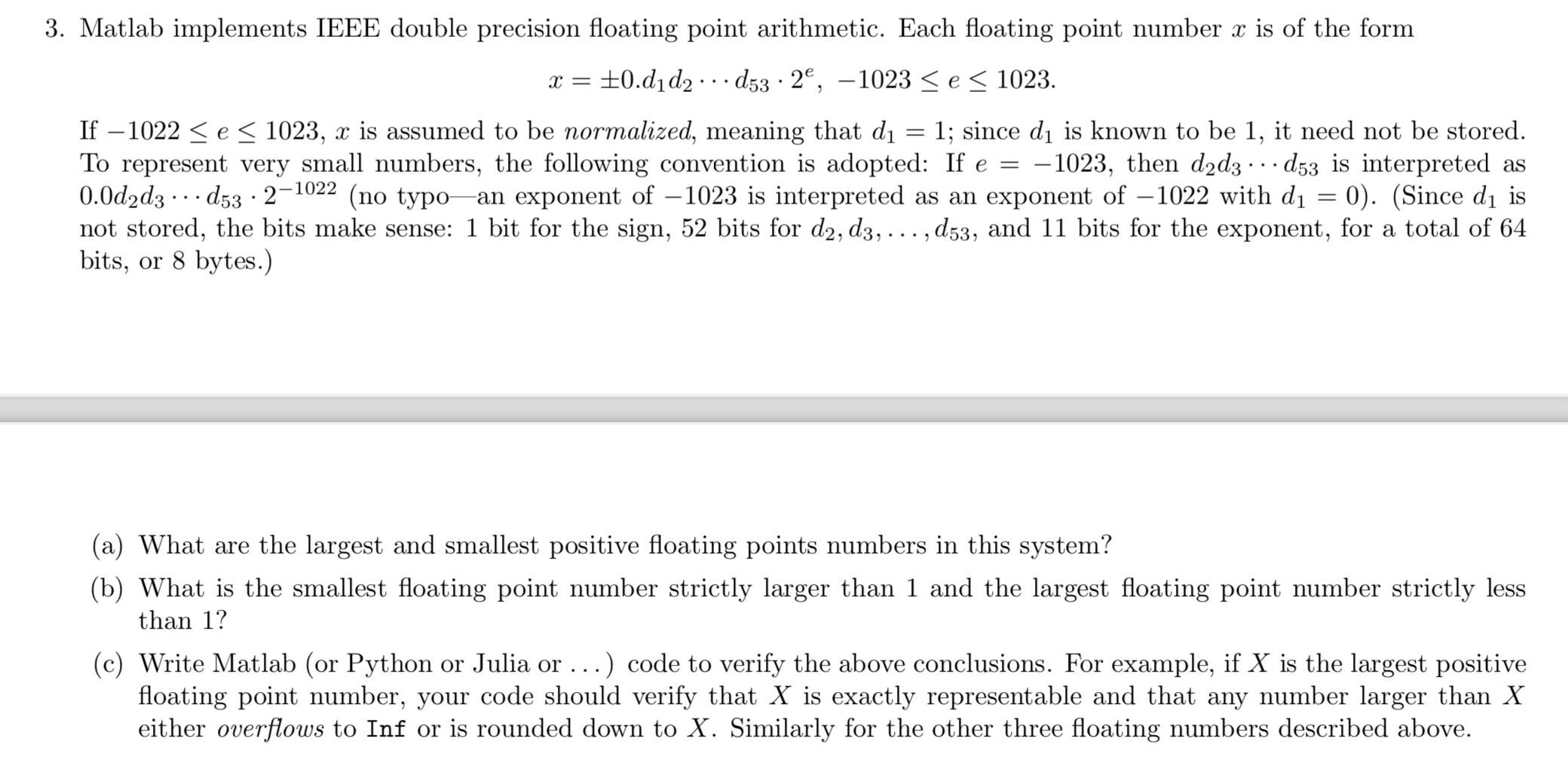
Question: Matlab implements IEEE double precision floating point arithmetic. Each floating point number x is of the form x = + - 0 . d 1
Matlab implements IEEE double precision floating point arithmetic. Each floating point number is of the form
If is assumed to be normalized, meaning that ; since is known to be it need not be stored. To represent very small numbers, the following convention is adopted: If then is interpreted as no typo an exponent of is interpreted as an exponent of with Since is not stored, the bits make sense: bit for the sign, bits for dots, and bits for the exponent, for a total of bits, or bytes.
a What are the largest and smallest positive floating points numbers in this system?
b What is the smallest floating point number strictly larger than and the largest floating point number strictly less than
c Write Matlab or Python or Julia or code to verify the above conclusions. For example, if is the largest positive floating point number, your code should verify that is exactly representable and that any number larger than either overflows to Inf or is rounded down to Similarly for the other three floating numbers described above.
Can you give me a detailed solution so that i can understand thank you
Step by Step Solution
There are 3 Steps involved in it
1 Expert Approved Answer
Step: 1 Unlock

Question Has Been Solved by an Expert!
Get step-by-step solutions from verified subject matter experts
Step: 2 Unlock
Step: 3 Unlock
 Study Help