







Question: MATLAB. PLEASE COMPLETE 4.2. FOLLOW THE CODE OUTLINE PROVIDED AND FILL IN THE '?' OF THE CODE. ALSO ADD TO THE CODE TO MAKE THE
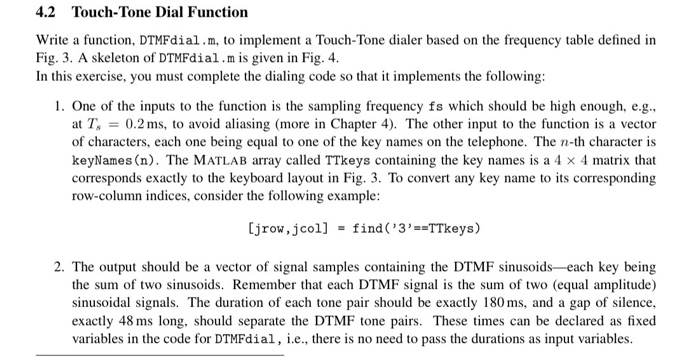
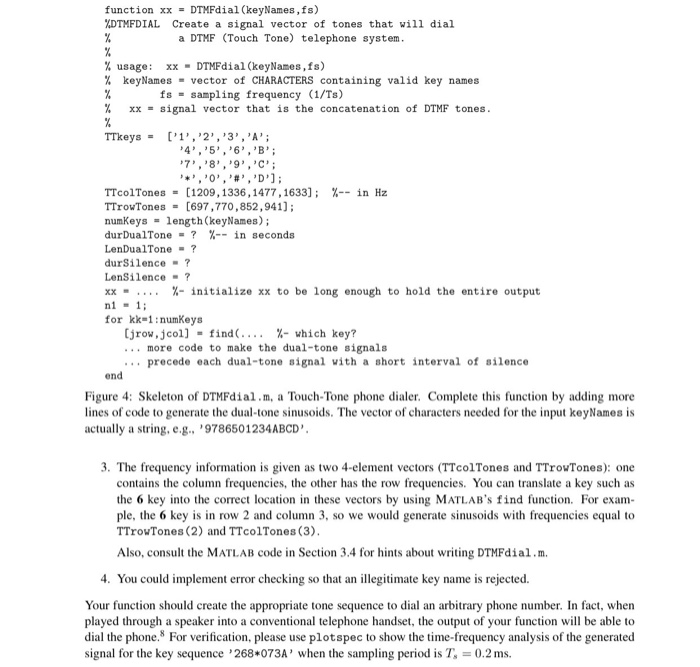
4.2 Touch-Tone Dial Function Write a function, DTMFdial.m, to implement a Touch-Tone dialer based on the frequency table defined in Fig. 3. A skeleton of DTMFdial.m is given in Fig. 4 In this exercise, you must complete the dialing code so that it implements the following: 1. One of the inputs to the function is the sampling frequency fs which should be high enough, e.g. at T, 0.2 ms, to avoid aliasing (more in Chapter 4). The other input to the function is a vector of characters, each one being equal to one of the key names on the telephone. The n-th character is keyNames(n). The MATLAB array called TTkeys containing the key names is a 4 4 matrix that corresponds exactly to the keyboard layout in Fig. 3. To convert any key name to its corresponding row-column indices, consider the following example 2. The output should be a vector of signal samples containing the DTMF sinusoids-each key being the sum of two sinusoids. Remember that each DTMF signal is the sum of two (equal amplitude) sinusoidal signals. The duration of each tone pair should be exactly 180 ms, and a gap of silence, exactly 48 ms long, should separate the DTMF tone pairs. These times can be declared as fixed variables in the code for DTMFdial, .e., there is no need to pass the durations as input variables
Step by Step Solution
There are 3 Steps involved in it

Get step-by-step solutions from verified subject matter experts
 Study Help