







Question: MATLAB. Please complete part 4.1. SHOW YOUR CODE AS WELL AS PLOT THE SPECTROGRAM PLEASE. I have also attached section 3.2 for help. 4.1 Synthesize
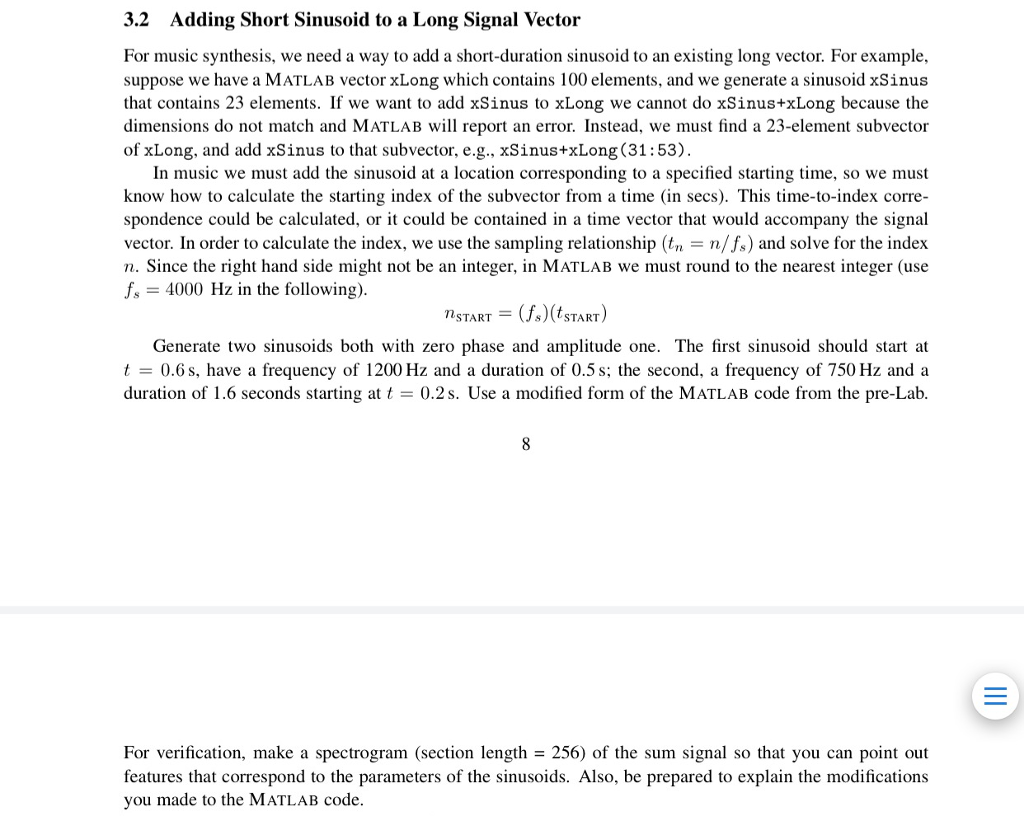
MATLAB. Please complete part 4.1. SHOW YOUR CODE AS WELL AS PLOT THE SPECTROGRAM PLEASE. I have also attached section 3.2 for help. 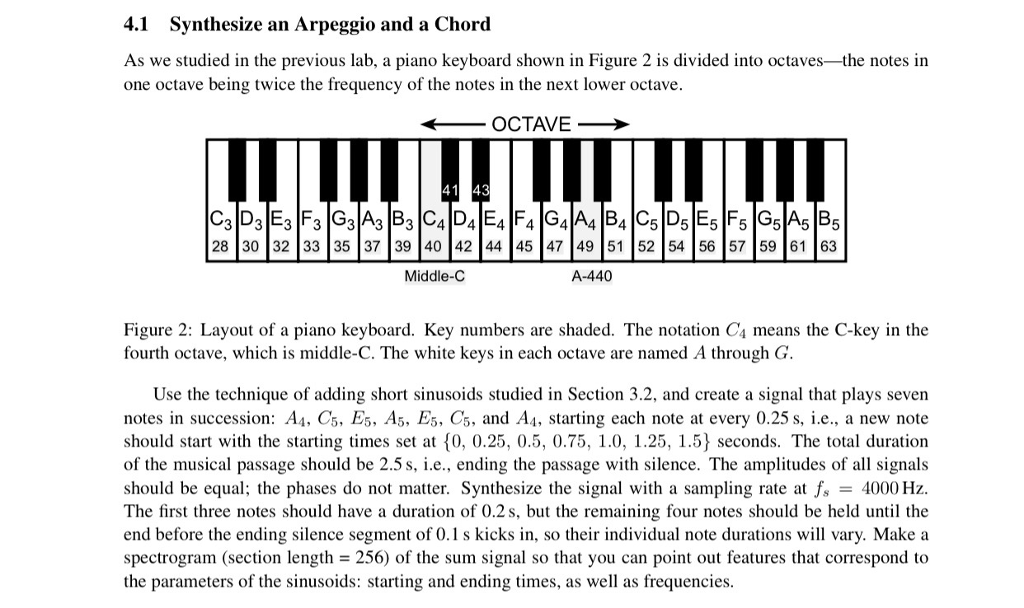
4.1 Synthesize an Arpeggio and a Chord As we studied in the previous lab, a piano keyboard shown in Figure 2 is divided into octaves-the notes in one octave being twice the frequency of the notes in the next lower octave. OCTAVE IIUUUII 28 30 32 | 33 35 | 37 39 40 42 44 45 47 ||49 51 52 | 54 56 |57 59 61 |63 Middle-C A-440 Figure 2: Layout of a piano keyboard. Key numbers are shaded. The notation C4 means the C-key in the fourth octave, which is middle-C. The white keys in each octave are named A through G. Use the technique of adding short sinusoids studied in Section 3.2, and create a signal that plays seven notes in succession: A4, Cs. Es. As, Es, Cs, and As, starting each note at every 0.25 s, i.e., a new note should start with the starting times set at 0, 0.25, 0.5, 0.75, 1.0, 1.25, 1.5) seconds. The total duration of the musical passage should be 2.5 s, i.e., ending the passage with silence. The amplitudes of all signals should be equal; the phases do not matter. Synthesize the signal with a sampling rate at fs = 4100 Hz. The first three notes should have a duration of 0.2s, but the remaining four notes should be held until the end before the ending silence segment of 0.1 s kicks in, so their individual note durations will vary. Make a spectrogram (section length- 256) of the sum signal so that you can point out features that correspond to the parameters of the sinusoids: starting and ending times, as well as frequencies. 4.1 Synthesize an Arpeggio and a Chord As we studied in the previous lab, a piano keyboard shown in Figure 2 is divided into octaves-the notes in one octave being twice the frequency of the notes in the next lower octave. OCTAVE IIUUUII 28 30 32 | 33 35 | 37 39 40 42 44 45 47 ||49 51 52 | 54 56 |57 59 61 |63 Middle-C A-440 Figure 2: Layout of a piano keyboard. Key numbers are shaded. The notation C4 means the C-key in the fourth octave, which is middle-C. The white keys in each octave are named A through G. Use the technique of adding short sinusoids studied in Section 3.2, and create a signal that plays seven notes in succession: A4, Cs. Es. As, Es, Cs, and As, starting each note at every 0.25 s, i.e., a new note should start with the starting times set at 0, 0.25, 0.5, 0.75, 1.0, 1.25, 1.5) seconds. The total duration of the musical passage should be 2.5 s, i.e., ending the passage with silence. The amplitudes of all signals should be equal; the phases do not matter. Synthesize the signal with a sampling rate at fs = 4100 Hz. The first three notes should have a duration of 0.2s, but the remaining four notes should be held until the end before the ending silence segment of 0.1 s kicks in, so their individual note durations will vary. Make a spectrogram (section length- 256) of the sum signal so that you can point out features that correspond to the parameters of the sinusoids: starting and ending times, as well as frequencies
Step by Step Solution
There are 3 Steps involved in it

Get step-by-step solutions from verified subject matter experts
 Study Help