







Question: Matlab Problem For an anticausal filter, the impulse response is zero for n > 0. Anticausal filtering can be accomplished in a three-step process: time
Matlab Problem
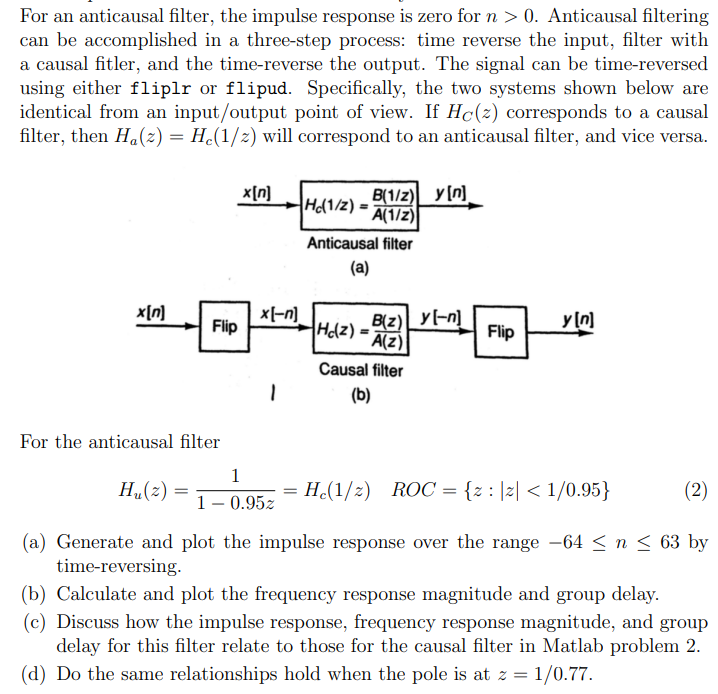
For an anticausal filter, the impulse response is zero for n > 0. Anticausal filtering can be accomplished in a three-step process: time reverse the input, filter with a causal fitler, and the time-reverse the output. The signal can be time-reversed using either fliplr or flipud. Specifically, the two systems shown below are identical from an input/output point of view. If Hc(2) corresponds to a causal filter, then H (2) = H.(1/2) will correspond to an anticausal filter, and vice versa. x[n] Hc(1/2) - B(1/2) yin] A(1/2) Anticausal filter (a) x[n] xl-n] Flip B(z)-n] yn yin Flip Hcz) A(z) Causal filter (b) For the anticausal filter H (2) 1 = H (1/2) ROC = {z : [2] 0. Anticausal filtering can be accomplished in a three-step process: time reverse the input, filter with a causal fitler, and the time-reverse the output. The signal can be time-reversed using either fliplr or flipud. Specifically, the two systems shown below are identical from an input/output point of view. If Hc(2) corresponds to a causal filter, then H (2) = H.(1/2) will correspond to an anticausal filter, and vice versa. x[n] Hc(1/2) - B(1/2) yin] A(1/2) Anticausal filter (a) x[n] xl-n] Flip B(z)-n] yn yin Flip Hcz) A(z) Causal filter (b) For the anticausal filter H (2) 1 = H (1/2) ROC = {z : [2]
Step by Step Solution
There are 3 Steps involved in it

Get step-by-step solutions from verified subject matter experts
 Study Help