







Question: Matlab SCIENTIFIC COMPUTING HOME WORK1 MATRICES a= 1 Create the following matrices, and use them in the exercises that follow: 115 3 221 3 8
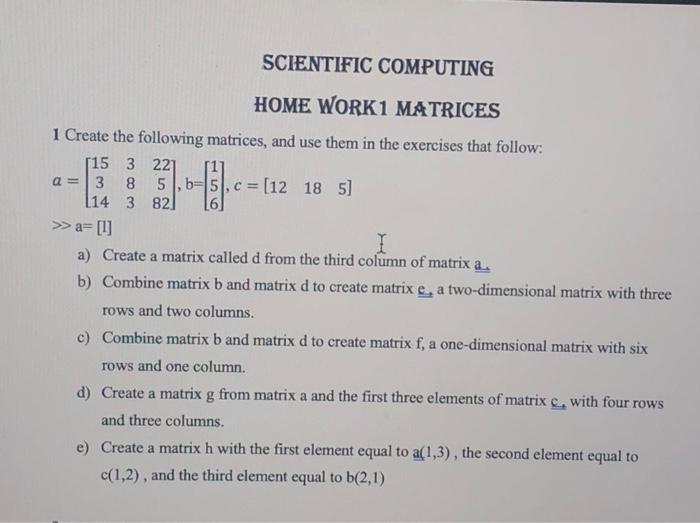
![3 8 5,b= 5.c = [12 18 5] (14 3 82 >>](https://dsd5zvtm8ll6.cloudfront.net/si.experts.images/questions/2024/09/66f31d1859f7a_72766f31d17efa9e.jpg)
![a= [1] I a) Create a matrix called d from the third](https://dsd5zvtm8ll6.cloudfront.net/si.experts.images/questions/2024/09/66f31d18eff99_72866f31d18908f5.jpg)
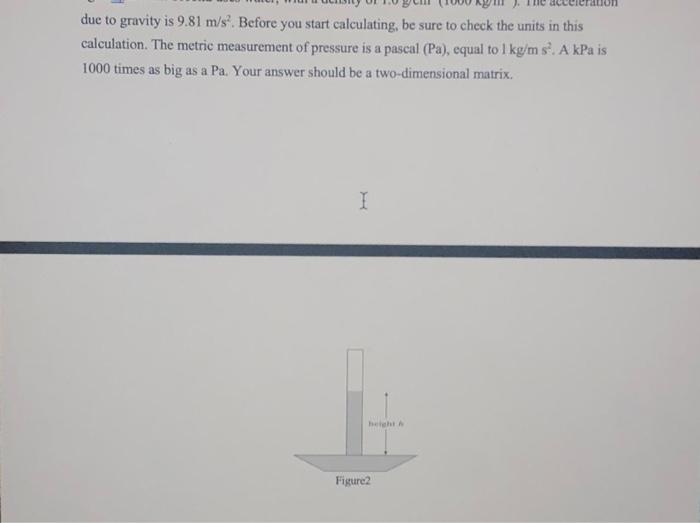
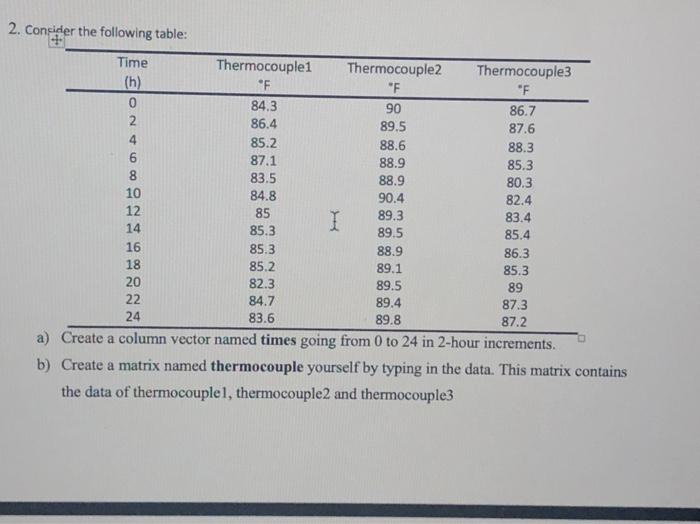
SCIENTIFIC COMPUTING HOME WORK1 MATRICES a= 1 Create the following matrices, and use them in the exercises that follow: 115 3 221 3 8 5,b= 5.c = [12 18 5] (14 3 82 >> a= [1] I a) Create a matrix called d from the third column of matrix a. b) Combine matrix b and matrix d to create matrix e a two-dimensional matrix with three rows and two columns. c) Combine matrix b and matrix d to create matrix f, a one-dimensional matrix with six rows and one column. d) Create a matrix g from matrix a and the first three elements of matrix with four row and three columns. e) Create a matrix h with the first element equal to a(1,3), the second element equal to c(1,2), and the third element equal to b(2,1) OWS 2. Consider the following table: ON Time Thermocouple1 Thermocouple2 Thermocouple3 (h) *F "F *F 84.3 90 86.7 86.4 89.5 87.6 4 85.2 88.6 88.3 6 87.1 88.9 85.3 8 83.5 88.9 80.3 10 84.8 90.4 82.4 12 85 I 89.3 83.4 14 85.3 89.5 85.4 16 85.3 88.9 86.3 18 85.2 89.1 85.3 20 82.3 89.5 89 22 84.7 89.4 87.3 24 83.6 89.8 87.2 a) Create a column vector named times going from 0 to 24 in 2-hour increments. b) Create a matrix named thermocouple yourself by typing in the data. This matrix contains the data of thermocouplel, thermocouple2 and thermocouple3 18 85.2 89.1 85.3 20 82.3 89.5 89 22 84.7 89.4 87.3 24 83.6 89.8 87.2 a) Create a column vector named times going from 0 to 24 in 2-hour increments. b) Create a matrix named thermocouple yourself by typing in the data. This matrix contains the data of thermocouplel, thermocouple2 and thermocouple3 I c) Combine the times vector you created in part (a) with the data from thermocouple to create a matrix corresponding to the table in this problem. d) Find the max and min number in each column of the table. Recall that both the max and min functions can retum not only the maximum values in a column, but also the element number where those values occur. Use this capability to determine the values of times at which the maxima and minima occur in each column. 3. The area of a triangle is, area = x base x height (see Figure 1). Find the area of a group of triangles whose base varies from 1 to 10 m and whose height varies from 2 to 6 m. Choose an appropriate spacing for your calculational variables. Your answer should be a two-dimensional matrix heighth baseb Figure 1 P PE 4. A barometer (see Figure 2) is used to measure atmospheric pressure and is filled with a high- density fluid. In the past, mercury was used, but because of its toxic properties it has been replaced with a variety of other fluids. The pressure, P, measured by a barometer is the height of the fluid column, h, times the density of the liquid, p, times the acceleration due to gravity, 8. or p=hxpxg. This equation could be solved for the height: h=; Find the height to which the liquid column will rise for pressures from 0 to 100 kPa for two different barometers. Assume that the first uses mercury, with a density of 13.56 g/cm (13,560 kg/m) and the second uses water, with a density of 1,0 g/cm (1000 kg/ml). The acceleration due to gravity is 9.81 m/s. Before you start calculating, be sure to check the units in this calculation. The metric measurement of pressure is a pascal (Pa), equal to 1 kg/m s. A kPa is 1000 times as big as a Pa. Your answer should be a two-dimensional matrix. due to gravity is 9.81 m/s. Before you start calculating, be sure to check the units in this calculation. The metric measurement of pressure is a pascal (Pa), equal to 1 kg/m . A kPa is 1000 times as big as a Pa. Your answer should be a two-dimensional matrix. 1 Figure2
Step by Step Solution
There are 3 Steps involved in it

Get step-by-step solutions from verified subject matter experts
 Study Help