







Question: matlab show code Problem Set 7 - Create a single M-file for each problem shown below: (Always suppress the echo for the vectors, label both
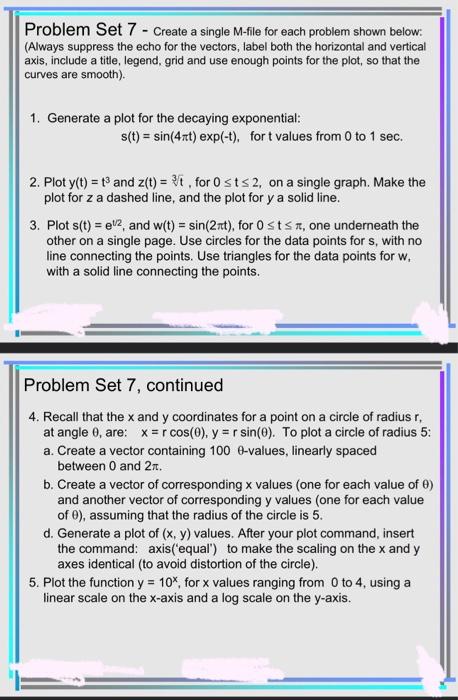
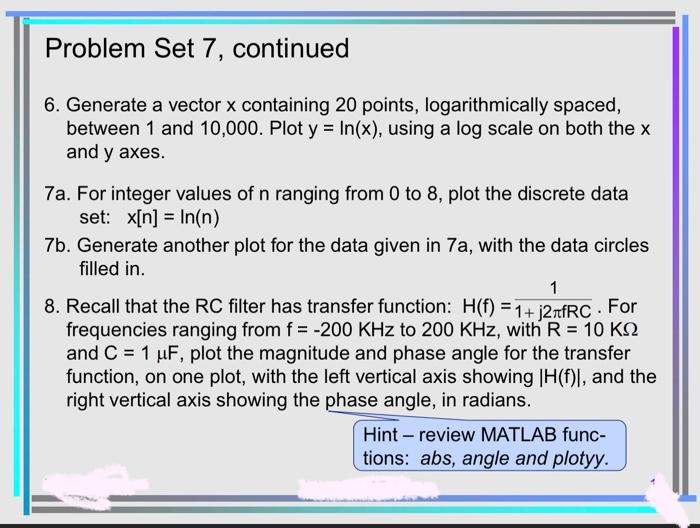
Problem Set 7 - Create a single M-file for each problem shown below: (Always suppress the echo for the vectors, label both the horizontal and vertical axis, include a title, legend, grid and use enough points for the plot, so that the curves are smooth). 1. Generate a plot for the decaying exponential: s(t)=sin(4t)exp(t), for t values from 0 to 1sec. 2. Plot y(t)=t3 and z(t)=3t, for 0t2, on a single graph. Make the plot for z a dashed line, and the plot for y a solid line. 3. Plot s(t)=e1/2, and w(t)=sin(2t), for 0t, one underneath the other on a single page. Use circles for the data points for s, with no line connecting the points. Use triangles for the data points for w, with a solid line connecting the points. Problem Set 7 , continued 4. Recall that the x and y coordinates for a point on a circle of radius r, at angle , are: x=rcos(),y=rsin(). To plot a circle of radius 5 : a. Create a vector containing 100 -values, linearly spaced between 0 and 2. b. Create a vector of corresponding x values (one for each value of ) and another vector of corresponding y values (one for each value of ), assuming that the radius of the circle is 5 . d. Generate a plot of (x,y) values. After your plot command, insert the command: axis('equal') to make the scaling on the x and y axes identical (to avoid distortion of the circle). 5. Plot the function y=10x, for x values ranging from 0 to 4 , using a linear scale on the x-axis and a log scale on the y-axis. Problem Set 7 , continued 6. Generate a vector x containing 20 points, logarithmically spaced, between 1 and 10,000. Plot y=ln(x), using a log scale on both the x and y axes. 7a. For integer values of n ranging from 0 to 8 , plot the discrete data set: x[n]=ln(n) 7b. Generate another plot for the data given in 7a, with the data circles filled in. 8. Recall that the RC filter has transfer function: H(f)=1+j2fRC1. For frequencies ranging from f=200KHz to 200KHz, with R=10K and C=1F, plot the magnitude and phase angle for the transfer function, on one plot, with the left vertical axis showing H(f), and the right vertical axis showing the phase angle, in radians
Step by Step Solution
There are 3 Steps involved in it

Get step-by-step solutions from verified subject matter experts
 Study Help