







Question: MATLAB...do not use the Matlab functions. Make your own. The Binomial Distribution is a probability distribution defined only at discrete values of r. It describes
MATLAB...do not use the Matlab functions. Make your own.
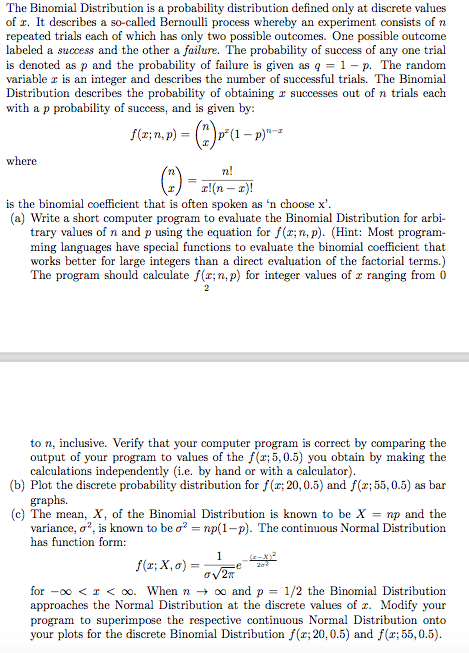
The Binomial Distribution is a probability distribution defined only at discrete values of r. It describes a so-called Bernoulli process whereby an experiment consists of n repeated trials each of which has only two possible outcomes. One possible outcome labeled a success and the other a failure. The probability of success of any one trial is denoted as p and the probability of failure is given as q 1-p. The random variable r is an integer and describes the number of successful trials. The Binomial Distribution describes the probability of obtaining x successes out of n trials each with a p probability of success, and is given by: where n! is the binomial coefficient that is often spoken as 'n choose x (a) Write a short computer program to evaluate the Binomial Distribution for arbi- trary values of n and p using the equation for f(r;n, p). (Hint: Most program ming languages have special functions to evaluate the binomial coefficient that works better for large integers than a direct evaluation of the factorial terms.) The program should calculate f(r;n,p) for integer values of z ranging from 0 to n, inclusive. Verify that your computer program is correct by comparing the output of your program to values of the f(x;5,0.5) you obtain by making the calculations independently (i.e. by hand or with a calculator) (b) Plot the discrete probability distribution for f(x; 20,0.5) and f(x;55,0.5) as bar graphs. (c) The mean, X, of the Binomial Distribution is known to be X-np and the variance, 2, is known to be 2-np(1-P). The continuous Normal Distribution has function form: for-oo
Step by Step Solution
There are 3 Steps involved in it

Get step-by-step solutions from verified subject matter experts
 Study Help