







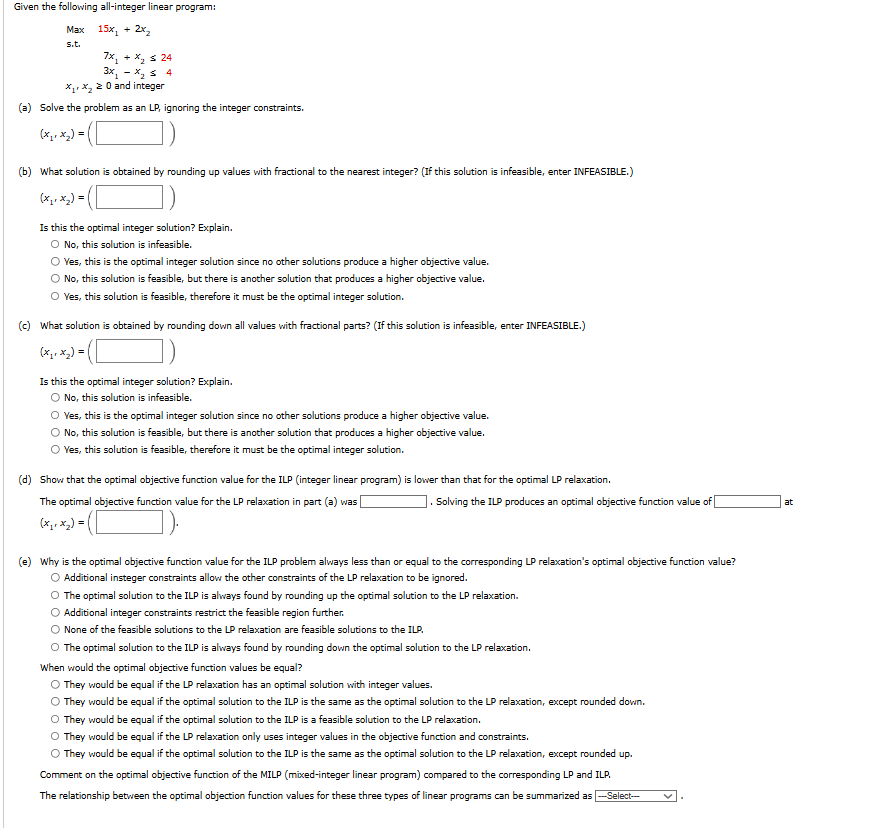
Question: Max 1 5 x 1 + 2 x 2 s . t . 7 x 1 + x 2 2 4 3 x 1 x
Max xx stx xx x x x and integer a Solve the problem as an LP ignoring the integer constraints. x xb What solution is obtained by rounding up values with fractional to the nearest integer? If this solution is infeasible, enter INFEASIBLE.x x Is this the optimal integer solution? Explain. No this solution is infeasible. Yes, this is the optimal integer solution since no other solutions produce a higher objective value. No this solution is feasible, but there is another solution that produces a higher objective value. Yes, this solution is feasible, therefore it must be the optimal integer solution. c What solution is obtained by rounding down all values with fractional parts? If this solution is infeasible, enter INFEASIBLE.x x Is this the optimal integer solution? Explain. No this solution is infeasible. Yes, this is the optimal integer solution since no other solutions produce a higher objective value. No this solution is feasible, but there is another solution that produces a higher objective value. Yes, this solution is feasible, therefore it must be the optimal integer solution. d Show that the optimal objective function value for the ILP integer linear program is lower than that for the optimal LP relaxation. The optimal objective function value for the LP relaxation in part a was Solving the ILP produces an optimal objective function value of at x xe Why is the optimal objective function value for the ILP problem always less than or equal to the corresponding LP relaxation's optimal objective function value? Additional insteger constraints allow the other constraints of the LP relaxation to be ignored. The optimal solution to the ILP is always found by rounding up the optimal solution to the LP relaxation. Additional integer constraints restrict the feasible region further. None of the feasible solutions to the LP relaxation are feasible solutions to the ILP. The optimal solution to the ILP is always found by rounding down the optimal solution to the LP relaxation. When would the optimal objective function values be equal? They would be equal if the LP relaxation has an optimal solution with integer values. They would be equal if the optimal solution to the ILP is the same as the optimal solution to the LP relaxation, except rounded down. They would be equal if the optimal solution to the ILP is a feasible solution to the LP relaxation. They would be equal if the LP relaxation only uses integer values in the objective function and constraints. They would be equal if the optimal solution to the ILP is the same as the optimal solution to the LP relaxation, except rounded up Comment on the optimal objective function of the MILP mixedinteger linear program compared to the corresponding LP and ILP. The relationship b
Step by Step Solution
There are 3 Steps involved in it
1 Expert Approved Answer
Step: 1 Unlock

Question Has Been Solved by an Expert!
Get step-by-step solutions from verified subject matter experts
Step: 2 Unlock
Step: 3 Unlock
 Study Help