



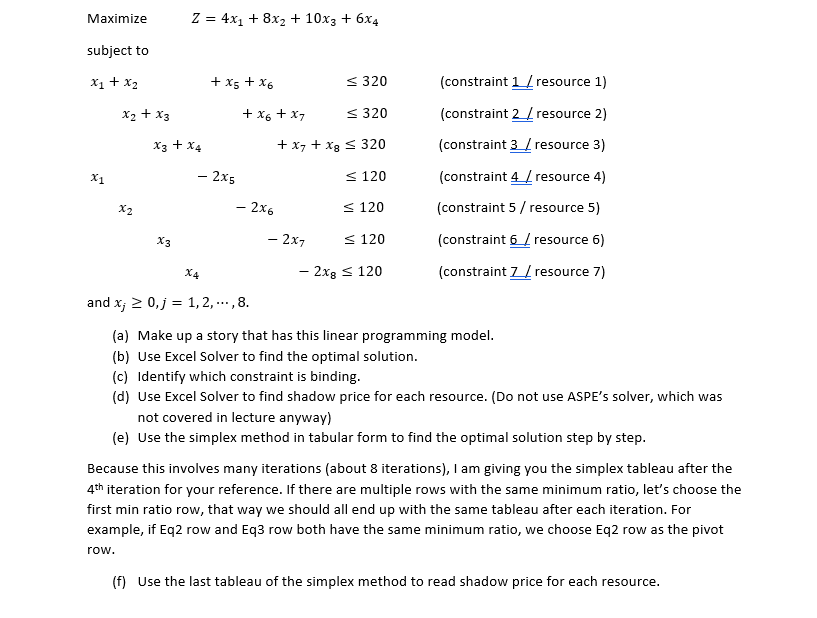
Question: Maximize Z = 4 x _ ( 1 ) + 8 x _ ( 2 ) + 1 0 x _ ( 3 ) +
Maximize Zxxxx
subject to
xxxxconstraint resource
xxxxconstraint resource
xxxxconstraint resource
xxconstraint resource
xxconstraint resource
xxconstraint resource
xxconstraint Z resource
and xjjcdots,
a Make up a story that has this linear programming model.
b Use Excel Solver to find the optimal solution.
c Identify which constraint is binding.
d Use Excel Solver to find shadow price for each resource. Do not use ASPE's solver, which was
not covered in lecture anyway
e Use the simplex method in tabular form to find the optimal solution step by step.
Because this involves many iterations about iterations I am giving you the simplex tableau after the
th iteration for your reference. If there are multiple rows with the same minimum ratio, let's choose the
first min ratio row, that way we should all end up with the same tableau after each iteration. For
example, if Eq row and Eq row both have the same minimum ratio, we choose Eq row as the pivot
row.
f Use the last tableau of the simplex method to read shadow price for each resource.
Step by Step Solution
There are 3 Steps involved in it
1 Expert Approved Answer
Step: 1 Unlock

Question Has Been Solved by an Expert!
Get step-by-step solutions from verified subject matter experts
Step: 2 Unlock
Step: 3 Unlock